Trastuzumab Deruxtecan Demonstrates 13.2-Month Median PFS in HR+/HER2-Low or Ultra-Low Metastatic Breast Cancer in DESTINY-Breast06 Phase III Trial

Daiichi-Sankyo
Pharmaceutical R&D Developer

AstraZeneca
Biopharmaceutical Manufacturer
Recently, the positive results of the Phase III DESTINY-Breast06 study showed that, compared with standard chemotherapy, trastuzumab deruxtecan (brand name: Enhertu, hereinafter referred to as "trastuzumab deruxtecan") demonstrated statistically significant and clinically meaningful improvements in progression-free survival (PFS) in HR-positive, HER2-low (IHC 1+ or IHC 2+/ISH-) metastatic breast cancer patients who had previously received one or more lines of endocrine therapy, as well as in the overall trial population (HR-positive, HER2-low, and HER2-ultra-low [defined as IHC 0 with membrane staining] patients). The study results were presented as an oral report (LBA1000) on June 2 at the 2024 American Society of Clinical Oncology (#ASCO24) Annual Meeting.
Trastuzumab deruxtecan is a HER2-targeted DXd antibody-drug conjugate (ADC) developed using Daiichi Sankyo's proprietary technology and co-developed and commercialized by Daiichi Sankyo and AstraZeneca.
The primary endpoint analysis of the study showed that, compared with standard chemotherapy, trastuzumab deruxtecan reduced the risk of disease progression or death by 38% in patients with HR-positive, HER2-low metastatic breast cancer (Hazard Ratio [HR]: 0.62; 95% Confidence Interval [CI]: 0.51-0.74; p<0.0001). According to the results assessed by Blinded Independent Central Review (BICR), the median PFS in the trastuzumab deruxtecan group was 13.2 months, while the median PFS in the chemotherapy group was 8.1 months.
Key secondary endpoints assessed by BICR showed that, compared with chemotherapy, trastuzumab deruxtecan reduced the risk of disease progression or death by 37% (HR 0.63; 95% CI: 0.53-0.75; p<0.0001) in the overall trial population. The median PFS was 13.2 months in the trastuzumab deruxtecan group and 8.1 months in the chemotherapy group.
Pre-specified subgroup analyses showed clinically meaningful improvements in PFS in both HER2-low and HER2-ultralow patients. Subgroup analysis of HER2-ultralow patients showed that trastuzumab deruxtecan reduced the risk of disease progression or death by 22% (HR 0.78; 95% CI: 0.50-1.21), with median PFS of 13.2 months in the trastuzumab deruxtecan group versus 8.3 months in the chemotherapy group.
In HER2-low patients, the confirmed objective response rate (ORR) was 56.5% in the trastuzumab deruxtecan group, with 9 complete responses (CR) and 194 partial responses (PR); the confirmed ORR in the chemotherapy group was 32.2%, with 114 PR and no CR. In the overall trial population, the confirmed ORR was 57.3% in the trastuzumab deruxtecan group, with 13 CR and 237 PR; the confirmed ORR in the chemotherapy group was 31.2%, with 134 PR and no CR. In HER2-ultralow patients, the confirmed ORR was 61.8% in the trastuzumab deruxtecan group, with 4 CR and 43 PR; the confirmed ORR in the chemotherapy group was 26.3%, with 20 PR and no CR.
In the DESTINY-Breast06 study, the safety profile of trastuzumab deruxtecan was consistent with previous breast cancer clinical trials, with no new safety issues identified. The most common ≥3 grade treatment-related adverse events (TEAEs) occurring in more than 5% of patients receiving trastuzumab deruxtecan included neutropenia (20.7%), leukopenia (6.9%), and anemia (5.8%). The incidence of interstitial lung disease (ILD) in patients treated with trastuzumab deruxtecan was 11.3%. Most ILD events were low-grade (grade 1 [n=7; 1.6%] or grade 2 [n=36; 8.3%]). The Independent Adjudication Committee determined that there were three grade 3 ILD events (0.7%), zero grade 4 events, and three grade 5 events (0.7%).
In the DESTINY-Breast06 trial, the median number of prior lines of endocrine therapy was two for each treatment group. In the overall trial population, 14.9% of patients (n=65) in the trastuzumab deruxtecan group had received one prior line of endocrine therapy, and 67.8% of patients (n=295) had received two prior lines of endocrine therapy. No patients in the trial had received chemotherapy in the metastatic setting. The median follow-up time was 18.2 months. As of the data cutoff date of March 18, 2024, a total of 119 patients (14%) were still receiving study treatment, including 89 patients (20.5%) who were still receiving trastuzumab deruxtecan and 30 patients (7.2%) who were receiving chemotherapy.
Summary of the Main Analysis Results of DESTINY-Breast06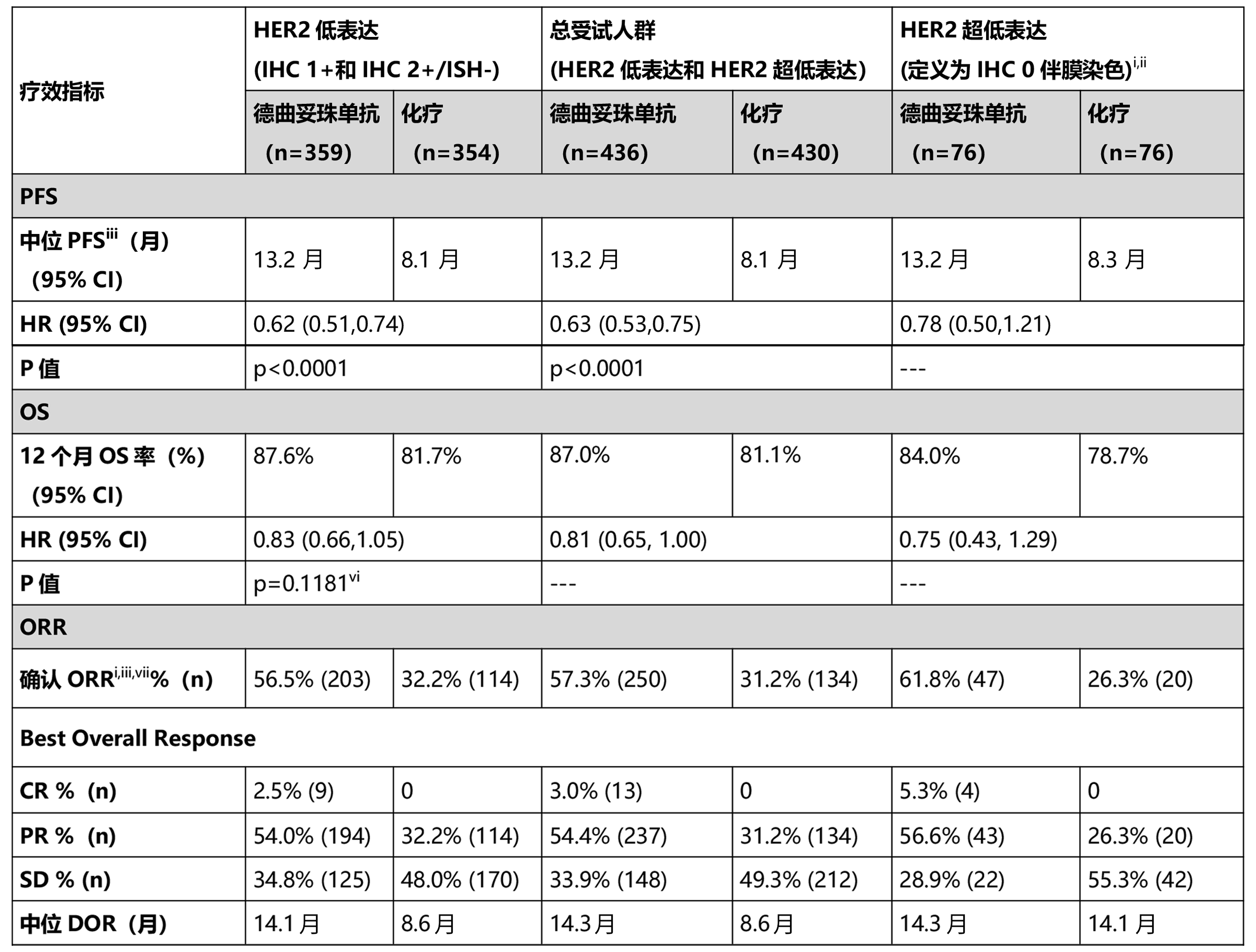
Image Source: Daiichi-Sankyo
CI, Confidence Interval; CR, Complete Response; DCR, Disease Control Rate; DOR, Duration of Response; HR, Hazard Ratio; NA, Not Available; PFS, Progression-Free Survival; ORR, Objective Response Rate; OS, Overall Survival; PR, Partial Response; SD, Stable Disease
i Descriptive Analysis
ii According to the central laboratory
iii According to BICR Assessment
The maturity of the interim OS analysis in Phase IV is less than 40% (HER2-low).
v According to multiple testing procedures, no significance test was performed.
vi The P value required for statistical significance is 0.0046
vii ORR is (CR+PR)
Other Data of Trastuzumab Deruxtecan at ASCO
Latest Results of DESTINY-Breast03
Latest Overall Survival Results from Phase III DESTINY-Breast03 Study Presented in a Poster at ASCO Show Significant Improvement in OS with Trastuzumab Deruxtecan vs. Trastuzumab Emtansine (T-DM1) in HER2-Positive Unresectable and/or Metastatic Breast Cancer Patients Previously Treated with Trastuzumab Over a Follow-up Period of More Than 3 Years. In the Latest OS Analysis, Both Treatment Groups Reached the Key Secondary Endpoint of Median OS. The Median OS in the Trastuzumab Deruxtecan Group was 52.6 Months (95% CI: 48.7–NE), Compared to 42.7 Months (95% CI: 35.4–NE) in the T-DM1 Group (HR: 0.73, 95% CI: 0.56–0.94).
The safety profile of trastuzumab deruxtecan remains generally manageable, with no cumulative toxicity observed during long-term follow-up. Among patients receiving trastuzumab deruxtecan, 48.6% experienced treatment-related TEAEs of Grade 3 or higher. Since the previous data cutoff date, there have been four new cases of Grade 2 ILD events.
DESTINY-Breast07 Results
During the ASCO meeting, interim results from the DESTINY-Breast07 phase 1b/2 study evaluating trastuzumab deruxtecan as monotherapy ± other anticancer agents for first-line treatment of HER2-positive metastatic breast cancer were presented in an oral report. Analysis showed that both trastuzumab deruxtecan monotherapy (n=75) and its combination with pertuzumab (n=50) demonstrated favorable activity.
Confirmed ORR in the trastuzumab deruxtecan monotherapy group was 76% (80% CI: 68.5-82.4), with 6 CRs and 51 PRs. Confirmed ORR in the trastuzumab deruxtecan plus pertuzumab combination therapy group was 84% (80% CI: 75.3-90.5), with 10 CRs and 32 PRs. The 12-month PFS rate in the trastuzumab deruxtecan monotherapy group was 80.8% (80% CI: 73.7-86.1), and in the trastuzumab deruxtecan plus pertuzumab combination therapy group, it was 89.4% (80% CI: 81.9-93.9).
The safety of trastuzumab deruxtecan monotherapy and its combination with pertuzumab is consistent with the known safety profiles of each treatment. The incidence rates of Grade 3 or higher TEAEs were 52% in the trastuzumab deruxtecan monotherapy group and 62% in the trastuzumab deruxtecan plus pertuzumab combination therapy group. The most common ≥Grade 3 treatment-related adverse events occurring in more than 5% of patients included neutropenia (20.7% in the trastuzumab deruxtecan group vs. 24% in the combination therapy group), anemia (4% in the trastuzumab deruxtecan group vs. 14% in the combination therapy group), and diarrhea (3% in the trastuzumab deruxtecan group vs. 6% in the combination therapy group). Most interstitial lung disease (ILD) events were low-grade (Grade 1 or 2). In the trastuzumab deruxtecan group, there were two Grade 1 events (2.7%) and five Grade 2 events (6.7%), with no Grade 3 or higher events observed. In the combination therapy group, there were six Grade 2 events (12%) and one Grade 3 event (2%), with no Grade 4 or 5 events observed.
This marks the first data release for trastuzumab deruxtecan in the first-line treatment of HER2-positive metastatic breast cancer. The ongoing Phase III study, DESTINY-Breast09, will further explore and analyze the efficacy and safety of trastuzumab deruxtecan in treating patients with HER2-positive breast cancer.
About DESTINY-Breast06
DESTINY-Breast06 is a global, randomized, open-label, Phase 3 study designed to evaluate the efficacy and safety of trastuzumab deruxtecan (5.4 mg/kg) versus investigator’s choice of chemotherapy (capecitabine, paclitaxel, or nab-paclitaxel) in patients with HR-positive, HER2-low (IHC 1+ or IHC 2+/ISH-) or HER2-ultralow (defined as IHC 0 with membranous staining) advanced or metastatic breast cancer. Eligible patients had not received prior chemotherapy for their condition and had undergone at least two prior lines of endocrine therapy in the metastatic setting. Patients who had progressed within six months of first-line treatment with an endocrine therapy combined with a CDK4/6 inhibitor, or who experienced disease progression within 24 months while receiving adjuvant endocrine therapy, were also eligible for enrollment.
The primary endpoint of the study was PFS in the HR-positive, HER2-low patient population as determined by BICR. Key secondary endpoints included PFS assessed by BICR in the overall trial population (HER2-low and HER2-ultralow), OS in HER2-low patients, and OS in the overall trial population. Other secondary endpoints included ORR, time to first subsequent treatment or death DOR, time to second subsequent treatment or death, and safety. Subgroup analysis of the HER2-ultralow population failed to demonstrate statistically significant results.
DESTINY-Breast06 enrolled 866 patients (HER2-low: n=713; HER2-ultralow: n=153) at multiple research centers in Asia, Europe, North America, Oceania, and South America.
About DESTINY-Breast03
DESTINY-Breast03 is a global, head-to-head, randomized, open-label, pivotal Phase III clinical trial designed to evaluate the efficacy and safety of trastuzumab deruxtecan (5.4 mg/kg) versus T-DM1 in patients with HER2-positive unresectable and/or metastatic breast cancer who have previously received trastuzumab and taxane treatment.
The primary efficacy endpoint of DESTINY-Breast03 is PFS assessed by BICR. OS is a key secondary efficacy endpoint. Other secondary endpoints include ORR, DoR, PFS assessed by investigators, and safety.
DESTINY-Breast03 enrolled 524 patients at multiple research centers in Asia, Europe, North America, Oceania, and South America. The primary results of DESTINY-Breast03 were published in the New England Journal of Medicine, and the latest OS results were published in The Lancet.
About DESTINY-Breast07
DESTINY-Breast07 is a global, randomized, open-label, Phase 1b/2 dose-finding and dose-expansion study. It aims to evaluate the safety, tolerability, and anti-tumor activity of trastuzumab deruxtecan as monotherapy or in combination with other anticancer agents in patients with HER2-positive metastatic breast cancer. The study consists of two phases: a dose-escalation phase and a dose-expansion phase. The dose-escalation phase enrolls patients with locally assessed second-line or later HER2-positive metastatic breast cancer. The dose-expansion phase enrolls patients with locally assessed previously untreated HER2-positive metastatic breast cancer.
The primary endpoint of DESTINY-Breast07 is safety and tolerability. Secondary endpoints include ORR and investigator-assessed PFS.
DESTINY-Breast07 enrolled 244 patients at multiple research centers in Asia, Europe, North America, and South America.
About Breast Cancer and HER2 Expression
Globally, breast cancer is the second most common cancer and one of the leading causes of cancer-related deaths.1In 2022, there were over 2 million confirmed cases of breast cancer globally, with more than 665,000 deaths.2Although patients with early-stage breast cancer have a high survival rate, it is estimated that about 30% of patients diagnosed with metastatic or progressive disease can survive for five years after diagnosis.3。
HER2 is a tyrosine kinase receptor pro-growth protein expressed on the surface of various tumor cells, including breast cancer.4Patients with HER2 high expression (IHC 3+ or IHC2+/ISH+) are classified as HER2-positive and are suitable for HER2-targeted therapy. These patients account for approximately 15% to 20% of all breast cancer patients.5For a long time, tumors not classified as HER2-positive have been categorized as HER2-negative; however, many of these tumors still exhibit some level of HER2 expression.6It is estimated that approximately 60% to 65% of HR-positive breast cancers are in a HER2-low state, and another 25% may be in a HER2-ultralow state.7,8。
In the early treatment of HR-positive metastatic breast cancer, endocrine therapy is widely and continuously used. However, after two lines of endocrine therapy, the efficacy of continuing endocrine treatment is often limited.9. The standard treatment regimen after endocrine therapy is chemotherapy, but its response rate and prognosis are both poor.10,11,12,13。
Prior to the approval of trastuzumab deruxtecan for HER2-low metastatic breast cancer previously treated with chemotherapy based on the DESTINY-Breast04 study, no targeted therapy specifically for HER2-low patients had been approved.14. Currently, there is no targeted therapy specifically approved for HER2 ultra-low expression patients.15。
About Trastuzumab Deruxtecan
Trastuzumab deruxtecan (known as fam-trastuzumab deruxtecan-nxki in the United States) is a HER2-targeted antibody-drug conjugate (ADC). Trastuzumab deruxtecan is designed using Daiichi Sankyo's proprietary DXd-ADC technology, representing the leading ADC product in Daiichi Sankyo's oncology portfolio and the most advanced project within AstraZeneca’s ADC scientific platform. Trastuzumab deruxtecan consists of a HER2 monoclonal antibody linked to multiple topoisomerase I inhibitor payloads (exatecan derivatives, DXd) via a cleavable tetrapeptide linker.
Based on the results obtained from the DESTINY-Breast03 study, trastuzumab deruxtecan (5.4 mg/kg) has been approved in more than 60 countries/regions worldwide for the treatment of adult patients with unresectable or metastatic HER2-positive (IHC 3+ or in situ hybridization [ISH]+) breast cancer who have received one prior anti-HER2-based therapy in the metastatic setting or during neoadjuvant or adjuvant therapy and experienced disease recurrence during or within 6 months after the completion of therapy.
Based on the results obtained from the DESTINY-Breast04 study, trastuzumab deruxtecan (5.4 mg/kg) has been approved in more than 55 countries and regions worldwide for the treatment of adult patients with unresectable or metastatic HER2-low (IHC 1+ or IHC 2+/[ISH]-) breast cancer who have received prior systemic therapy in the metastatic setting or developed disease recurrence during or within 6 months after completing adjuvant chemotherapy.
Based on the results obtained from the DESTINY-Lung02 study, trastuzumab deruxtecan (5.4 mg/kg) has been approved in more than 35 countries/regions worldwide for the treatment of adult patients with unresectable or metastatic NSCLC whose tumors have HER2 (ERBB2) activating mutations as detected by locally or regionally approved testing methods and who have previously received one systemic therapy. Confirmation of clinical benefit in confirmatory studies will support full approval of this indication in the United States.
Based on the results obtained from the DESTINY-Gastric01 and/or DESTINY-Gastric02 studies, trastuzumab deruxtecan (6.4 mg/kg) has been approved in more than 45 countries/regions worldwide for the treatment of adult patients with locally advanced or metastatic HER2-positive (IHC 3+ or IHC 2+/ISH+) gastric or gastroesophageal junction (GEJ) adenocarcinoma who have previously received a trastuzumab-based treatment regimen.
Based on the efficacy results from the DESTINY-PanTumor02, DESTINY-Lung01, and DESTINY-CRC02 studies, trastuzumab deruxtecan (5.4 mg/kg) has been approved in the United States for the treatment of adult patients with unresectable or metastatic HER2-positive (IHC 3+) solid tumors who have previously received systemic therapy and have no satisfactory alternative treatment options. The full approval of this indication will be supported upon the verification and confirmation of clinical benefit in confirmatory trials.
About the Clinical Development Plan for Trastuzumab Deruxtecan
A comprehensive clinical development program aimed at evaluating the efficacy and safety of trastuzumab deruxtecan monotherapy in treating various HER2-targeted cancers is currently underway globally. Research on other anticancer therapies, including combination immunotherapy, is also being conducted.
Regarding the Collaboration between Daiichi Sankyo and AstraZeneca
Daiichi Sankyo and AstraZeneca reached global collaborations in March 2019 and July 2020, respectively, to jointly develop and commercialize trastuzumab deruxtecan and datopotamab deruxtecan. Daiichi Sankyo holds exclusive rights to each ADC product in the Japanese market. Daiichi Sankyo is responsible for the production and supply of trastuzumab deruxtecan and datopotamab deruxtecan.
About Daiichi Sankyo's DXd ADC Portfolio
Daiichi Sankyo's DXd ADC portfolio currently includes six ADC drugs in clinical development, covering various types of cancer. Trastuzumab deruxtecan (HER2-targeted ADC) and datopotamab deruxtecan (Dato-DXd, TROP2-targeted ADC) are currently co-developed by Daiichi Sankyo and AstraZeneca and commercialized globally. Patritumab deruxtecan (HER3-DXd, HER3-targeted ADC), ifinatamab deruxtecan (I-DXd, B7-H3-targeted ADC), and raludotatug deruxtecan (R-DXd, CDH6-targeted ADC) are currently co-developed by Daiichi Sankyo and Merck & Co., Inc. (Rahway, NJ, USA) and commercialized globally. DS-3939 is a TA-MUC1-targeted ADC currently under development by Daiichi Sankyo.
Each ADC is designed using Daiichi Sankyo's proprietary DXd ADC technology to target cancer cells expressing specific cell surface antigens and deliver cytotoxic payloads into the cancer cells. Each ADC consists of a monoclonal antibody connected through a cleavable tetrapeptide linker to multiple topoisomerase I inhibitor payloads (a derivative of exatecan, DXd).
Datopotamab deruxtecan, ifinatamab deruxtecan, patritumab deruxtecan, raludotatug deruxtecan, and DS-3939 are all investigational drugs that have not been approved for any indication in any country/region. Their safety and efficacy have not been fully established.
References:
1. Bray F, et al. CA Cancer J Clin. 2024; 10.3322/caac.21834.
2. Bray F, et al. CA Cancer J Clin. 2024; 10.3322/caac.21834.
3. National Cancer Institute. SEER Cancer Stat Facts: Female Breast Cancer Subtypes. Accessed April 2024.
4. Iqbal N, et al. Mol Biol Int. 2014;852748.
5. Ahn S, et al. J Pathol Transl Med. 2020;54(1):34-44.
6. Sajjadi E, et al. Cancer Drug Resist. 2022;5(4):882-888.
7. Denkert C, et al. Lancet Oncol. 2021 Aug;22(8):1151-1161.
8. Chen Z, et al. Breast Cancer Res Treat. 2023 Nov;202(2):313-323.
9. Manohar P, et al. Cancer Biol Med. 2022 Feb 15; 19(2):202–212.
10. Manohar P, et al. Cancer Biol Med. 2022 Feb 15; 19(2):202–212.
11. Cortes J, et al. Lancet. 2011;377:914-923.
12. Yuan P, et al. Eur J Cancer. 2019;112:57-65.
13. Jerusalem G, et al. JAMA Oncol. 2018;4(10):1367–1374.
14. Modi S, et al. N Engl J Med. 2022;387:9-20.
15. Eiger D, et al. Cancers. 2021 Mar; 13(5): 1015.

Editor: Mu Mian
Disclaimer: This article is a reprint from Pharmacist Network, with all images and text reserved by the original author. The purpose of the reprint is to convey more information and does not represent the views of this platform. If there are any issues regarding content, copyright, or other problems, please leave a message on this platform, and we will address it promptly.