On May 31 local time, the 2024 American Society of Clinical Oncology (ASCO) Annual Meeting officially kicked off in Chicago. As one of the most important events in the oncology field, the ASCO Annual Meeting brings together the most cutting-edge and extensive advancements in cancer research, serving as a global benchmark for new oncology drug development. From the highly sought-after PD(L)-1 tumor immunotherapy to the rapidly emerging ADC therapies, the ASCO Annual Meeting has chronicled the evolution of one groundbreaking drug after another and has also witnessed the clinical transformation in cancer treatment.Nowadays, with the synchronized resonance of various new technologies, new concepts, and new targets, the breakthrough progress presented at the ASCO Annual Meeting has become increasingly diversified, also indicating more possibilities in cancer treatment. For instance, the radiopharmaceuticals track, which has been particularly popular in recent years, shows a significant increase in the number of abstracts at this year's ASCO meeting when searched with the keyword "radiopharmaceuticals," especially with clinical studies related to Radioligand Therapy (RLT) frequently appearing.Among them, Novartis' RLT product Pluvicto(177Lu-PSMA-617)The most impressive. At the ASCO conference, Novartis updated the OS and quality of life data from the Phase III clinical study PSMAfore, demonstrating a trend of OS benefit as well as pain relief and improved quality of life for patients. Novartis plans to submit the FDA application for PSMAfore this year, which is expected to revolutionize the clinical treatment landscape for prostate cancer.
From Financing Heat to BD Wave, RLT Track Surges with Enthusiasm
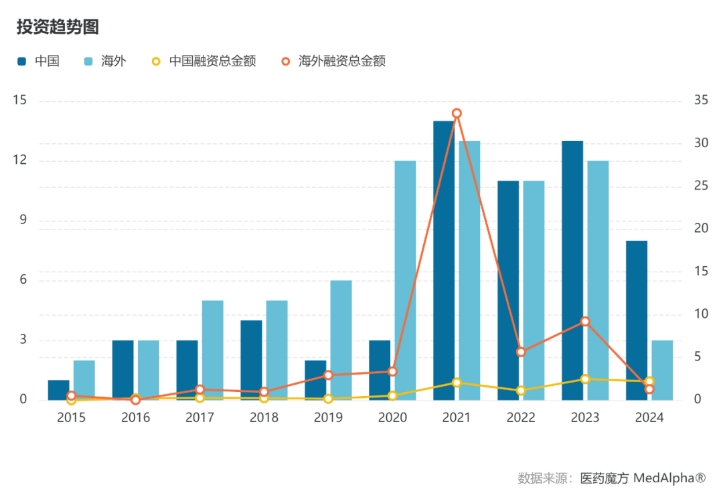
The outbreak of any emerging track will not happen overnight, but requires years of accumulation. The "nuclear medicine" track is no exception. From medical diagnosis to radiotherapy, and then to RLT, the clinical application of nuclear medicine has gone through decades of development. And in the star product Lutathera of RLT.(177Lu-dotatate)Driven by the impressive commercial performance of Pluvicto, the radiopharmaceuticals sector has entered the spotlight, becoming the "new darling" of the investment and industrial communities.According to the MedAlpha database of pharmaceutical financing and investment by PharmaCube, since 2017, there has been a significant increase in financing and investment activities in the overseas radiopharmaceuticals sector. In that year, Lutathera, the world’s first RLT drug, was successfully approved for marketing by the EMA, marking the beginning of a new era in radioligand therapy. By 2020, this field had entered a financing boom, with the number of projects receiving funding doubling compared to the previous year.In 2021, the track's popularity climbed to its peak. The overseas investment and financing sector experienced explosive growth, with the total annual funding amount reaching $3.3 billion, a year-on-year increase of 9 times. This wave of investment fever was not only prevalent overseas but also quickly spread to China. Compared to the previous year, the number of financing events in China in 2021 achieved significant growth, even more than quadrupling.Global Nuclear Medicine Investment TrendsDespite the changing funding environment in 2022 making financing difficult for global biopharmaceutical Biotech companies and causing a pullback in investment attraction for the radiopharmaceuticals sector in the primary market, the wave of RLT asset BD acquisitions led by MNCs has started to take over. Especially since 2023, the surge in RLT project transactions, collaborations, and acquisitions has kept the industry's attention on RLT therapy at a high level.MNC Cooperation/Acquisition Status Since 2023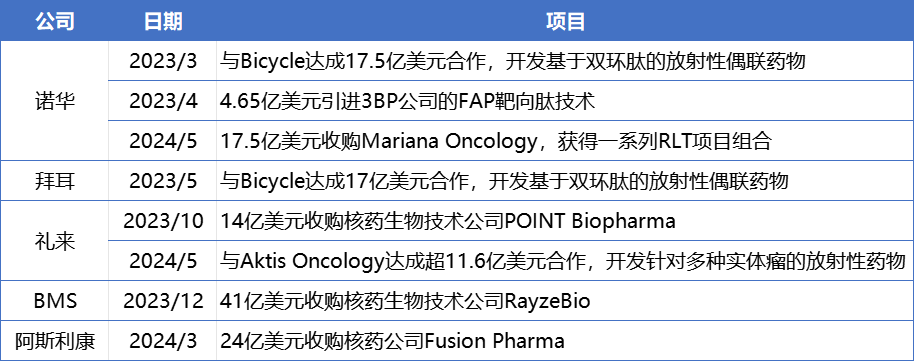
Against the backdrop of continuously rising R&D investment expectations, the story of the RLT track is still unfolding brilliantly. However, it should be noted that the RLT track is still fraught with challenges. Just last month, Johnson & Johnson's RLT therapy JNJ-69086420 reported the unfortunate news of four patient deaths in Phase I studies, starkly revealing the difficulty of RLT drug development. Successfully developed radioligand therapy drugs, such as Pluvicto, are the result of meticulous integration across multiple disciplines including pharmaceuticals, radiation dosimetry, and radiation biology.
Foresight and Vision: Novartis Continues to Lead Innovation in the RLT Field
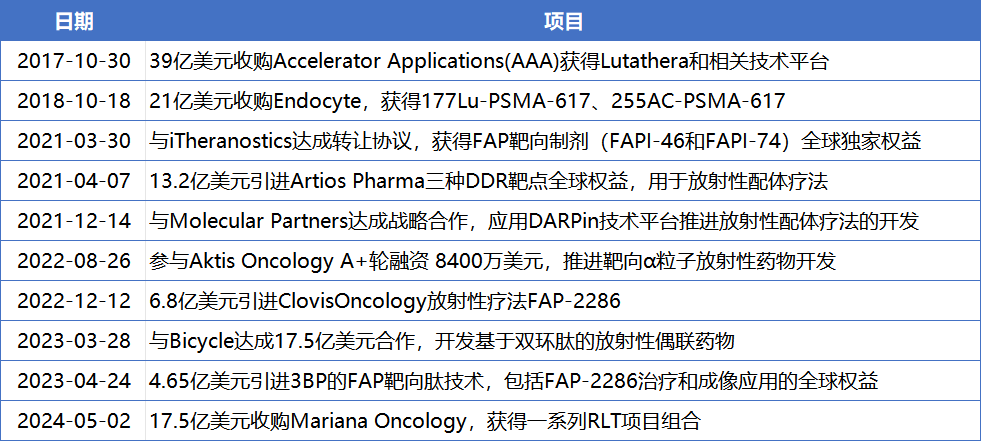
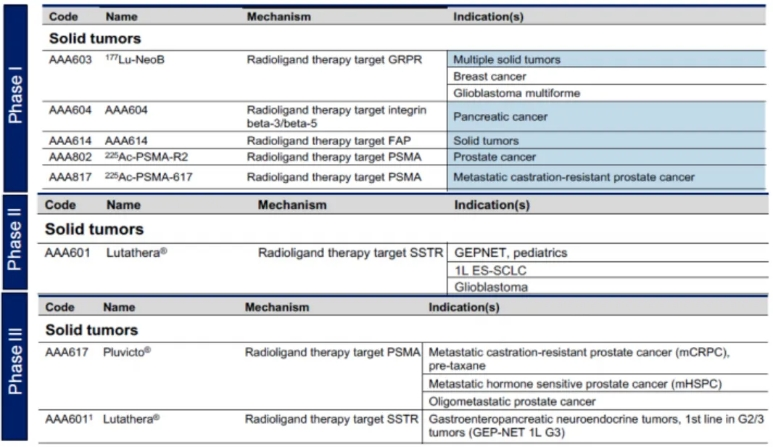
The favor of pharmaceutical giants towards RLT now seems to have become a common phenomenon, and Novartis is undoubtedly one of the earliest and most deeply rooted giants in this field, with every move being highly forward-looking. As early as 2017-2018, when radiopharmaceuticals were not as highly sought after as they are today, Novartis spent $6 billion acquiring Advanced Accelerator Applications (AAA) and Endocyte, gaining multiple radiopharmaceutical assets including Lutathera, Pluvicto, and 255AC-PSMA-617. Since then, Novartis has accelerated its pace of layout, with the cumulative potential value of M&A deals initiated in RLT exceeding $6.5 billion from 2021 to the present.Representative Collaborations and M&A Events of Novartis in the RLT FieldThe development of new drugs is highly uncertain, and the fact that it can attract capital attention and become a target pursued by MNC giants indicates that the clinical value and commercialization prospects of RLT have become relatively clear. The industry's recognition of RLT's clinical and commercial value is largely driven by Novartis' flagship products, Lutathera and Pluvicto.As the world's first approved therapeutic peptide radioligand therapy, the launch of Lutathera is undoubtedly a milestone, as it realizes the concept of delivering radioactive isotopes to tumor cells and subsequently destroying them.In terms of clinical value, Lutathera has also demonstrated superior therapeutic effects. The latest results from the Phase III NETTER-2 study show that, compared to high-dose long-acting octreotide, the combination of Lutathera and long-acting octreotide as first-line treatment nearly tripled the median progression-free survival to 22.8 months in patients with somatostatin receptor (SSTR)-positive, well-differentiated grade 2 and 3 advanced gastroenteropancreatic neuroendocrine tumors (GEP-NETs), reducing the risk of disease progression or death by 72%.Crowned with the FIC (First-in-Class) halo, Lutathera's commercial performance has drawn significant attention within the industry. The results show that Lutathera lived up to expectations, delivering an impressive report card with cumulative sales revenue exceeding $2.1 billion since its launch.Compared to Lutathera, the rapid rise of Pluvicto has attracted the hottest attention in the industry. Its approval marks the use of radioligand therapy for treating more common tumors like prostate cancer.Pluvicto was approved for marketing by the U.S. FDA in March 2022 for the treatment of adult patients with metastatic castration-resistant prostate cancer (mCRPC) who are positive for prostate-specific membrane antigen (PSMA) and have progressed after prior treatment with androgen receptor pathway inhibitors (ARPI) and taxane chemotherapy. It is the world's first PSMA-targeted radioligand therapy. Its growth has been astonishing, achieving a strong start with $271 million in sales within nine months of its launch. The following year, sales nearly reached $1 billion ($980 million, +261%). In the first quarter of this year, Pluvicto maintained robust growth (+47%), generating revenue of $310 million, securing its position as a "blockbuster drug."This achievement is inseparable from the extremely high clinical value of Pluvicto. The approval and market launch of Pluvicto were supported by the first Phase III VISION study, which mainly included patients with mCRPC who had failed treatment with ARPI and taxane chemotherapy. Adding 177Lu-PSMA-617 to standard therapy significantly extended rPFS (median rPFS: 8.7 vs 3.4 months) and OS (median OS: 15.3 vs 11.3 months) compared to standard therapy alone, reducing the risk of death by 38% and the risk of radiographic progression or death by 60%.Pluvicto Continues to Advance in Early-Stage Prostate Cancer. In 2022, ESMO released the results of the Phase III PSMAfore study, which showed that compared with switching to another ARPI, Pluvicto demonstrated more than double the radiographic progression-free survival benefit in chemotherapy-naïve mCRPC patients (median time: 12.0 months vs. 5.6 months). Analysis of adverse events revealed that Pluvicto had a better safety profile, with lower incidence rates of Grade 3-4 adverse events (33.9% vs. 43.1%) and serious adverse events (20.3% vs. 28.0%) compared to the ARPI group. Unsurprisingly, Pluvicto is set to become a new first-line treatment option for mCRPC patients, once again highlighting the clinical therapeutic potential of radioligand therapy.mCRPC is highly aggressive with a generally poor prognosis. The median survival time for patients is only 17.5 to 34.7 months. ARPI is currently the standard treatment for mCRPC, but patients still develop rapid resistance after receiving the treatment, significantly reducing its efficacy. However, the clear benefits demonstrated by Pluvicto not only provide a more effective treatment option for patients whose disease has progressed but also have the potential to change the clinical treatment guidelines for mCRPC.As is well known, radiotherapy is one of the most crucial methods in cancer treatment, with its clinical usage frequency second only to surgery. In China, more than half of cancer patients need to undergo radiation therapy. However, due to the risk of safety issues caused by whole-body exposure during radiotherapy and the fact that it cannot effectively target and kill every tumor cell in patients with advanced metastatic cancer, its efficacy remains suboptimal.The uniqueness of radioligand therapy lies in the targeting capability of radioactive particles, which theoretically avoids the limitations of traditional radiotherapy. At this stage, although it is not yet possible to fully determine the adaptability of radioligand therapy for broader cancer treatments, the clinical performance of Lutathera and Pluvicto can indeed be perfectly explained through the RLT mechanism. Moreover, given the mechanistic synergy between RLT therapy and immune checkpoint inhibitors as well as the "synthetic lethality" concept that inhibits DNA repair, the potential for combination therapies also holds promise for further exploration.Since the molecular structure of RLT is characterized by the conjugation of precision-targeting molecules (monoclonal antibodies or peptides/small molecules) that act as "navigators" with radiopharmaceutical isotopes responsible for imaging or treating tumors via linkers, it can achieve product improvement or iteration through different molecular combinations, similar to ADC. Based on this understanding of the characteristics of RLT drugs, Novartis began exploring more diversified strategic layouts targeting receptors, ligands, radionuclides, and technological platforms after 2021.For example, in terms of targets, in addition to SSTR and PSMA, Novartis has also placed significant bets on broader-expressed targets such as Gastrin-Releasing Peptide Receptor (GRPR) and Fibroblast Activation Protein (FAP). These are abnormally expressed across multiple cancer types and hold promise for application in a wider range of tumor treatments. Relevant candidate products have already entered Phase I/II clinical trials. Moreover, Novartis is heavily investing in ideal ligand peptides with higher adaptability for RLT therapy, especially bicyclic peptides. To identify and optimize cyclic peptides with high affinity and specificity, Novartis introduced Bicycle’s phage display technology platform in 2023 to support the development of targeted peptide radioligand therapies.With层层进阶, Novartis has also achieved a scaled-up RLT product pipeline reserve, with indications covering a wide range, including breast cancer, glioma, colon cancer, lung cancer, pancreatic cancer, and other types of cancer.Novartis' Partial RLT Pipeline Under ResearchTop-tier pharmaceutical companies often have distinct label attributes, and Novartis is no exception. Looking at the overall product pipeline, focusing on cutting-edge innovation has become Novartis' image tag. Of course, the generous investment in radioligand therapy is just a microcosm of its relentless pursuit of frontier technologies. Novartis has also simultaneously built up technology platforms for chemotherapy, biologic therapy, xRNA therapy, gene and cell therapy, comprehensively enhancing its innovation-driven capabilities to launch more groundbreaking therapies.Behind the First RLT "Blockbuster"
Generally speaking, a good molecular design is half the battle in successful drug development. For RLT, this is particularly crucial, as stability, precise targeting, and high efficiency must all be fully integrated into the design concept. Looking back, the remarkable efficacy and safety advantages of Pluvicto are inseparable from its "intentional" excellent design.Since RLT therapy requires locking onto the target under the guidance of a ligand before releasing radiation energy to destroy tumor cells, the distribution of the target within the tumor tissue directly affects the treatment efficacy. Meanwhile, higher selectivity leads to fewer potential side effects. It is not difficult to see that the key factor enabling Pluvicto to stand out lies in its high selectivity. PSMA is highly expressed in 90% of patients with metastatic prostate cancer but shows low expression levels in normal tissues. This characteristic also gives Pluvicto high selectivity, allowing it to precisely target and destroy prostate cancer cells while minimizing damage to surrounding healthy cells.Radionuclides are the driving force behind radioligand therapy, and a key factor in the success of Pluvicto is the use of the radioactive particle Lu-177. If the radionuclide's radiation energy is too high or its radiation range too long, it will indiscriminately kill cells. However, Lu-177 has optimal radiation energy, radiation range, and an appropriate half-life, enabling it to effectively target and destroy tumor cells without harming normal cells.However, the appropriate radionuclides often have short half-lives, lasting only a few days, necessitating on-demand production. This imposes stringent requirements on the manufacturing and distribution capabilities of enterprises. At this point, economies of scale become a competitive advantage. Novartis has evidently achieved this.Earlier this year, in addition to the existing three production bases in Millburn, New Jersey, USA, Zaragoza, Spain, and Ivrea, Italy, the Indianapolis base located in the central United States has received FDA approval for production. Undoubtedly, this will greatly promote the clinical use and scaling up of Pluvicto. Meanwhile, Novartis has also established a dedicated logistics team with the aim of ensuring the stable supply of radioligand therapy drugs.In order to provide better services to healthcare institutions, doctors, and patients, Novartis has launched a suite of systems and products serving healthcare institutions, doctors, and patients. These include support for healthcare system development, drug ordering, logistics tracking, RLT technical support, medical education and training, and more, accelerating market accessibility.From developing new drugs with high clinical value, to ensuring continuous production and supply, to providing comprehensive patient and medical services, under Novartis' strategic progress, Pluvicto has also evolved into a "blockbuster" drug.As a pioneer and leader in the industry, Novartis is not only expanding RLT globally but also continuously investing heavily in development and exploration in China, its most strategically significant market.Upholding the mission of "Commitment to China," Novartis focuses on four key areas: introduction, research and development, production, and market expansion. According to information from the CDE’s official website, Novartis has initiated multiple registration clinical studies in China involving frontline RLT therapy pipeline products under global synchronized development. In addition to introducing innovative drugs, on December 1, 2023, Novartis and the Haiyan County government of Zhejiang Province announced the establishment of a new production base in Zhejiang, which is expected to commence operations by the end of 2026 to ensure the production capacity and supply of RLT drugs in China. Meanwhile, Novartis is committed to bringing its experience in advancing the standardization of the nuclear medicine industry to China, promoting the development of China's radiopharmaceuticals industry and policy implementation, supporting high-quality growth in China's nuclear medicine and nuclear healthcare sectors, and enhancing the accessibility of advanced integrated oncology diagnosis and treatment solutions, enabling patients to improve their quality of life and extend survival.Summary
Innovation knows no bounds. From the forward-looking layout in the RLT track to the launch of groundbreaking, era-defining products, and the all-out effort to build a nuclear medicine ecosystem, Novartis has been bold and pioneering, continuously pushing the boundaries of innovation. This highlights the hardcore strength of a true trailblazer, consistently leading the advancement of the RLT track. With innovative forces represented by Novartis continuously emerging, it is believed that this track will embrace even more possibilities in the future.Copyright © 2024 PHARMCUBE. All Rights Reserved.
Welcome to forward, share, and reasonably cite. When citing, please clearly indicate the source of the article.For reprint, please leave a message or send a message to the WeChat Official Account backend, and indicate the name and ID of the official account.
Disclaimer: The information in this WeChat article is for general reference only and should not be directly used as decision-making content. PharmaCube assumes no responsibility for any loss incurred by any party due to the use of the content herein.