

Bristol Myers Squibb's Opdivo Plus Yervoy Shows Nearly Triple Objective Response Rate in Phase 3 Trial for First-Line Hepatocellular Carcinoma
Bristol-Myers Squibb
Biopharmaceutical and Nutritional Product R&D and Sales
▎WuXiEdited by Kant Content Team
Today, Bristol Myers Squibb announced the first publication of results from the Phase 3 CheckMate-9DW trial, which evaluated the efficacy and safety of its重磅 PD-1 inhibitor Opdivo (nivolumab) in combination with the CTLA-4 targeted antibody Yervoy (ipilimumab), compared to investigator-selected targeted therapies, as a first-line treatment for patients with advanced hepatocellular carcinoma (HCC). The analysis showed,The trial met its primary endpoint, with the combination therapy of Opdivo and Yervoy significantly improving overall survival (OS) in patients. Moreover, the objective response rate (ORR) in the Opdivo and Yervoy combination therapy group was nearly three times that of the control group.According to the release at this year's American Society of Clinical Oncology (ASCO)Annual MeetingAbstract inThe positive data from the trial show that Opdivo combined with Yervoy has the potential to become a new first-line standard therapy for patients with unresectable HCC.

Liver cancer is the third leading cause of cancer death globally.HCC is the most common type of primary liver cancer, accounting for 90% of all liver cancers.HCC is often diagnosed at an advanced stage, when effective therapies are limited and patients generally have a poor prognosis. Up to 70% of patients may experience recurrence within five years, particularly those considered at high risk even after surgery.
CheckMate-9DW is a Phase 3 randomized, open-label trial evaluating the efficacy and safety of Opdivo in combination with Yervoy compared to investigator’s choice of sorafenib or lenvatinib monotherapy for the treatment of patients with advanced HCC who have not received prior systemic therapy. A total of approximately 668 patients were enrolled in the trial, with overall survival as the primary endpoint and key secondary endpoints including objective response rate and time to symptom deterioration.
Image Source: 123RF
During the median follow-up period of approximately 35.2 months, treatment with Opdivo in combination with Yervoy demonstrated:
Significantly improved the primary endpoint OS in clinical and statistical terms.The median OS for patients receiving Opdivo plus Yervoy combination therapy was 23.7 months (95% CI: 18.8–29.4), compared to 20.6 months (95% CI: 17.5–22.5) for patients treated with sorafenib or lenvatinib, with a hazard ratio of 0.79 (0.65–0.96; p=0.018).The overall survival benefit was generally consistent across patient subgroups.
Significantly improved key secondary endpoint ORR in clinical and statistical terms,The ORR for patients receiving Opdivo plus Yervoy combination therapy was 36% (95% CI: 31-42), compared to 13% (95% CI: 10-17) for patients treated with sorafenib or lenvatinib.
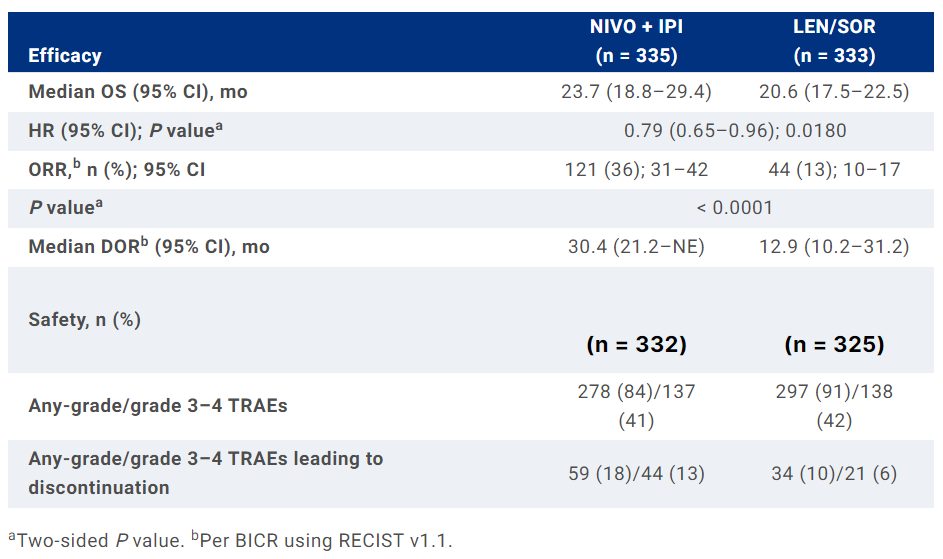
▲CheckMate-9DW TrialSummary of efficacy results (Image source: Reference [3])
The complete response (CR) rate was higher in the Opdivo plus Yervoy combination therapy group., reaching 7%, while the CR of patients in the sorafenib or lenvatinib group was only 2%. In addition,Patients Show Durable Remission.In patients who achieved remission, the median duration of response was 30.4 months (95% CI: 21.2-NE) in the Opdivo plus Yervoy combination therapy group, compared to 12.9 months (95% CI: 10.2-31.2) in the sorafenib or lenvatinib group.
Compared with sorafenib or lenvatinib, Opdivo plus Yervoy significantly reduced the risk of symptom worsening by 24% (HR: 0.76, 95% CI: 0.62-0.93; p=0.0059).
The safety of the Opdivo plus Yervoy combination therapy is consistent with previously reported data and can be managed through established protocols. Treatment-related adverse events (TRAEs) of any grade were reported in 84% of patients in the Opdivo plus Yervoy group, compared to 91% in the sorafenib or lenvatinib group.
Opdivo is a PD-1 immune checkpoint inhibitor, aimed at helping to restore anti-tumor immune responses, utilizing the body's own immune system to fight cancer.Yervoy targets and inhibits CTLA-4CTLA-4 antibody enhances tumor-killing capability by boosting T-cell activity. This product received FDA approval in the United States in 2011 for the treatment of advanced melanoma, making it the world's first approved CTLA-4 antibody drug.

▲To learn more about the application of cutting-edge technologies in the biopharmaceutical industry, please long-press and scan the QR code above to access "WuXi Live Studio" and watch live discussions and exciting replays on related topics.
References:
[1] Bristol Myers Squibb Announces Opdivo (nivolumab) Plus Yervoy (ipilimumab) Significantly Improved Overall Survival Compared to Lenvatinib or Sorafenib as First-Line Treatment for Patients with Advanced Hepatocellular Carcinoma in CheckMate -9DW Trial. Retrieved June 4, 2024 from https://news.bms.com/news/details/2024/Bristol-Myers-Squibb-Announces-Opdivo-nivolumab-Plus-Yervoy-ipilimumab-Significantly-Improved-Overall-Survival-Compared-to-Lenvatinib-or-Sorafenib-as-First-Line-Treatment-for-Patients-with-Advanced-Hepatocellular-Carcinoma-in-CheckMate--9DW-Trial/default.aspx
[2] Bristol Myers' Opdivo-Yervoy beats Lenvima and Nexavar in Phase 3 early liver cancer trial. Retrieved June 4, 2024 from https://endpts.com/bristol-myers-opdivo-yervoy-combo-hits-endpoints-in-phase-3-early-liver-cancer-trial/
[3] Nivolumab (NIVO) plus ipilimumab (IPI) vs lenvatinib (LEN) or sorafenib (SOR) as first-line treatment for unresectable hepatocellular carcinoma (uHCC): First results from CheckMate 9DW. Retrieved June 4, 2024 from https://meetings.asco.org/abstracts-presentations/234365
Disclaimer: The content team of WuXi AppTec focuses on introducing the research progress in global biopharmaceuticals and health. This article is for the purpose of information exchange only. The views expressed in the article do not represent the position of WuXi AppTec, nor does it imply that WuXi AppTec supports or opposes these views. This article is not a recommendation for treatment plans. For guidance on treatment options, please visit a正规 hospital.
Copyright Statement: This article is from the WuXi AppTec content team. Individuals are welcome to share it on their social media platforms, but unauthorized reproduction by media or institutions in any form to other platforms is prohibited. For authorization to reproduce, please reply with "reprint" on the "WuXi AppTec" WeChat Official Account to obtain reprint guidelines.


Share,PointLike,In view,Focusing on Global Biomedical Health Innovation