

AstraZeneca's GPC3-Targeted CAR-T Therapy C-CAR031 Shows Tumor Shrinkage in Over 90% of Advanced Liver Cancer Patients

AstraZeneca
Biopharmaceutical Manufacturer
▎WuXiEdited by Kant Content Team
Recently, AstraZeneca participated in this year's American Society of Clinical Oncology (ASCO).Annual MeetingChina announced the latest clinical trial results of its GPC3-targeted CAR-T therapy, C-CAR031. The study shows,More than 90% of GPC3-positive advanced hepatocellular carcinoma (HCC) patients experienced tumor shrinkage, with an overall response rate (ORR) of up to 75% in patients receiving the highest dose of C-CAR031., and the safety of this therapy is controllable. Dr. Matt Hellmann, Head of Early Oncology Development at AstraZeneca, stated in an interview with the industry media STAT: "This is the first CAR-T therapy to demonstrate efficacy in liver cancer treatment. It also represents the first clinical validation of the GPC3 target.”
The trial announced this time is an open-label dose-escalation trial, which isC-CAR031The "first-in-human" trial of the therapy. A total of 24 GPC3-positive advanced HCC patients were enrolled, all of whom had received ≥1 line of systemic treatment and experienced disease progression. After standard lymphodepletion, the patients received a single intravenous infusion of C-CAR031. The primary endpoints were safety and tolerability, with other endpoints including pharmacokinetics and preliminary efficacy.
As of January 5, 2024, a total of 24 patients have received C-CAR031 infusions at four dose levels (DL). All patients are at stage C of the Barcelona Clinic Liver Cancer (BCLC) staging system, indicating that cancer cells have spread to blood vessels, lymph nodes, or other organs, but liver function remains adequate. Among the enrolled patients, 83.3% (20/24) had extrahepatic metastases. The median number of prior treatment lines was 3.5 (range: 1-6), and 23 patients (95.8%) had previously received immune checkpoint inhibitors and tyrosine kinase inhibitors.
During the median follow-up period of 5.82 months, among 22 evaluable patients,Tumor shrinkage, both intrahepatic and extrahepatic, was observed in 90.9% of patients, with a median reduction of 44.0% (range: 3.4-94.4%). The disease control rate for patients receiving all dose levels was 90.9%, and the objective response rate (ORR) was 50.0%. In patients receiving dose level 4, the ORR reached 57.1%.
All patients were evaluable for safety.No dose-limiting toxicity or immune effector cell-associated neurotoxicity syndrome (ICANS) events were observed in the trial.Cytokine release syndrome (CRS) occurred in 22 patients (91.7%), with only 1 patient (4.2%) experiencing grade 3 CRS.The most common ≥3 grade adverse reactions were lymphocytopenia (100%), neutropenia (70.8%), thrombocytopenia (37.5%), and elevated transaminases (16.7%).All adverse reactions are reversible.
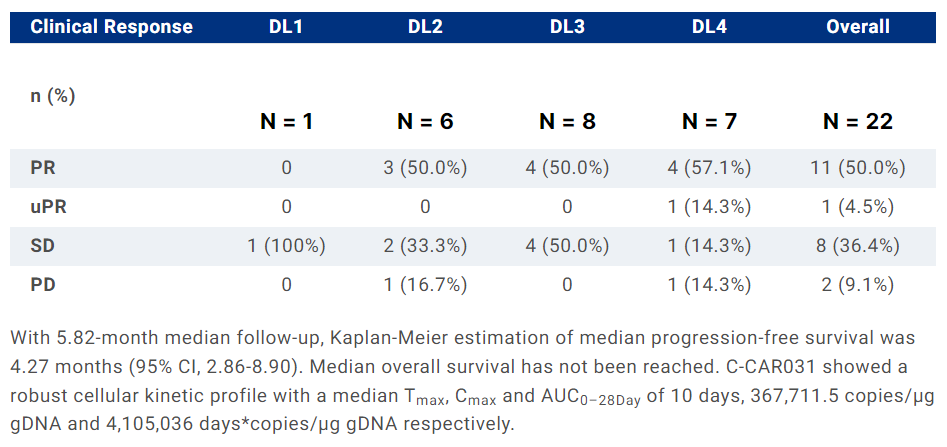
▲Summary of C-CAR031 Efficacy Results (Image Source: Reference [1])
GPC3 is a surface antigen that is overexpressed in liver cancer and is almost absent in healthy tissues.C-CAR031 is a GPC3-targeted autologous CAR-T therapy. This CAR-T therapy is also "equipped" with TGFβ to resist the immunosuppressive microenvironment, enhancing its efficacy.

▲To learn more about the application of cutting-edge technologies in the biopharmaceutical industry, please long-press and scan the QR code above to access "WuXi Live Studio" and watch live discussions and exciting replays on related topics.


Share,PointLike,In View, Focus on Global Biomedical Health Innovation