

$4.1B Nuclear Medicine RYZ101 Trial Paused Due to Ac-225 Shortage
RayzeBio
Targeted Drug Developer
Bristol-Myers Squibb
Biopharmaceutical and Nutritional Product R&D and Sales
On June 4, 2024, Bristol-Myers Squibb (hereinafter referred to as BMS) announced that it has currently suspended the recruitment of new patients for the Phase 3 trial of the radiopharmaceutical RYZ101. After confirming via email with a spokesperson from radiopharmaceutical developer RayzeBio, it was revealed that the suspension was due to a shortage in the supply of actinium-225, the alpha-particle radioisotope chosen for RYZ101.
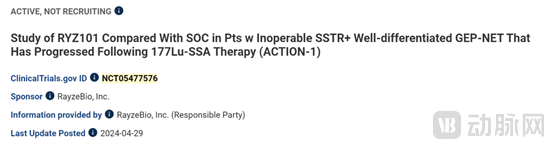
Image source: Clinical Trials official website
The development of nuclear medicine occasionally has to be put on hold due to supply constraints, a situation that has become an accepted reality within the industry. However, Bristol-Myers Squibb, operating in the seemingly ever-booming hotspot of nuclear medicine, has had to personally experience this by halting its Phase 3 clinical trial.
After all, there was a time when BMS made a significant acquisition of RayzeBio, a rising star in nuclear medicine, at a premium of approximately 250%, with a total cost of $4.1 billion. For BMS, whose oncology business desperately needed new vitality at that time, this move was both an expansion of its business sector and a bold gamble to revive its performance.
Radiopharmaceutical Supernova: Sold for $4.1 Billion Three Years After Establishment
On December 26, 2023, Bristol-Myers Squibb and RayzeBio, Inc. announced that they had reached a definitive merger agreement under which Bristol-Myers Squibb will acquire RayzeBio, Inc. for $62.50 per share in cash, with an equity value of approximately $4.1 billion. The transaction has been unanimously approved by the boards of directors of both Bristol-Myers Squibb and RayzeBio, Inc.
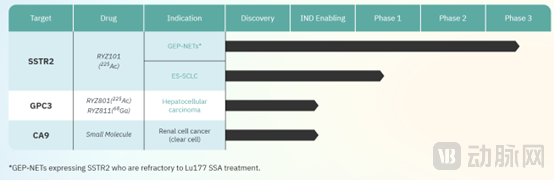
RayzeBio Pipeline, from the official website of RayzeBio
The story of RayzeBio, the supernova in nuclear medicine, has been celebrated in the industry: founded in 2020, with only three products in its pipeline, the company successfully completed four rounds of financing within three years, raising a total of $418 million. Also within three years, RayzeBio went public against the backdrop of cooling capital markets in 2023 and successfully raised $311 million, becoming the second-largest IPO in the U.S. biotech sector that year. Not only that, but just over three months after its IPO, RayzeBio was acquired by Bristol-Myers Squibb for $4.1 billion, at a premium of 250%.
Calling RayzeBio a "pig on the风口" seems unfair.
RayzeBio's novel proprietary peptide RYZ801, which targets glypican-3 (GPC3), is currently under IND investigation for actinium-based radiotherapy to treat hepatocellular carcinoma. Additionally, the pipeline targeting CA9 has also entered the IND stage.
The most notable product in RayzeBio's potential BIC pipeline is RYZ101. RYZ101 is a radiopharmaceutical conjugate (RDC) that targets somatostatin receptor 2 (SSTR). The biggest difference between this drug and most current nuclear medicines lies in the radionuclide it uses.
Radionuclides, also known as radioactive isotopes, refer to metal or non-metal elements that can emit α, β, or γ radiation. These radionuclides decay and emit radioactive rays, which damage the chromosomes of cells, halt their growth, and thereby destroy proliferating cancer cells. Currently, the radionuclides used in the RDC field are mainly β-emitting radionuclides. For example, Lutathera, Novartis' star radiopharmaceutical, utilizes a β-emitting radioactive isotope.
RYZ101, on the other hand, uses the alpha-particle emitting isotope Actinium-225 as its radionuclide. Compared to beta particles, alpha particles deliver 400 times more energy, causing more frequent double-strand DNA breaks, thereby killing tumor cells. Theoretically, RYZ101 is expected to outperform radiopharmaceuticals that use beta-emitting radionuclides in terms of efficacy.
RYZ101 is advancing into Phase 3 clinical trials for the treatment of gastroenteropancreatic neuroendocrine tumors (GEP-NETs), as well as early-stage development for the treatment of small cell lung cancer and other potential tumors. In terms of both R&D progress and therapeutic potential, RYZ101 has the possibility to become a new therapy in the field of GEP-NETs; if successful, it may pave a new path for the development of nuclear medicine.
Bristol-Myers Squibb Company is precisely focused on this point.
It is worth mentioning that, in addition to RayzeBio's clinical prospects, Bristol-Myers Squibb has also expressed interest in RayzeBio's upcoming factory, which is approximately 60 million square meters and will be completed in Indianapolis. Previously, RayzeBio stated on its official website that it is gradually building the capability of this factory to produce Actinium-225.
It can be said that, from the outset of the acquisition, BMS incorporated the improvement of the nuclear medicine supply chain into its future business planning considerations, but still could not escape the predicament of isotope shortages.
Actinium-225 Supply: A Critical Step Behind Schedule, Accelerated Production Too Late
When discussing the various challenges of innovative drug development, the difficulty of radiopharmaceuticals R&D is singled out due to its unique characteristics. The supply chain, selection of appropriate isotopes, drug efficacy, and logistics during transportation are all difficult points that need to be addressed, especially for a Biotech company, particularly a startup. Among these, the supply chain is one of the key factors affecting radiopharmaceutical sales. Unlike ordinary drugs that can be stored for a long time, the half-life of radionuclides in radiopharmaceuticals is extremely short, resulting in a shelf life of only a few days. This requires pharmaceutical companies to not only have production capabilities but also distribution capabilities.
Novartis, which invested heavily in nuclear medicine pipelines earlier than BMS, also faced the same issues earlier than BMS.
In March 2022, Novartis' Pluvicto received FDA approval for third-line treatment of PSMA-positive metastatic castration-resistant prostate cancer, becoming the world's first PSMA-targeted radioligand therapy. In the first quarter of 2023, despite extremely tight supply, Pluvicto's sales still reached $211 million, a year-on-year increase of 18%, surpassing Wall Street's expectation of 11%. In the second quarter of the same year, Pluvicto continued to gain momentum, with sales reaching $240 million. This brought the total sales of Pluvicto in the first half of the year to $450 million. Industry experts believe that, barring any unforeseen circumstances, Pluvicto’s sales in 2023 will easily exceed $1 billion, securing its place as a blockbuster drug.
Pluvicto's actual sales in 2023 were $980 million. Despite the impressive figure, its full potential was not realized. The reason lies in supply constraints.
Due to the enormous demand, Pluvicto's production capacity has been insufficient because of an isotope supply shortage, resulting in a significant clinical demand gap. Additionally, the drug has a shelf life of only a few days and cannot be stockpiled in advance, which limits its widespread application. This has forced Novartis to suspend patient recruitment. In cases where all chemotherapy options have failed, patients who should have had a lifeline are left waiting for months, at the mercy of luck.
The RYZ101 targeted by BMS uses the radionuclide actinium-225, which has a half-life of 10 days and is extremely rare in nature, requiring artificial synthesis. Internationally, the actinium-225 isotope used for clinical research or drug synthesis is primarily produced through the decay of thorium-229. The annual production is less than 2.5 curies, and it once reached a price extreme of 1 million USD/mCi (millicuries), being referred to as "the rarest drug on Earth."
Despite multiple countries joining the competition for mass production of Actinium-225, due to Bristol-Myers Squibb's insufficient control over the production progress of Actinium-225 in the early stage, the factory built by RayzeBio in Indianapolis in 2023 for the mass production of Actinium-225 isotopes and radiopharmaceutical formulations has not been fully put into use until now. The consequence of being "one critical step" behind is the suspension of the Phase 3 clinical trial of RYZ101, which was forced to replay a scene no different from its competitor Novartis.
Novartis' wake-up call didn't alarm its competitor BMS, but it provided a solution for AstraZeneca.
In March 2024, AstraZeneca announced the acquisition of Fusion Pharmaceuticals (hereinafter referred to as Fusion) for $2.4 billion.
Fusion is also coincidentally conducting a Phase 2 study on actinide therapy for prostate cancer. Fusion's most advanced R&D project at present is FPI-2265, a prostate-specific membrane antigen (PSMA)-targeted radiopharmaceutical therapy, which is currently in Phase 2 clinical trials as a treatment for metastatic castration-resistant prostate cancer (mCRPC). The radioactive isotope delivered by FPI-2265 is Actinium-225.
Although it may not shine as brightly as RayzeBio, Fusion's Actinium-225 production facility has been fully operational since January 2024. This means that AstraZeneca won’t have to worry about any Phase II clinical trials being forced to halt after acquiring Fusion, and it will also help pave a smoother path for subsequent commercialization.
Global Isotope Mass Production Accelerates
The road to mass production of Actinium-225 is risky and long, with many countries joining the capacity competition.
In 2021, Canadian Nuclear Laboratories (CNL) and ITM Isotope Technologies Munich SE signed a memorandum of cooperation to jointly advance the research, development, and industrial application of Actinium-225 production technology. In 2023, Canadian Nuclear Laboratories also reached an agreement with the Saskatchewan Centre for Nuclear Innovation at the University of Saskatchewan to further boost the production of Actinium-225 by more than 30 times.
In 2022, Kolesnikova, Deputy General Manager of Rusatom Healthcare, stated that Rosatom is prepared to begin construction of the largest radiopharmaceutical production plant in Europe in Obninsk. Commercial operations are planned to commence as early as 2025. The construction cost is approximately 9 billion rubles, with an annual production capacity of 89,000 curies. The facility will produce commonly used radiopharmaceuticals (such as iodine-131, samarium-153, and molybdenum-99), as well as certain promising radiopharmaceuticals (such as lutetium-177, actinium-225, and radium-223).
In China, at the beginning of 2024, a research team led by Qin Zhi, a researcher from the Nuclear Chemistry Laboratory of the Institute of Modern Physics, Chinese Academy of Sciences, utilized the beam provided by the Lanzhou Heavy Ion Accelerator Research Facility (HIRFL) to bombard a metallic thorium target. Using an independently developed automated separation device, they successfully prepared the medical isotope actinium-225. The related achievement has applied for and been granted an invention patent titled "An Automated Processing Device for Separating Actinium-225 and Its Operation Method."
It is reported that Qin Zhi's team used the beam provided by HIRFL to bombard a metallic thorium target, establishing the chemical separation and purification process for the medical isotope actinium-225. By employing an independently designed and processed automated separation system, they achieved efficient, repeatable batch separation and purification of the medical isotope actinium-225, avoiding the tedious manual operations and the potential risks posed by high-dose radioactivity to operators. This breakthrough is expected to change the situation where China currently relies entirely on imports for actinium-225.
Companies also enter the commercial production market of Actinium-225.
Medical Radioisotope Company NorthStar Achieves Commercial Production of Therapeutic Radioisotope Actinium-225 in the U.S. in 2023. A custom IBA Rhodotron TT 300-HE electron beam accelerator has been delivered to NorthStar's new Ac-225 production base in Beloit, Wisconsin. This facility will be dedicated to producing carrier-free actinium-225.
Founded in 2023 and located in Guangdong Province, Panthera Medical Holdings (Shenzhen) Co., Ltd., led by two British academicians and in collaboration with Tsinghua University's Institute of Nuclear and New Energy Technology, focuses on the research, production, and sales of "the rarest drug on Earth," Ac-225. It is committed to breaking through and resolving the dual bottlenecks of technology and production capacity that have long relied on imports in China.
Back to BMS, the remedial measures taken by this multinational giant cannot change the fact that patient recruitment for RYZ101 in Phase 3 trials has been suspended. However, its existing efforts may reduce some obstacles for RYZ101 on its subsequent commercialization path. In March 2024, Ratio, a nuclear medicine company backed by BMS, expanded its manufacturing agreement with CDMO PharmaLogic to ensure a commercial GMP-grade supply chain as much as possible.
In addition, a spokesperson for RayzeBio also repeatedly emphasized that all patients currently participating in ACTION-1 will continue to receive treatment, with plans to resume recruitment of new patients in the third quarter.