Boston Scientific's Next-Gen Drug-Coated Balloon AGENT DCB Receives NMPA Approval for In-Stent Restenosis Treatment

Boston Scientific
Medical Device Manufacturer

Source: Heart Future
Recently, AGENT Paclitaxel-Coated PTCA Balloon Catheter (DCB) (referred to as "AGENT DCB") from Boston Scientific (NYSE: BSX) received approval from the National Medical Products Administration (NMPA) for the treatment of in-stent restenosis (ISR) in coronary arteries. In-stent restenosis refers to the recurrence of lesions with a diameter stenosis greater than 50% within the previously implanted stent.
In March 2024, Agent DCB received FDA approval, becoming the first coronary DCB in the U.S. for treating in-stent restenosis (ISR) in patients with coronary artery disease.
As the world's first coronary DCB product to receive FDA approval for marketing in the United States, AGENT DCB is currently the only coronary DCB product to have received approvals from the EU CE, FDA, and NMPA, and will bring more diverse options for coronary intervention treatments in China.
Currently, this balloon catheter has been marketed in many international markets and has treated more than 100,000 patients, including those in Europe, parts of the Asia-Pacific region, and Latin America. The device was approved by Japan's pharmaceutical regulatory authority in 2023, obtained the CE mark as early as 2014, and was granted "Breakthrough Device Designation" by the FDA in 2021.
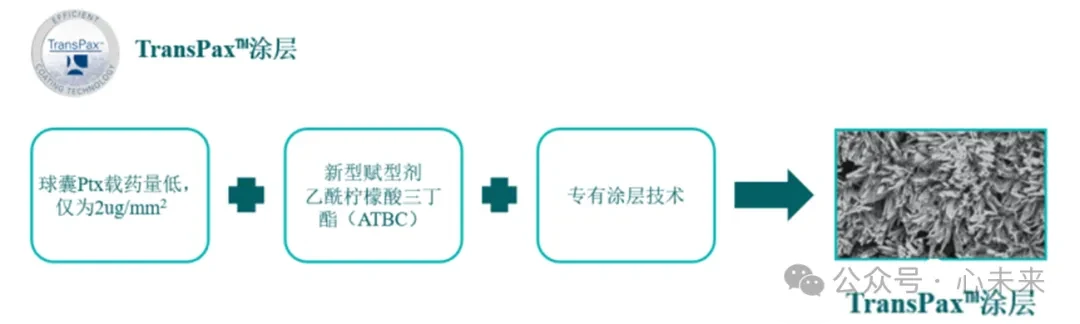
Agent DCB is a drug-coated balloon that utilizes TransPax coating technology for the treatment of ISR and previously untreated small vessel coronary artery disease patients. Through the TransPax™ coating technology, it delivers a targeted therapeutic dose of the anti-proliferative drug paclitaxel to the site of the coronary lesion. It also minimizes particulates while maintaining excellent deliverability.
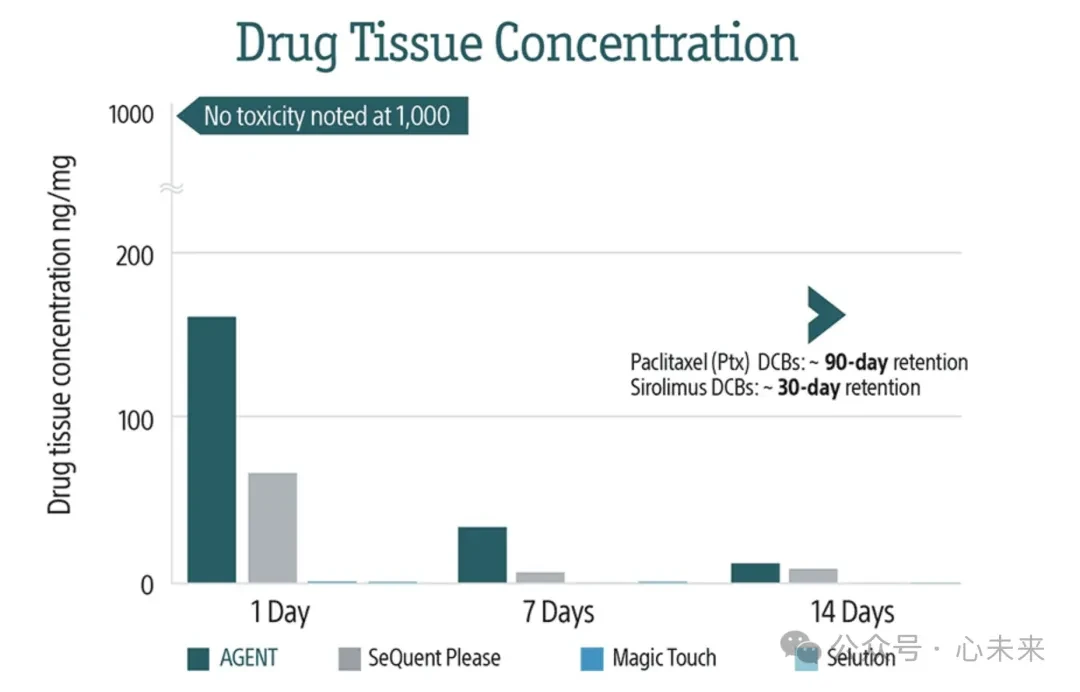
▲From the company's official website
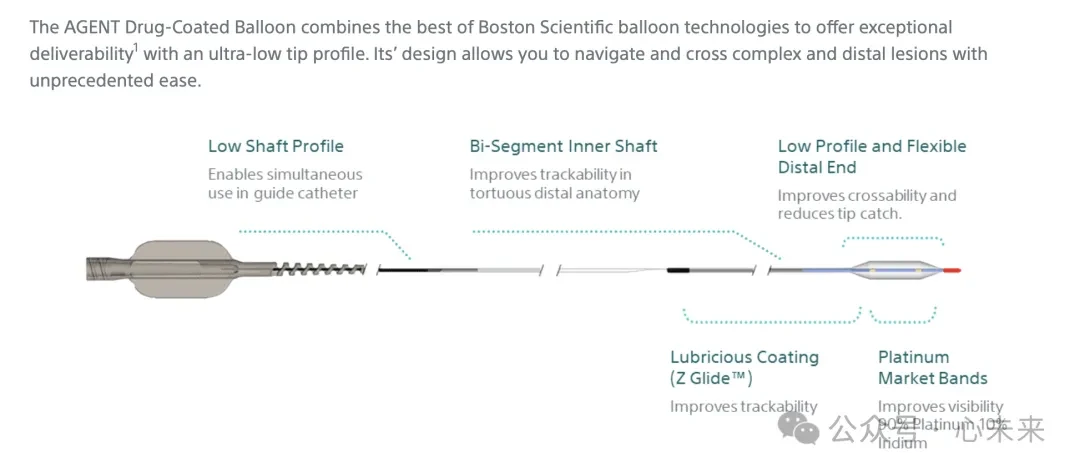
Agent DCB Drug-Coated Balloon adopts advanced balloon technology, featuring an ultra-low tip profile that ensures ease of crossing complex and distal lesions during cardiovascular interventional procedures.
The low-profile design of this balloon supports simultaneous use within the catheter, while its dual-segment inner shaft enhances trackability in tortuous distal anatomy. The low profile and flexible distal design optimize the balloon's ability to cross stenotic lesions and reduce the risk of slippage.
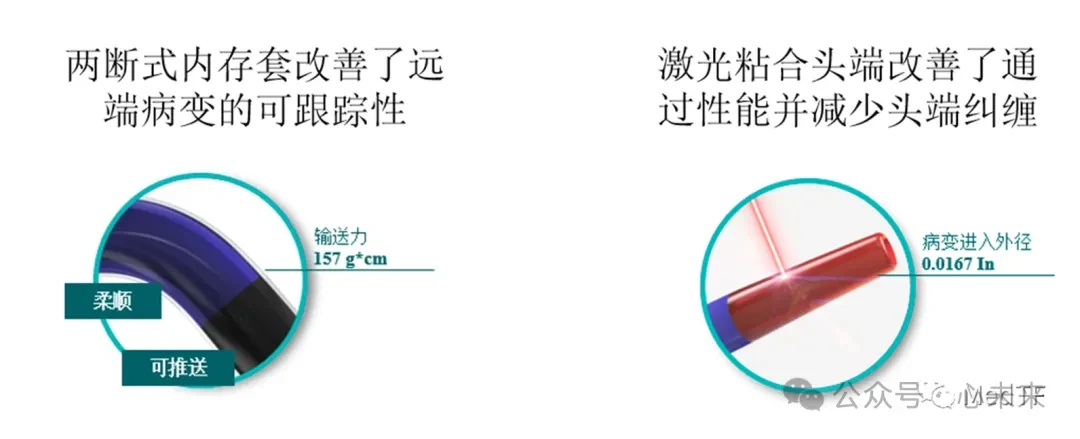
▲Source: Company's official website
In addition, the lubricious coating (Z Glide™) on the balloon surface further enhances trackability, while the platinum marker band improves visibility during the procedure, allowing for clearer balloon positioning and increasing the precision and safety of the surgery.
At the 2022 TCT conference, Boston Scientific announced the IDE clinical research data of the Agent DCB. The AGENT IDE is a pivotal randomized trial designed to compare the safety and efficacy of the Agent Paclitaxel-Coated Balloon (Agent DCB) versus conventional balloon angioplasty in patients with ISR.
A total of 480 patients with in-stent restenosis (ISR) due to coronary artery obstruction who had previously undergone stent implantation were enrolled from 40 centers in the United States. After successful pre-dilation of the target lesion, patients were randomized in a 2:1 ratio to receive treatment with the Agent DCB (n=321) or balloon angioplasty (BA, n=159). The primary endpoint was the incidence of target lesion failure at 1 year, defined as a composite of recurrent obstruction, heart attack caused by the treated vessel, or cardiac death.
The results showed that the primary endpoint of target lesion failure (TLF) was reached at 12 months. The target lesion failure rate in the Agent DCB group was significantly lower than that in the BA group at 1 year (17.9% vs. 28.7%, P=0.0063), indicating that Agent DCB was significantly superior to BA in reducing target lesion failure rate.
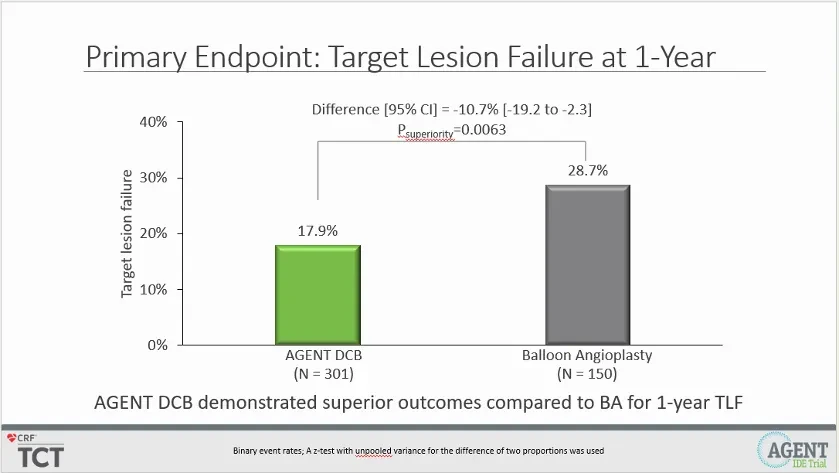
▲ Primary Endpoint Results (Source: Company Official Website)
Compared with BA, the application of Agent DCB significantly reduced the risk of cumulative target lesion revascularization by 51% (12.4% vs. 24.0%, P=0.002) and the risk of target vessel-related heart attack by 49% (6.4% vs. 12.3%, P=0.03); moreover, no stent thrombosis occurred (0.0% vs. 3.9%, P=0.001).
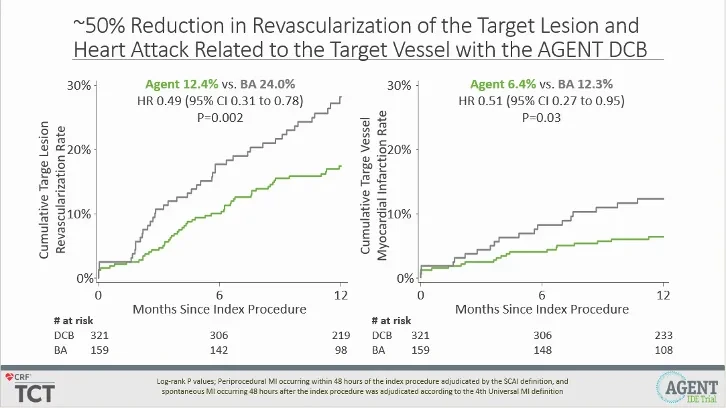
▲ Target Lesion Revascularization Rate and Target Vessel-Related Myocardial Infarction Rate (Source: Company Official Website)
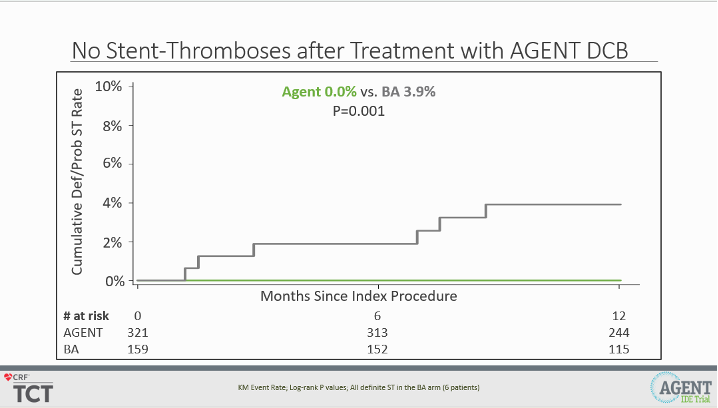
▲ Stent Thrombosis Results (Source: Company's Official Website)
The emergence of Bare Metal Stents (BMS) has, to a certain extent, addressed issues such as vascular wall dissection, acute vessel occlusion, and vascular elastic recoil that may occur after balloon dilation. However, it has introduced another serious challenge: in-stent restenosis. Continuous irritation of the vascular intima by metal stents can lead to excessive intimal hyperplasia, causing in-stent restenosis (ISR), with an incidence rate reaching up to 30%.
Drug-coated balloon angioplasty allows the drug to act on the inner wall of blood vessels, maintaining better vascular patency without leaving any foreign objects inside. It has obvious advantages in treating in-stent restenosis (ISR), small vessels, and bifurcation lesions, and its application in primary lesion expansion is continuously being explored and verified.
With the promotion of the "intervention without implant" concept in recent years, the usage of drug-coated balloons has grown rapidly. According to Frost & Sullivan's forecast data, after drug-coated balloons were first approved for the treatment of coronary artery disease in China, the usage surged from 7,500 units in 2016 to 290,000 units in 2021. The market size is expected to further increase to 1 million units by 2025 and reach 2.042 million units by 2030.
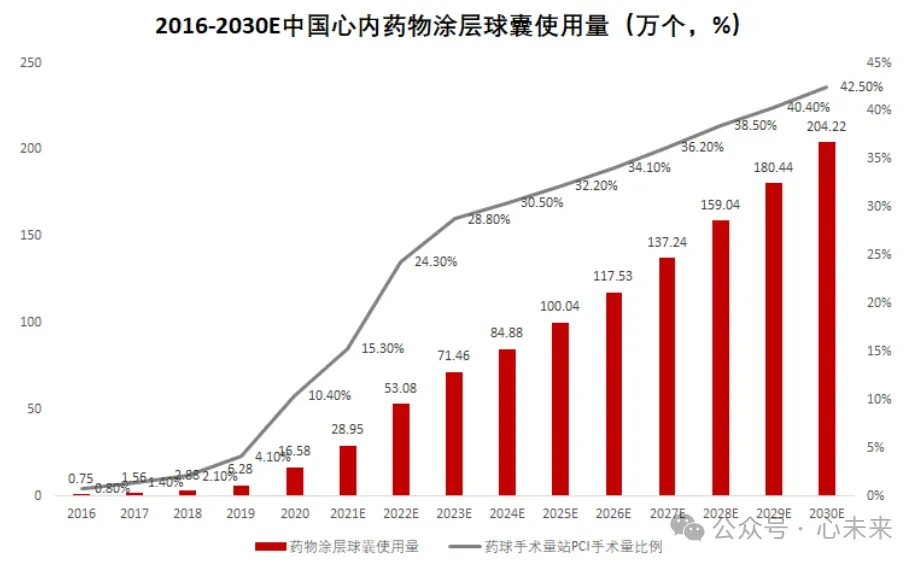 ▲ Source: Frost & Sullivan
According to Frost & Sullivan forecast data, the market size of coronary drug-coated balloons in China surged from 1.35 billion yuan in 2016 to 20.09 billion yuan in 2021. It is expected to further increase to 43.86 billion yuan by 2025 and reach 59.33 billion yuan by 2030.
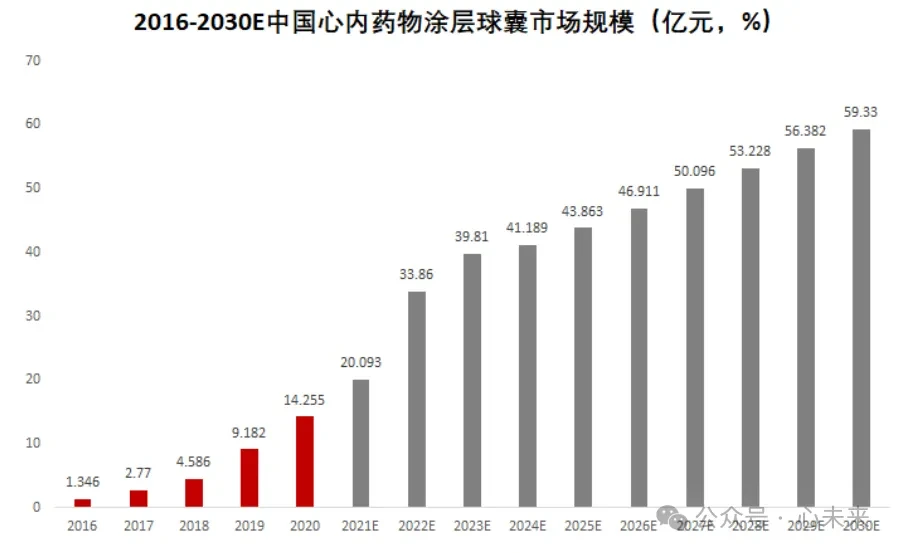
▲ Source: Frost & Sullivan
Coronary Drug-Coated Balloons are high-end Class III medical devices, characterized by highly sophisticated technology and significant entry barriers. The development of China’s drug balloon industry started relatively late, with a shorter growth period. The domestic market is dominated by a few companies, leaving considerable room for further advancement.
Public information shows that drug-coated balloons were first applied in Europe around 2009. In the global market, Medtronic, Boston Scientific, B. Braun Medical, and Biotronik are the main players. However, the broad prospects of this product have also attracted many Chinese medical device companies to successively lay out their strategies.
SeQuent Please by German B. Braun was the first drug-coated balloon to be launched in China, with indications for the treatment of in-stent restenosis in coronary arteries. The Light Boat® Drug-Eluting Balloon by Yinyi Bio received priority approval from the former China Food and Drug Administration (CFDA) for marketing in 2017. It is the world's first product suitable for primary coronary bifurcation lesions and also the first product in China to obtain a registration certificate. In 2019, the second registration certificate was obtained by Shanghai Shenqi.
Yinyi Bio's Light Boat® Drug-Eluting Balloon boasts excellent deliverability and trackability, along with superior drug coating quality. It has been clinically applied in many renowned cardiovascular hospitals and over a thousand hospitals across China. Since its market launch, sales have grown rapidly, breaking the market monopoly previously held by Germany's B. Braun.
2020 was a milestone year for drug-coated balloons made in China:
On April 20, the balloon jointly developed by Grand Pharma and Germany's Cardionovum was approved by NMPA;
On April 28, MicroPort's HeartFlow received domestic approval in China for its peripheral drug-coated balloon.
On July 14, the first clinical application of LePu Medical's drug-coated balloon was performed after its market launch.
Moreover, the drug-coated balloon of Jiwei Medical, a subsidiary of Blue Sail Medical, entered the special review process of the Center for Medical Device Evaluation under the National Medical Products Administration in August 2021.
In addition to drug-coated balloon products developed by multiple local companies such as Yinyi Bio, Shanghai Shenqi, Lepu Medical, Cardionovum (Grand Pharmaceutical), Winson Medical, Beta Medical, Dikang Medical, Ciro Medical, and Xinmai Medical being approved for marketing, dozens of other companies are still engaged in the research and development of drug-coated balloons. As more competitors and competing products enter the market, competition will intensify. However, the entry of competing products will further enhance domestic market education within the industry and promote an increase in product market penetration in China.
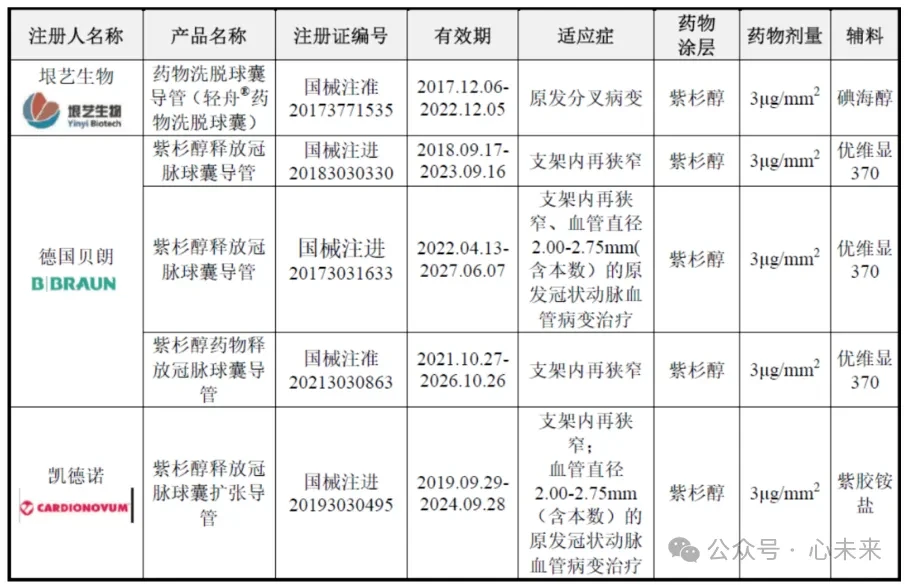
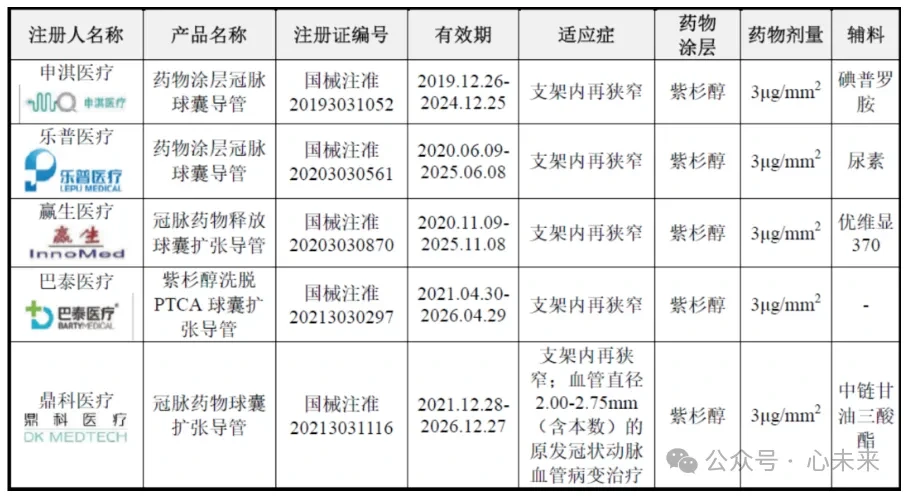 ▲Comparison of Coronary Drug-Coated Balloon Competitors (Source: Yinzhi Bio's Prospectus)
04
Boston Scientific (NYSE: BSX) was founded in 1979 and is headquartered in Natick, Massachusetts, USA. It is a global leading medical technology company.
In 1997, Boston Scientific entered China, establishing branch offices and research centers in Beijing, Shanghai, and Guangzhou, with its headquarters in China located in Shanghai. Boston Scientific has over 17,000 products and has been granted more than 16,000 authorized patents worldwide. In May 1992, Boston Scientific was successfully listed on the New York Stock Exchange.
On January 31, 2024, Boston Scientific announced its 2023 fiscal year annual results. The report showed that in this fiscal year, the company: achieved annual net sales of $14.24 billion (approximately 101.1 billion RMB), representing a year-on-year increase of 12.3%; net sales in the fourth quarter were $3.73 billion, representing a year-on-year increase of 14.9%.
By division, Boston Scientific Corporation's business is divided into two segments: Medical Surgical and Cardiovascular. Both segments showed similar growth rates: the former achieved an organic growth of 10% for the full year, with total net sales reaching $5.422 billion; the latter achieved an organic growth of 13% for the full year (including a 33% growth in electrophysiology and a 25% growth in the Watchman Left Atrial Appendage Closure Device), with total net sales amounting to $8.819 billion.
This article is reprinted, all opinions belong to the original platform.(Heart Future), Medical DeviceMedical Business Review remains neutral on all viewpoints in the article and only shares for communication purposes.
*Advertisement