

Domestic Rivals Clash Over $3.4B Pomalidomide Capsules as Originator Remains Unlaunched in China

Qilu Pharmaceutical
Specialty Formulations and Active Pharmaceutical Ingredients (API) Developer
The market battle for Pomalidomide Capsules, a blockbuster potential product, has already begun.
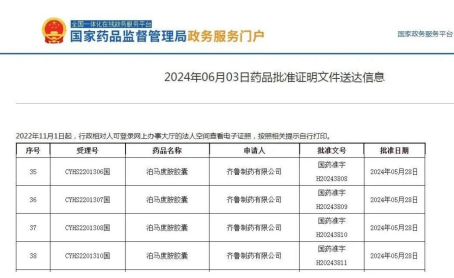
Recently, according to the official website of the National Medical Products Administration, Qilu Pharmaceutical's anti-tumor drug Pomalidomide Capsules has officially received marketing approval.
Pomalidomide (Pomalyst/Imnovid) is a thalidomide analog developed by Celgene, a subsidiary of Bristol-Myers Squibb (BMS), and belongs to the class of immunomodulatory drugs. The original drug was developed by Celgene and received FDA approval for marketing in February 2013, followed by European approval in August of the same year. However, the drug did not enter the Chinese market immediately.
In fact, the pomalidomide capsule is a typical case where a generic drug was approved for marketing before the original drug. In the Chinese market, the first company to launch the product was Zhengda Tianqing, which received approval for the first generic version in November 2020. In June 2022, the original developer, Bristol-Myers Squibb (Celgene), also submitted a marketing application for the pomalidomide capsule. In the coming years, as one of the popular generic drugs for multiple myeloma, the market competition for pomalidomide will become increasingly intense.
Qilu, the second Chinese-produced
Multiple Myeloma (MM) is a malignant disease characterized by the abnormal proliferation of clonal plasma cells and is one of the most common malignant tumors of the hematological system. Currently, the incidence of multiple myeloma in China has surpassed that of acute leukemia, making it the second most common hematological malignancy.
In recent years, with the rapid development of pharmaceutical technology, pomalidomide, as the third-generation immunomodulatory drug following the first-generation thalidomide and second-generation lenalidomide, has demonstrated unique effects in anti-infection, immune modulation, anti-tumor proliferation, and anti-tumor angiogenesis. It has also shown its unique value in the treatment of multiple myeloma, particularly demonstrating good efficacy and lower toxicity in clinical trials for refractory and relapsed multiple myeloma.
Clinical data show that pomalidomide has a high remission rate in the treatment of newly diagnosed relapsed/refractory multiple myeloma, and can significantly prolong progression-free survival and overall survival during subsequent maintenance and consolidation therapy. Pomalidomide also demonstrates convincing efficacy in patients refractory to both lenalidomide and bortezomib.
In February 2013, pomalidomide was first approved by the FDA for marketing to treat multiple myeloma patients who have received at least two prior therapies (including lenalidomide and proteasome inhibitors) and have demonstrated disease progression during or within 60 days after the last therapy. In August of the same year, this indication was approved in the EU. In May 2020, pomalidomide expanded its indications in the United States for the treatment of Kaposi's sarcoma, becoming the first oral drug for this disease.
Since its launch, the sales of Pomalidomide have continued to grow. It rapidly increased from US$305 million in 2013 to US$2.04 billion in 2018, breaking through the US$2 billion mark for the first time and bringing significant profits to BMS.
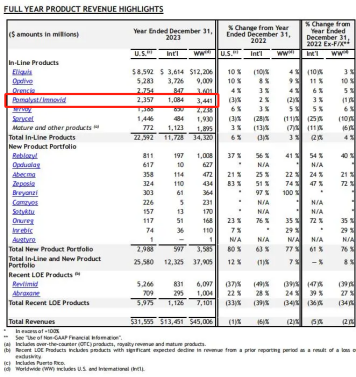
According to BMS financial report, the global sales of Pomalidomide in 2023 were $3.441 billion. Meanwhile, data from Menet shows that the sales of Pomalidomide capsules in Chinese public medical institutions, including urban public hospitals, county public hospitals, urban community health centers, and township health centers, reached nearly 200 million yuan in 2023, representing a year-on-year increase of 44.02%.
It is worth mentioning that pomalidomide's "brother" – lenalidomide, a second-generation drug for multiple myeloma (MM) – has grown into a multi-billion-dollar product, and is currently one of the best-selling drugs globally. In 2021, it ranked 2nd in the list of the world’s top-selling oncology drugs with sales reaching $12.82 billion, just behind Keytruda. Currently, pomalidomide is generally used as a supplementary treatment to lenalidomide, mainly applicable in cases where lenalidomide is ineffective or resistance has developed. Additionally, the breadth of indications for pomalidomide still needs further development.
Qilu Pharmaceutical Co., Ltd. initiated the research and development of Pomalidomide Capsules in 2013, submitted a new drug application on August 16, 2022, and received acceptance from the CDE. The approved Pomalidomide Capsules cover four clinical specifications. Compared with the existing Pomalidomide Capsules in China, two new specifications, 2mg and 3mg, have been added, making it more suitable for patients with mild to severe hepatic and renal impairment, and allowing for more convenient dose adjustments.
At the same time, according to a national population analysis study, from 2012 to 2016, the prevalence and incidence of MM in China were 5.68/100,000 people and 1.60/100,000 people respectively, indicating a significant clinical demand for pomalidomide in China. Despite the availability of one domestically produced pomalidomide product in the market, there are still many unmet needs in clinical practice and the market.
Step on the Rapid Scaling Period
According to the CDE official website, multiple companies in China have already entered the pomalidomide capsule market.
China Resources Tianqing Pharmaceutical Group was the first to submit the marketing application for Pomalidomide Capsules in July 2018, with specifications of 1mg and 4mg. In October of the same year, it was included in the priority review process, and in November 2020, it became the first generic drug to be approved and the first to pass the evaluation.
It is worth mentioning that Pomalidomide Capsules successfully entered the National Reimbursement Drug List (NRDL) in the 2021医保 negotiation and also successfully renewed in the 2023版 National Reimbursement Drug List (Class B).
Data from MiNe Network shows that after being included in the medical insurance, Chia Tai Tianqing Pharmaceutical Group's pomalidomide capsules experienced a significant sales increase. In 2022, the product's sales in Chinese urban public hospitals, county-level public hospitals, urban community health centers, and township health centers (referred to as Chinese public medical institutions) exceeded 130 million yuan, with a growth rate of 648.30%. In terms of sales channels, urban public hospitals accounted for over 80%, while county-level public hospitals accounted for approximately 15%.
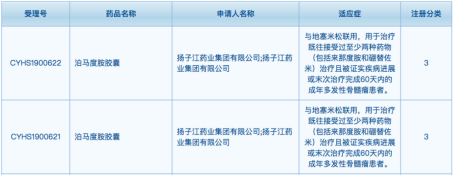
In 2020, Yangtze River Pharmaceutical's submitted Category 3 generic drug – Pomalidomide Capsules received two clinical implied approvals. The indications are: used in combination with dexamethasone for the treatment of adult patients with multiple myeloma who have previously received at least two therapies (including lenalidomide and bortezomib) and have demonstrated disease progression or completed their last treatment within 60 days.
In addition, in the development and preparation of generic drugs by local pharmaceutical companies in China, companies that have registered for the imitation variety include Jiangsu Hengsen Pharmaceutical, Jiangsu Simcere Pharmaceutical, Jiangsu Aosaikang Pharmaceutical, Nanjing Huaweiyi Pharmaceutical, Nanjing Cavendish Bio, Hefei Jiunuo Pharmaceutical, Hebei Guolong Pharmaceutical, Shijiazhuang Siyao, Hefei Xinfeng Technology, Jiangsu Jiayi Pharmaceutical, Beijing Furui Kangzheng Pharmaceutical, Beijing Kelai Bo Pharmaceutical, Hangzhou Heze Pharmaceutical, Dafeng Desano Pharmaceutical, Shanghai Create Pharmaceutical, and Qilu Aote Pharmaceutical.
According to statistics, there were approximately 176,000 new cases of MM globally in 2020, accounting for 1% of all new cancer cases worldwide. Additionally, according to Frost & Sullivan and Kantar Health, the number of MM patients in 2021 in the four major markets—the United States, China, the five European countries, and Japan—was approximately 148,000, 126,000, 122,000, and 28,000, respectively.
With the population growth and aging trend, along with the application of earlier effective treatment methods and new drugs, patient survival time has significantly increased. China will become the country with the fastest-growing number of patients in the next decade, with an annual compound growth rate as high as 8%. By 2030, the number of patients is expected to increase to 266,000, making it the largest MM patient market globally.
It is estimated that, starting from 2017, the MM market in 8 major countries (the United States, Europe G5, China, and Japan, 8MM = 8 major markets) has approached 15 billion US dollars. It is expected to grow at a compound annual growth rate of 6.7%, reaching 27.8 billion US dollars by 2027. Among them, the Chinese MM market will increase from 670 million US dollars in 2017 to 4.14 billion US dollars in 2027, with a high compound annual growth rate of 20.3%.
In terms of clinical indication development, indications such as myelofibrosis, brain cancer, and scleroderma have entered clinical development. If approved in the future, it will bring greater benefits to the market expansion of pomalidomide. In terms of domestic variety registration and application, pomalidomide has received high favor, with nearly 20 companies仿制 this variety. The competition for the domestic market has already begun, and it is believed that the future domestic market for this variety will show a certain degree of positive performance.
Editor:Cheng Lin




www.yyjjb.com.cn
Insight into Industry Trends

"Pharmaceutical Economy News"
Academic Official Account
Focus on the Frontiers of Oncology Academia

Terminal Official Account