Medtronic Submits IPO Prospectus for Infuse™ Bone Graft Following FDA Breakthrough Device Designation

Medtronic
Chronic Disease Medical Device and Therapy Developer

Medical Device Media Reporting Pioneer
Share Professional Medical Device Knowledge
May 29, 2024Medtronic Announces FDA Grants Breakthrough Device Designation for Infuse Bone GraftFor use with Infuse™ Bone Graft in Transforaminal Lumbar Interbody Fusion (TLIF) procedures at one or two adjacent levels from L2 to S1 for the treatment of degenerative disc disease in the lumbosacral region.
Infuse Bone Graft with LT-CAGE Lumbar Tapered Fusion Device
Infuse™ Bone Graft has previously received FDA approval for specific spinal, oral and maxillofacial, and orthopedic trauma surgeries. Since its market launch in 2002, it has been used in more than one million patients worldwide. It is the most extensively studied bone graft material globally and is recognized by the ISASS (International Society for the Advancement of Spine Surgery).The only bone repair material that can replace autologous iliac bone.
Currently,The use of Infuse in TLIF is still in the research stage.
TLIF (Transforaminal Lumbar Interbody Fusion) is currently the mainstream surgical procedure in clinical practice. It involves accessing the target intervertebral disc through the posterior intervertebral foramen space and performing disc space management at the affected segment, such as discectomy, disc space preparation, and bone graft fusion.
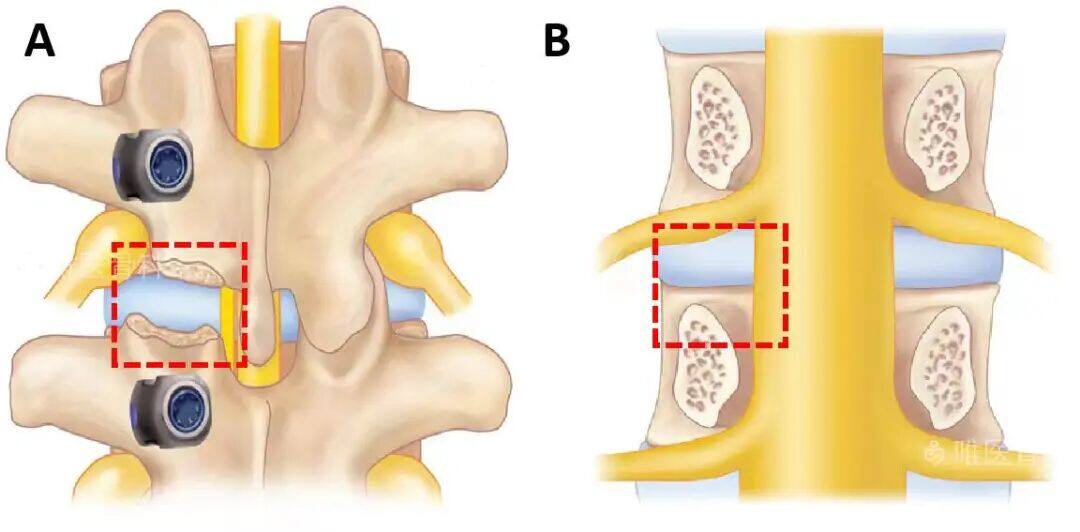
TLIF Surgical Approach Anatomical Diagram
A: After exposing the bony structure, resect the articular processes on the approach side, including the inferior and superior articular processes. After removing the ipsilateral ligamentum flavum, expose the dural sac and nerve root. Expose the intervertebral disc from the intervertebral foramen area to complete the TLIF surgical exposure.
B:Schematic diagram of the exposure range of TLIF surgery after removing the posterior bony structure.Red dashed line:TLIF Surgical Exposure Range.
The Infuse Bone Graft, which has received the Breakthrough Device Designation this time, is applicable for use with Infuse in conjunction with interbody fusion devices and commercially available metal screws and rod systems. It extends from L2 to S1 at one or two adjacent levels for the treatment of degenerative diseases of the lumbosacral spine and alleviates donor site pain.
The use of Infuse will avoid the need for a second surgery to harvest bone from the patient. Currently, the use of Infuse in TLIF is still in the research stage.
Medtronic is recruiting a prospective randomized clinical trial to evaluate Infuse with the TLIF method. It aims to provide clinical evidence demonstrating the safety and effectiveness sufficient to expand the TLIF indications.
Medtronic Vice President and General Manager of Spine and Biologics, Michael Carter, said: "We appreciate the FDA's recognition of Infuse's potential to raise the standard of care for TLIF. With this designation, our goal is to expand the availability of this proven technology to benefit more patients affected by debilitating spinal conditions. Our aim is to provide healthcare providers with effective tools to address the challenges posed by degenerative spinal diseases. Ultimately, our mission is to improve the quality of life for individuals suffering from these conditions, promoting a future where patients can enjoy better mobility and comfort."
Approved in China
In 2002, Infuse™ Bone Graft, the world's first product containing pure rhBMP-2 lyophilized powder and a type I bovine collagen carrier, was officially approved by the FDA for marketing.,To date, it has covered more than 50 countries and regions, treated over 2 million patients with severe risks of non-union bone healing, and been praised by clinicians as the ultimate bone repair solution surpassing autologous bone.
In August 2023, Infuse Bone Graft successfully received NMPA approval for marketing in China. The indication is for spinal fusion surgery in skeletally mature patients with degenerative disc disease at a single level from L2 to S1, becoming the second bone repair material containing rhBMP-2 (recombinant human bone morphogenetic protein) to be approved after Zhenghai Bio's product, which was approved in China in October 2022.
Bone Morphogenetic Protein-2 (BMP-2) is a substance that can induce bone formation when implanted into soft tissue in the body. It belongs to the transforming growth factor-beta superfamily and is the first, and currently the only, protein approved for use as a bone graft substitute.
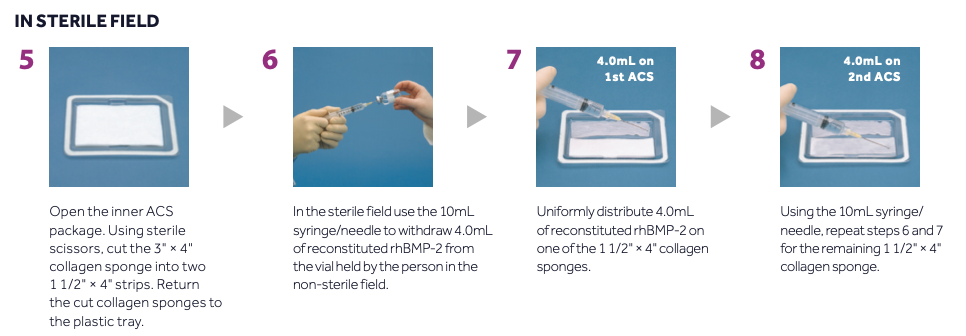
Medtronic's Infuse is a drug-device combination product, consisting of a recombinant human bone morphogenetic protein (rhBMP-2) injector, a sterile absorbable collagen sponge (ACS), an injector, and sterile water for injection. The rhBMP-2 solution is absorbed into the collagen sponge, which is then implanted into the patient’s body (in conjunction with a PEEK implant).
Among them, the absorbable collagen sponge (ACS) is a sponge-like matrix made of type I bovine collagen, with an appropriate pore size and porosity. It serves as a carrier for rhBMP-2 and a scaffold for new bone formation, supporting the ingrowth of local tissue cells and blood vessels, allowing them to survive within it and gradually absorb and replace it. Recombinant human bone morphogenetic protein (rhBMP-2), as an osteoinductive agent, promotes new bone formation. During the bone repair and healing process, it can recruit mesenchymal cells and induce their proliferation and differentiation into osteoblasts or chondrocytes, promoting osteoblast mineralization and new blood vessel formation, ultimately completing bone formation and reconstruction. Meanwhile, it collaborates with other regulatory factors in bone tissue formation. Bone repair materials achieve the filling and repair of bone defects through the synergistic effects of absorbable collagen sponge and recombinant human bone morphogenetic protein.
——
In China, the number of patients suffering from bone defects or functional disorders caused by traumatic fractures, bone tumors, or other orthopedic diseases exceeds 6 million each year, with approximately 20-25% undergoing surgical repair using bone repair materials. Currently, among various bone repair materials, autologous bone is the most effective and serves as the "gold standard" for treating bone defects, accounting for over 60% of surgical applications. However, its availability is somewhat limited, and the process of harvesting autologous bone can cause secondary injury.
Active biological bone, by combining recombinant signaling molecules that specifically bind to collagen with bone repair materials, achieves highly directional repair, and its clinical efficacy is no less than that of autologous bone. It will become the optimal implant material for current bone defect treatments, with a broad market space.
More exciting content
Welcome to follow WeChat Video Channel


Ranking of Chinese Medical Device Companies Going Global: Mindray, Weigao...
China's Leading Electrophysiology Company Halts IPO
Raising One Billion in a Year, China's Cardiovascular Giant May Split
Leading Chinese-Made Medical Device Company: Were the Father-Son Controlling Persons Once Investigated?
Orthopedic Market Leader, Acquires Competitor
Why is the "Father of Valves" Selling its Key Business for 30 Billion?
Shorten R&D Cycle, Improve Product Testing Efficiency! YIHU JIAYE Obtains UL Witness Laboratory Accreditation
Medical Device Giant, Major Layoffs in Restructuring
Instrument Family: Top 10 Cardiovascular Innovation Products of 2024
Industry Giant Acquires 52 Medical Institutions


BusinessBusiness cooperation email: qxzj@landianyiliao.com