China Set to Welcome Its First AI-Driven Drug Discovery Company to Go Public as AI's Value in Pharma Gains Recognition
XtalPi
Computation-Driven Innovative Drug R&D Provider

Over the past decade, artificial intelligence technology has gradually been applied in the field of drug research and development to accelerate the screening time of drugs and reduce R&D costs. However, there are still questions about the value of AI-assisted drug research and development—can it really improve the success rate of drug R&D?
Two events in May recently released positive signals from different perspectives, to some extent proving the prospects and value of AI pharmaceuticals.
First, in early May, Boston Consulting Group (BCG) released a report titled *How successful are AI-discovered drugs in clinical trials? A first analysis and emerging lessons*, which provides the first quantitative analysis of the clinical pipelines of 100+ AI pharmaceutical companies. The data shows that the overall probability of success for drug molecules discovered by AI has increased from 5%-10% to approximately 9%-18%, achieving a doubling improvement.
Especially, the success rate of Phase I clinical trials is as high as 80%-90%, while the average level in the traditional historical industry is about 50%. Although the sample size used is relatively small and lacks data from Phase III clinical trials, this is the first time that quantitative clinical data has been used to validate the effectiveness and value of AI-assisted drug research and development.
The second is that, on May 26, XtalPi passed the Hong Kong Stock Exchange listing hearing and is expected to become the first AI pharmaceutical company to go public in China.
The value of AI in aiding drug pipeline research and development is evident, but whether companies engaged in AI pharmaceuticals can achieve profitability is also a concern for investors and new entrants, which is crucial for the future development of the industry. Therefore, the successful listing of AI pharmaceutical concept companies indicates that the industry is seen to have profit potential in the capital market.
Although XtalPi is still in a loss-making state, with a loss of 1.906 billion yuan in 2023, it is applying for listing under Hong Kong's Rule 18C, which targets "specialized technology companies" that have not yet started commercialization or are in the early stages of commercialization — namely, high-tech companies with potential — and does not require them to be already profitable.
This highlights the high-tech nature of XtalPi's AI-assisted pharmaceutical technology. Additionally, XtalPi is also investing in and incubating innovative drug companies internally, such as Metis Pharmaceutical, LaiMang Bio, Signet Therapeutics, and ModaBio. In the future, revenue sharing from drug pipelines could become a significant source of income.
Previously, Insilico Medicine, an AI drug discovery company, successfully licensed out its drug pipeline externally. To a certain extent, AI drug discovery has also achieved a closed-loop business model, which means it can generate revenue through pipeline licensing. In September 2023, Insilico Medicine granted Exelixis, an oncology biotech company, the global development and commercialization rights to ISM3091, a potential best-in-class oral, highly selective small molecule USP1 inhibitor, for an upfront payment of $80 million.
These industry events all indicate that the value of AI-enabled drugs has been recognized and is gradually moving towards commercialization.
In addition to XtalPi, there are a number of AI pharmaceutical companies in China, such as Yingxi Intelligence, Aigelin Pharmaceuticals, Metis Pharmaceutical, Yuyao Biotech, Sino-Israel HaiDe, and NeoBio Therapeutics. Relying on the advantages of their AI drug platforms, these companies are already developing internal self-research pipelines. By promoting the market launch of AI-driven drug pipelines, they aim to accelerate the validation of their commercial value. After all, globally, there has yet to be an AI-discovered drug successfully launched on the market, and there is still a lack of strong evidence demonstrating the value of AI-assisted drug development.
As of 2023, among the 102 AI drug pipelines approved for clinical trials globally, 56 are in Phase I, 41 are in Phase II, and 5 pipelines have entered Phase III.
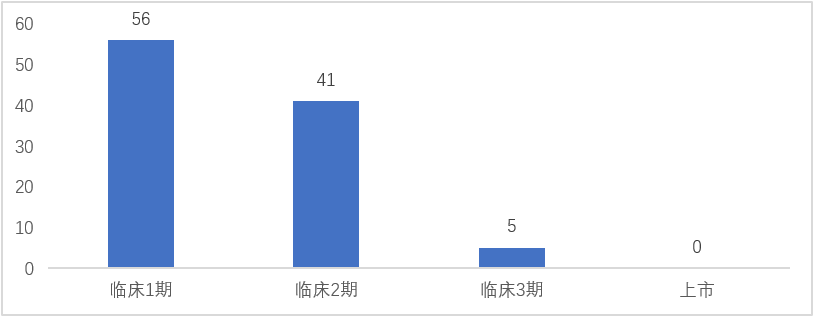 Figure 1. Progress of Global AI Pharmaceutical Companies' Clinical Pipelines in 2023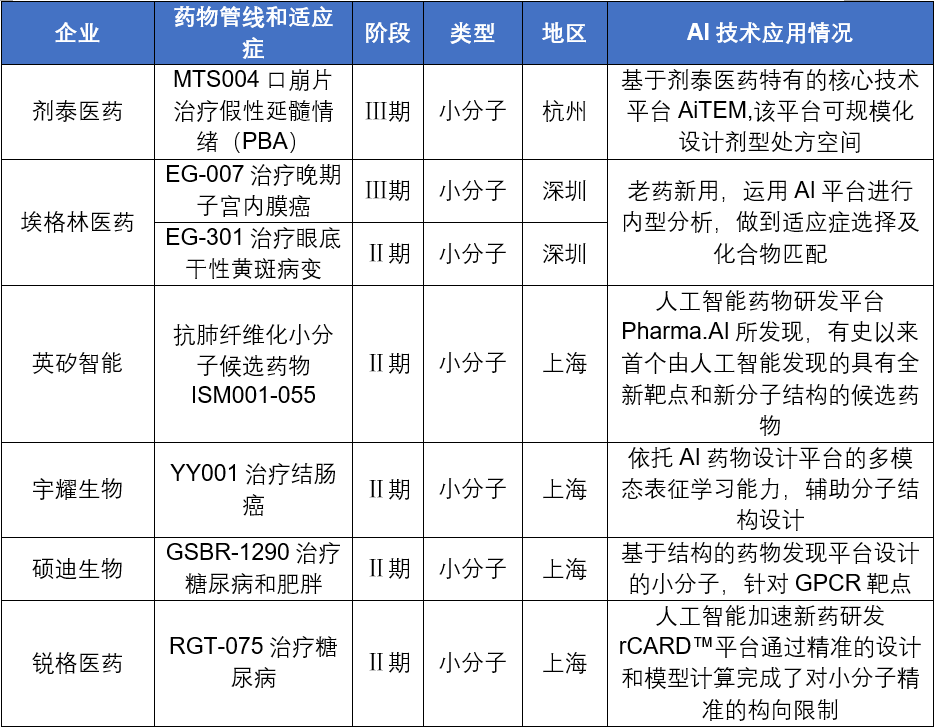


The Underlying Logic of Solubilization for Poorly Soluble Drugs: Springs and Parachutes