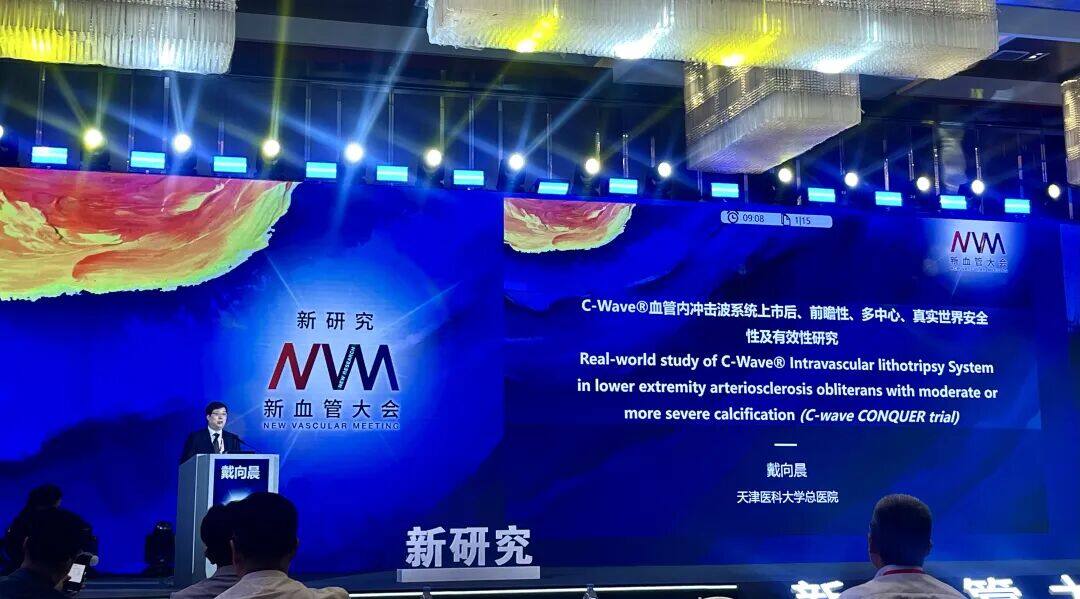
Professor Xiangchen Dai: C-Wave®Prospective, Multicenter, Real-World Safety and Effectiveness Study of the Vascular Shockwave System - CONQUER-I Trial
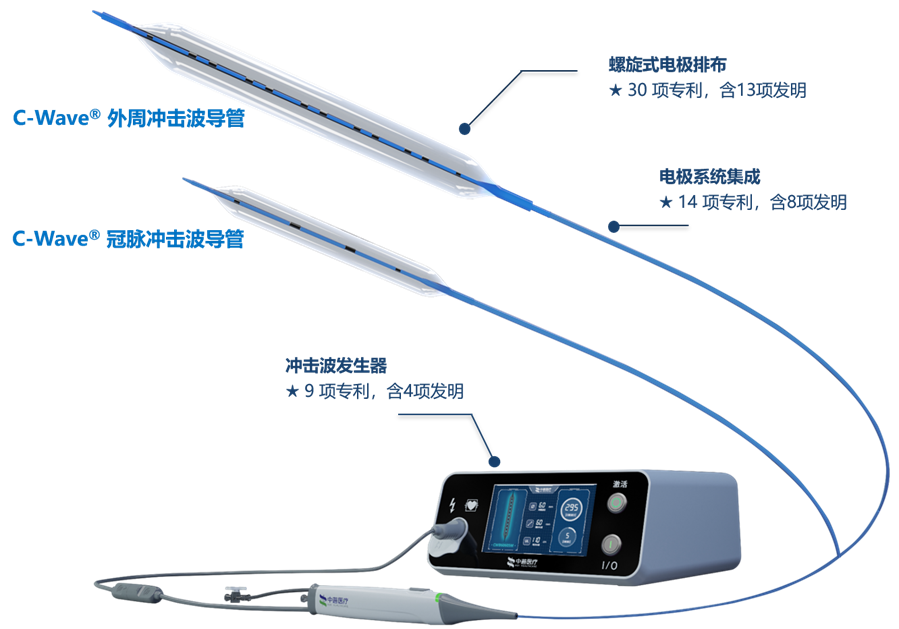
C-Wave®Innovative Design Empowers卓越 Clinical EfficacyC-Wave®Innovative electrode arrangement structure, uniform shock wave intensity, and 360° full-sector discharge characteristics efficiently open calcified stenotic lesions and immediately restore lumen patency; the catheter has a hydrophilic coating, improving device passage through lesions; uniform energy coverage eliminates the need for central alignment, offering convenient operation. C-Wave®It has complete independent intellectual property rights, and its globally unique "helical electrode arrangement" owns 53 patents, including 29 invention patents and 1 PCT patent. Different from Shockwave's circumferential electrode arrangement, it solidifies the moat of intellectual property rights.C-Wave®The model is complete and applicable to a wide range of lesions. For the superficial femoral artery segment, the balloon diameter ranges from 3.5 to 7.0 mm, with lengths of 60/80 mm; for the infrapopliteal artery segment, the balloon diameter ranges from 2.5 to 4.0 mm, with a length of 40 mm.
C-Wave®Holding 53 patents:Pre-market Confirmatory Study: C-Wave®Technical success rate and intervention efficiency significantly improvedC-Wave®The pre-market confirmatory clinical study was a prospective, multi-center, randomized controlled trial, enrolling 122 patients across 10 centers in China, who were randomly assigned in a 1:1 ratio to the IVL+DCB group (n=57) and the PTA+DCB group (n=63). In the IVL group, the degree of target lesion stenosis was 0.53±0.22, with a target lesion stenosis rate of 92.98%±9.59%; in the PTA group, the ABI was 0.54±0.22, with a target lesion stenosis rate of 90.27%±12.79%. The results suggest,The technical success rate of the IVL group was 72.13%, significantly higher than the 49.21% in the PTA group. Surprisingly, despite patients in the C-Wave study having more severe femoropopliteal stenosis, lower ABI, and significantly worse Rutherford classification compared to the SW PAD III study, the technical success rate was higher in the C-Wave study.
Interestingly, in the patient group with more severe symptoms, C-Wave®Higher technical success rate, intervention efficiency increased by 25%, and MACE within 30 days post-operation was 0%.The research results validated C-wav.e®Safety and Efficacy in the Treatment of Moderate and Severe Calcified Lower Limb Arterial Stenosis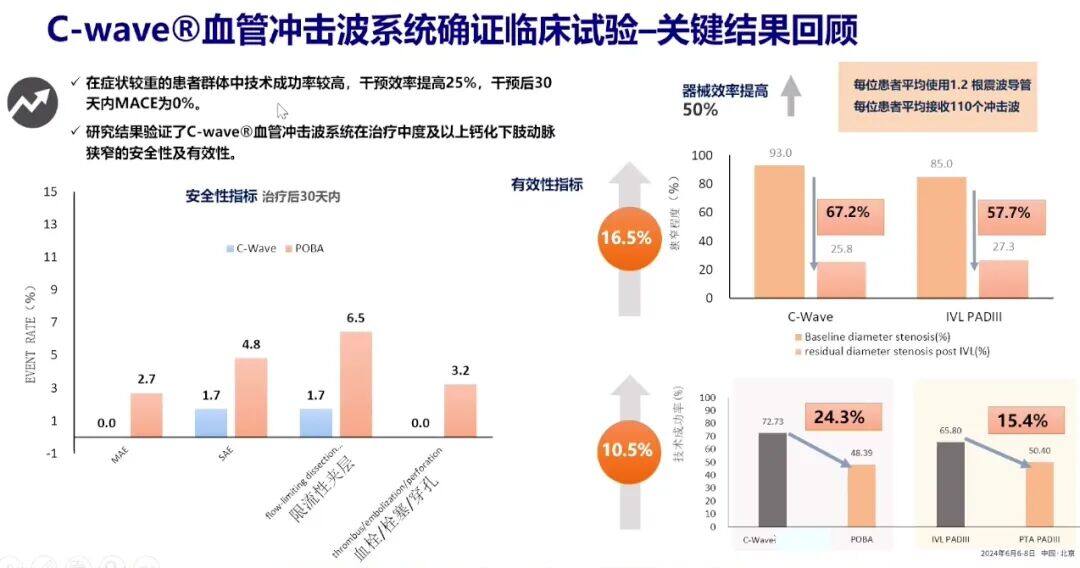
C-Wave®Real-World Study Officially Launched
August 2023, C-Wave®Approved by the National Medical Products Administration (NMPA) for marketing, it is the first domestically produced shock wave device to be launched in China and the second IVL product globally. The C-Wave CONQUER-I Trial real-world study is a prospective, multi-center, single-arm study designed to evaluate C-Wave.®Effectiveness and Safety of Intravascular Shockwave System in Treating Lower Extremity Arteriosclerosis Obliterans with Moderate or Severe Calcified Lesions in Real-World Settings: Phase I Enrollment of 300 Cases (Planned for Three Phases, Totaling 1000 Cases).
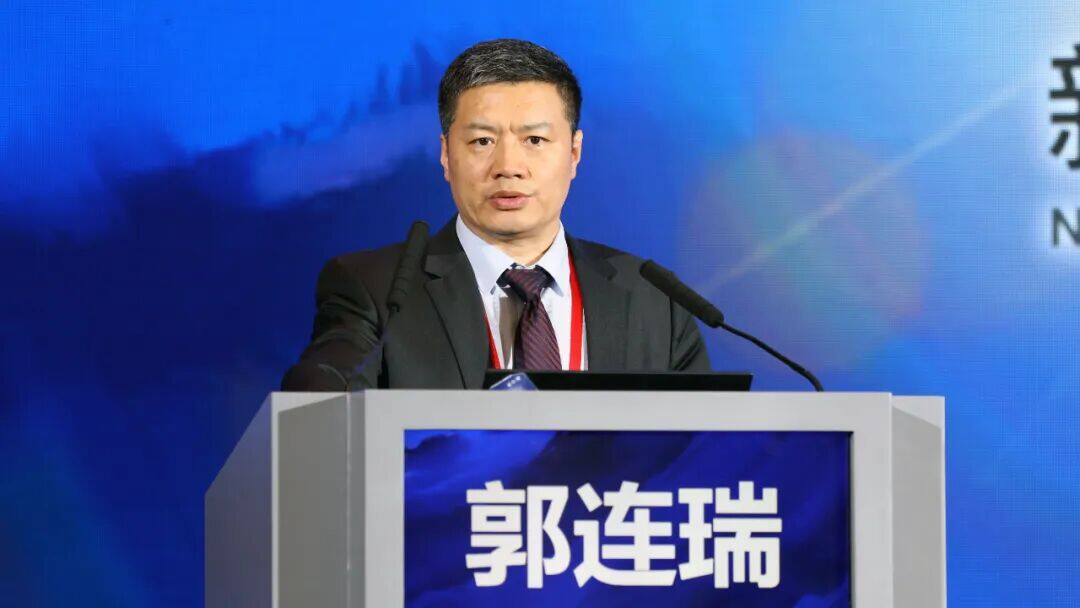
C-Wave CONQUER-I Trial Led by Professor Xiangchen Dai from Tianjin Medical University General Hospital and Professor Lianrui Guo from Xuanwu Hospital, Capital Medical University, with Participation of Over 20 Hospitals, Expected to Complete Center Initiation in September 2024 and Enroll 300 Cases by September 2025.Professor Lianrui Guo: Application of IVL in Lower Limb Arterial Calcification LesionsLower extremity arterial calcification often involves the tunica media.Epidemiological survey data of a large sample aged 30-70 show that the overall prevalence of vascular calcification is 24.39%. Histopathological studies indicate that over 60% of patients aged 60 and above with femoral-popliteal artery calcification exhibit calcification in the tunica media. Additionally, among patients with chronic limb ischemia (CLI), nearly 60% show tunica media calcification in the anterior tibial artery and posterior tibial artery. Research indicates that 97% of CLI patients experience early elastic recoil after plain old balloon angioplasty (POBA), resulting in approximately a 29% reduction in minimal lumen diameter. Up to 77% of patients may develop restenosis during long-term follow-up after endovascular treatment, which is directly related to tunica media calcification. Calcification of the tunica media reduces lumen compliance, limits adequate balloon expansion, leading to insufficient lumen preparation, complications, early elastic recoil, or restenosis.
Shockwave balloon energy can act on the middle membrane layer.Medial Calcification and Arterial Stiffness Significantly Impact the Technical Success Rate and Long-Term Outcomes of Endovascular Interventions. Currently, common methods for vessel preparation include POBA, special balloons, and debulking techniques. POBA achieves lumen gain by displacing plaque under pressure, but the lumen is not sufficiently and uniformly obtained. Postoperative elastic recoil and dissection rates are high, often necessitating rescue stent implantation. Debulking technology cannot address medial calcification and may cause excessive vascular wall injury, leading to reactive intimal hyperplasia.Shockwave technology, under low-pressure conditions, applies energy waves to the vascular wall, simultaneously affecting intimal and medial calcification, achieving plaque cracking without fragmentation. It alters lumen compliance, avoids additional injury, reduces elastic recoil, promotes DCB drug absorption, and maintains long-term efficacy.Previous foreign studies have confirmed the clinical efficacy of shock wave technology in treating calcified lesions of the superficial femoral and popliteal arteries. The results showed that IVL significantly improved the surgical success rate, reduced the incidence of ≥Type C dissections, and decreased the use of bailout stents.C-Wave®360° full-sector discharge, with uniform and stable energyC-Wave®Is China’s first domestically produced shockwave catheter system, with the world’s first 360° full-fan calcification treatment. It is suitable for pre-treatment and balloon dilation of calcified lesions (vascular stenosis >50%) in adult iliac arteries, femoral arteries, iliofemoral arteries, popliteal arteries, renal arteries, and infrapopliteal arteries. Quantitative comparative testing of its energy distribution shows that C-Wave®Full axial coverage, no axial attenuation, uniform energy, no need for alignment during surgery,全程作用于病变, facilitating the operator's manipulation.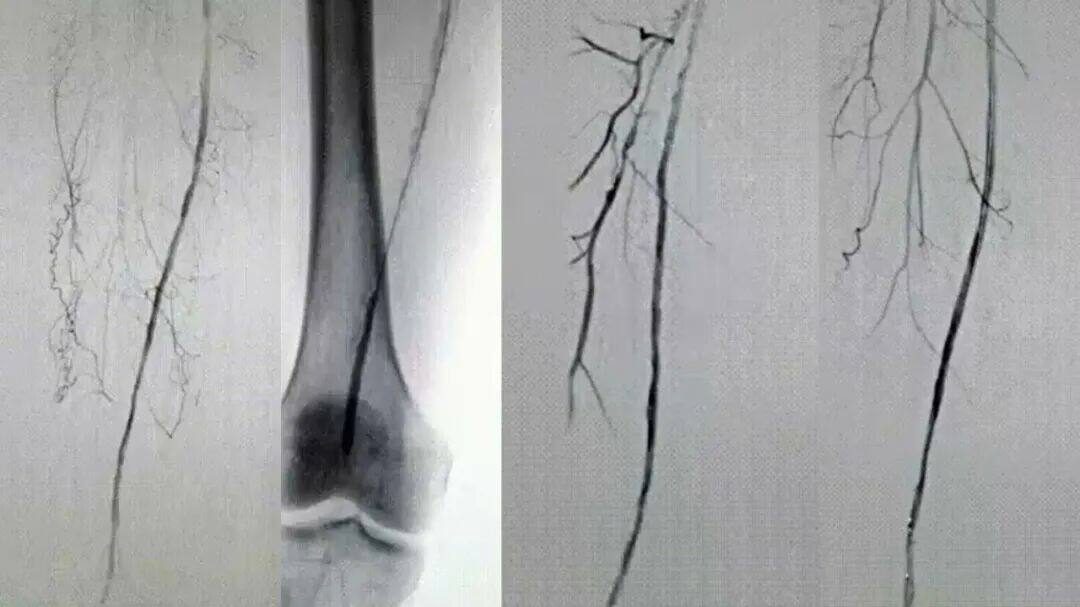 Professor Guo Lianrui also shared the "Xuanwu Experience" of using shock wave combined with DCB to treat severe calcified stenosis lesions in the superficial femoral artery.
Overall,Whether in terms of product design, or in terms of RCT study results and clinical practice efficacy, C-Wave®Both are excellent tools for preparing vessels in severe calcified lesions.C-Wave CONQUER-I Trial Real-World Study is ongoing, looking forward to more data in the future to support the efficacy of this domestically produced IVL device in lower limb vascular preparation.
Professor Dai Xiangchen and Professor Pan Hongrui: Interpretation of Multi-Center Clinical Research Plan and Quality Control Standards
During the clinical research process, the quality of clinical data is crucial to the success or failure of the entire research project and serves as the foundation for conducting clinical research work. The "C-wave CONQUER-I Trial Clinical Research Quality Objectives" and the "C-wave CONQUER-I Trial Clinical Research Quality Control Plan" are the cornerstone documents for quality control in this trial.
Professors Dai and Pan provided a detailed introduction of the procedures and quality control standards related to the implementation of multicenter clinical trials in their subsequent sharing, includingThe process of subject screening, hand-related imaging and data recording, collection of case-related data, quality control, and regular monitoring plans, etc., to ensure the reliability and authenticity of the trial data.
Experience Sharing 【In order of speaking, ranking不分先后】
Dai XiangchenProfessor: The control of research quality is crucial. From experience, incomplete and non-standard research results cannot gain sufficient recognition, nor can they be published in high-quality articles. Therefore, the C-Wave CONQUER-I Trial implemented strict quality control management and formulated the "C-wave®"Quality Objectives of the CONQUER-I Trial Clinical Study" and "Quality Control Plan for the C-wave CONQUER-I Trial Clinical Study" to ensure the smooth progress of subsequent research.
Guo MingjinProfessor: The C-Wave CONQUER-I Trial involves multiple centers, a large patient population, and is a real-world study, which means the patient conditions will be more complex, such as severe calcification, combined renal insufficiency, or the need for dialysis. From the design perspective, the C-Wave CONQUER study is very comprehensive, and subsequent attention can be paid to outcome assessment criteria, patient stratification, central laboratory evaluation, and other aspects.Wang GangProfessor: C-Wave®Pre-market studies have confirmed a high technical success rate, fewer complications, and improved surgical efficiency. The C-Wave CONQUER-I Trial real-world study will further provide evidence for clinical efficacy, while also further refining and optimizing the use of the IVL device, and expanding its indications.Luan JingyuanProfessor: The C-Wave CONQUER-I Trial protocol, after meticulous analysis and design, complies with the quality control standards for multicenter clinical research and is bound to produce high-quality research data for C-Wave.®provide strong support for clinical applications. From the current data, C-Wave®High success rate, low incidence of postoperative dissection and adverse events, does this mean that it can replace other balloons in the treatment of lower extremity arterial disease in subsequent clinical work?Dai XiangchenProfessor: Currently, severe calcification lesions in lower limb arteries account for a large proportion in clinical practice, but there is a lack of treatment methods with definitive efficacy. And C-Wave®It has unique advantages in severe calcified lesions. The energy wave acts on the calcified plaque, even reaching the middle membrane layer without damaging the intima, achieving cracking but not shattering of the calcified plaque, effectively improving vascular compliance and promoting subsequent DCB drug absorption.Guo LianruiProfessor: As Professor Dai Xiangchen said, the more obvious the degree of calcification, the C-Wave®The more prominent the advantage is. In clinical operations, if C-Wave®If the shockwave balloon can directly pass through the lesion, it should first be slowly expanded to 4 atm for pulse emission. Then, the balloon should be expanded to 6 atm and maintained at that pressure. If good lumen gain is achieved at this point, high-pressure balloon dilation may not be necessary, and a drug-coated balloon (DCB) can be used directly.Zhao LiangProfessor: Our center has accumulated over 100 cases of IVL usage experience. Regarding the C-Wave CONQUER-I Trial real-world study, our center will strictly adhere to the standards for participant screening, surgery, data recording, organization, and reporting. We look forward to this research proceeding as planned in an orderly manner, and completing the preliminary data compilation and release as soon as possible.Chen ZhiyongProfessor: Based on clinical experience, for the treatment of calcified lesions, C-Wave®Indeed, unexpected therapeutic effects can be achieved. Future research should focus on conducting patient stratification analysis to further explore C-Wave.®Efficacy in Different Types of Calcified Lesions.Shi YaxueProfessor: Our center treats a large number of hemodialysis access patients, whose lower extremity arterial disease is characterized by severe calcification, mostly involving the tunica media. The shockwave balloon provides an excellent opportunity to overcome severe calcified lesions, especially compensating for the shortcomings of other methods that cannot act on the tunica media. In October 2023, our center admitted a patient with lower extremity ASO, with severe calcified lesions involving the popliteal artery joint plane, and was treated with C-Wave.®+ Stent implantation treatment, no restenosis during follow-up to date. This successful attempt has also made us realize the unique advantages of shockwave balloon in treating calcified lesions. It is worth noting that, compared with the PACSS score, the Fanelli circumferential evaluation method can clearly show the distribution of circumferential calcification, guide clinical decision-making, and help further explore the efficacy of shockwave balloon on lesions with different calcification grades.Shen ChenyangProfessor: C-Wave®As a tool for vascular preparation, its advantages in severe calcified lesions are commendable. In subsequent clinical studies, we should focus more on its performance in handling calcified lesions, with an emphasis on collecting efficacy data for different grades of calcified lesions. Of course, the design of the C-Wave CONQUER-I Trial is very meticulous and meets standards, and we hope to obtain more high-quality evidence-based data.Xiaoming ShiProfessor: The real-world research data from the C-Wave CONQUER-I Trial is very important for expanding indications. Only if the preliminary results are good can we have the confidence to proceed with more subsequent and refined studies. Therefore, in the first phase, we can focus on specific segments, such as the planned femoropopliteal artery segment, and then expand the indications later to obtain more data.Wu MengtaoProfessor:Recently, we used C-Wave®Successfully treated multiple cases of severe calcified lesions in the distal superficial femoral artery and popliteal artery, achieving favorable clinical outcomes. This genuine clinical experience has strengthened my confidence in the C-Wave CONQUER-I Trial. C-Wave®The total number of balloon pulses is 300. During use, we can adjust the discharge position based on the condition of the lumen and the expansion of the shockwave balloon. The vast majority of patients require only one catheter to complete the procedure.Hao LiangyuProfessor: C-Wave®The admission procedures have been completed at our hospital. In the subsequent development of the C-Wave CONQUER study, our center will strictly adhere to the standards for enrollment, surgery, and other tasks to ensure the study proceeds in an orderly manner.DongHealthProfessor: Currently, the application of shockwave balloons still lacks evidence-based medical evidence for the Chinese population. The C-Wave CONQUER Trial is expected to enroll 1,000 patients in its third phase, undoubtedly filling this gap. Moreover, the C-Wave CONQUER study is meticulously designed, covering multiple centers and a wide range of patients. As subsequent analysis data from subgroups with varying degrees of calcified lesions, different segments such as femoral-popliteal and infrapopliteal arteries, and subgroups with primary and restenosis cases are released, it will undoubtedly further refine the application of shockwave balloons in lower extremity arterial diseases while providing high-quality evidence-based medical data more aligned with the conditions of the Chinese population.