Lilly's Nasal Glucagon Baqsimi Approved in China for Severe Hypoglycemia, Targeting 140 Million Diabetic Patients
Eli Lilly
Global Pharmaceutical R&D and Production Company
New Nasal Spray for Severe Hypoglycemia Approved for Marketing in China, Global Sales Exceeded 4.9 Billion Yuan Last Year.
1. Over 140 Million Diabetes Patients Have Potential Needs
New Drug for Severe Hypoglycemia Approved for Marketing in China
According to information from the National Medical Products Administration on June 12, nearly two years after being accepted by the CDE, Eli Lilly's Glucagon Nasal Powder (Baqsimi) was recently approved for marketing in China. It is indicated for the treatment of severe hypoglycemia in patients with diabetes aged 4 years and older.
Baqsimi is the world's first non-injectable glucagon therapy for the treatment of severe hypoglycemia, approved by the FDA in July 2019 for the emergency treatment of severe hypoglycemia in diabetic patients aged 4 years and older.
In a healthy human body, the first response to a drop in blood glucose levels within the normal range is the inhibition of insulin secretion. When blood glucose levels fall below the normal range, the body releases glucagon; as glucose continues to decrease, the body will also release adrenaline, cortisol, and growth hormone to further maintain blood glucose levels.
Patients with diabetes are more prone to hypoglycemic events due to the impaired regulatory function mentioned above. Baqsimi and other glucagon products stimulate the liver to release stored glucose into the bloodstream, thereby increasing the patient's blood glucose level.
Hypoglycemia is one of the most common acute complications of diabetes, and even patients who are able to continuously monitor their blood glucose levels cannot completely prevent severe hypoglycemic events.
Compared with patients who did not experience severe hypoglycemia, patients with type 2 diabetes who experienced severe hypoglycemia had an increased risk of heart failure and atherosclerotic cardiovascular disease, as well as an increased risk of all-cause mortality and transient ischemic attack.
Moreover, recurrent hypoglycemia may exacerbate cerebral ischemic injury in patients and affect their immune response, among other issues.
The "IDF2021 Global Diabetes Atlas" released by the International Diabetes Federation shows that the number of adult diabetes patients in China has exceeded 140 million, of which about 40 million patients require lifelong dependence on insulin injection therapy. Severe hypoglycemia can occur in any diabetes patient, especially those receiving hypoglycemic treatments such as insulin or insulin secretagogues.
A study mentioned by the research team at the Leicester Diabetes Centre in the UK showed that among the 53,000-plus patients with type 2 diabetes included, nearly half had experienced mild hypoglycemic events, and 6% had experienced severe hypoglycemic events. The frequency of mild hypoglycemia was 19 episodes per person per year, while the frequency of severe hypoglycemia was 0.8 episodes per person per year.
The literature mentions that among insulin users, the prevalence of mild hypoglycemia is 50%, with an occurrence frequency of 23 times per person per year, while the prevalence of severe hypoglycemia is 21%, with an occurrence frequency of 1 time per person per year.
In the SAGE study, the proportions of patients with type 1 diabetes experiencing level 1, level 2, and severe hypoglycemia were 67.7%, 49.9%, and 11.9%, respectively; the HYPOS-1 study showed that the incidence of symptomatic hypoglycemia in patients with type 1 diabetes was 53.3 episodes per person per year, and the incidence of severe hypoglycemia was 0.49 episodes per person per year.
2, 30-Second Nasal Spray Administration
Meet certain out-of-hospital emergency needs
The CRASH study found that 80% to 87% of severe hypoglycemic events occur at home, and current treatment methods, such as intravenous glucose infusion, require professional medical personnel for rescue.
Statistics show that in China, the average time for patients experiencing severe hypoglycemia to receive assistance is 2.6 hours, and the success rate of out-of-hospital emergency treatment is only 29.7%. Based on this, preventive and therapeutic interventions for hypoglycemia are receiving increasing attention.
In addition to Baqsimi, several products for severe hypoglycemia have been approved worldwide, including Novo Nordisk's GlucaGen, Xeris Pharmaceuticals' Gvoke, and Zealand Pharma's Zegalogue (dasiglucagon).
Among them, Novo Nordisk's GlucaGen is a lyophilized glucagon formulation. Due to its low solubility, it needs to be reconstituted into a solution before use.
Xeris Pharmaceuticals' Gvoke is an immediately usable, room-temperature stable glucagon formulation administered via pre-filled syringe or auto-injector. In September 2019, it was approved by the FDA for the treatment of severe hypoglycemia in pediatric patients aged 2 years and older and adults with diabetes.
Zealand Pharma's Zegalogue is a first-of-its-kind water-soluble glucagon analog, preloaded in an emergency pen for subcutaneous injection. In March 2021, it was approved by the FDA for the treatment of severe hypoglycemia in pediatric and adult diabetes patients aged 6 years and older.
An article in the Chinese Journal of Endocrinology and Metabolism stated that continuous glucose monitoring technology and a new glucagon nasal powder inhaler have shown positive effects in the management of hypoglycemia.
Compared with subcutaneous and parenteral treatments, the administration process of intranasal glucagon powder is significantly simplified.
Taking Baqsimi as an example, it can be passively absorbed through the patient's nasal mucosa in the emergency treatment of severe hypoglycemia, without requiring the patient to inhale. At the same time, the person administering the drug does not need to master professional techniques and can complete the administration within 30 seconds, with a success rate of over 90%.
Compared with traditional glucagon injections, Baqsimi carries a relatively lower risk of causing secondary hyperglycemia (blood glucose exceeding 10 mmol/L one hour after administration). Additionally, this medication has the advantages of being compact in size, storable at room temperature, portable, having a fixed single-dose administration, and not requiring reconstitution.
In April last year, Eli Lilly sold the global rights of Baqsimi to Amphastar. Amphastar will pay Eli Lilly $500 million in cash upon the completion of the transaction and another $125 million on the first anniversary of the completion. In addition, Eli Lilly is also eligible to receive sales milestone payments totaling up to $450 million.
Eli Lilly's annual report shows that Baqsimi's global sales in 2023 exceeded $677 million (approximately RMB 4.9 billion at the current exchange rate), with sales in the United States reaching nearly $646 million, accounting for 95% of total sales.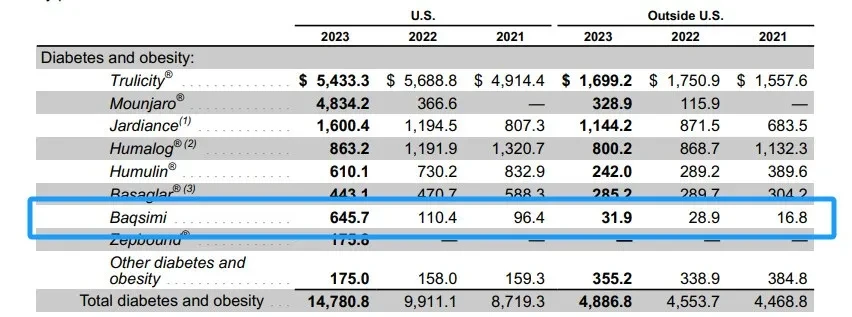

Editor: Baiji
Disclaimer: This article is a reprint from Yaozhi.com. The images and text are the original property of their respective owners. The purpose of the reprint is to convey more information and does not represent the views of this platform. If there are any issues regarding content, copyright, or other matters, please leave a message on this platform, and we will address it promptly.