

Roche's Bispecific Antibody Columvi Nearly Doubles Overall Survival in Phase 3 Trial for Relapsed/Refractory DLBCL

Roche
Oncology Drug Research, Development, and Manufacturing
▎WuXiEdited by Kant Content Team
Roche Presents Detailed Results of Phase III STARGLO Trial at EHA Conference. Analysis shows that, compared with the active control drug,Patients with relapsed or refractory (R/R) diffuse large B-cell lymphoma (DLBCL) treated with Roche's bispecific antibody Columvi (glofitamab) in combination with gemcitabine and oxaliplatin showed statistically significant and clinically meaningful benefits in overall survival (OS), progression-free survival (PFS), and complete response (CR) rate.Industry media Endpoints News pointed out that the trial data will be submitted to regulatory authorities as the basis for glofitamab's expanded indication application. According to the abstract,Glofitamab is the first CD3 x CD20-targeted bispecific antibody to demonstrate survival benefits in DLBCL in a randomized Phase 3 trial.
Malignant lymphoma is divided into Hodgkin lymphoma (HL) and non-Hodgkin lymphoma (NHL). Large B-cell lymphoma is a type of NHL, which includes DLBCL, marginal zone lymphoma (MZL), primary mediastinal large B-cell lymphoma (PMBCL), and grade 3B follicular lymphoma (FL3B), among others.Among them, DLBCL is the most common, with an annual average of 5.6 people per 100,000 diagnosed with diffuse large B-cell lymphoma., with an average of 1.8 deaths per 100,000 people from this cancer.
STARGLO is a multicenter, open-label, randomized Phase 3 study designed to evaluate the efficacy and safety of glofitamab in combination with gemcitabine plus oxaliplatin (Glofit-GemOx) compared to rituximab combined with gemcitabine plus oxaliplatin (R-GemOx) in patients with DLBCL who have received at least one prior line of therapy and are ineligible for autologous stem cell transplantation. A total of 274 patients with DLBCL were enrolled and randomly assigned in a 2:1 ratio to receive Glofit-GemOx (8 cycles, plus 4 additional cycles of glofitamab monotherapy, n=183) or R-GemOx (8 cycles, n=91), stratified by the number of prior treatments (1 vs ≥2) and resistance to the last treatment. The primary endpoint was OS. Secondary endpoints included PFS assessed by an Independent Review Committee (IRC) and CR rate.
Preliminary analysis as of March 29, 2023, shows,Glofit-GemOx demonstrated a significant OS advantage compared to the active control drug (HR: 0.59, 95% CI: 0.40–0.89, p=0.011).The median follow-up time was 11.3 months. The median OS for Glofit-GemOx was not reached (95% CI: 13.8–not evaluable), while it was 9 months for the active control group (95% CI: 7.3–14.4).In the IRC-assessed PFS (HR: 0.37, 95% CI: 0.25-0.55, p<0.0001) and CR rate (50.3% vs 22.0%, 95% CI: 16.3-40.3, p<0.0001), a significant advantage of Glofit-GemOx was also observed.
Follow-up analysis was conducted after all patients completed their treatment. As of February 16, 2024,The median follow-up time was 20.7 months, Glofit-GemOx continued to show superior median OS (25.5 vs 12.9 months, HR: 0.62, 95% CI: 0.43–0.88), median PFS (13.8 vs 3.6 months, HR: 0.40, 95% CI: 0.28–0.57), and CR rate (58.5 vs 25.3%) compared to the active control group.
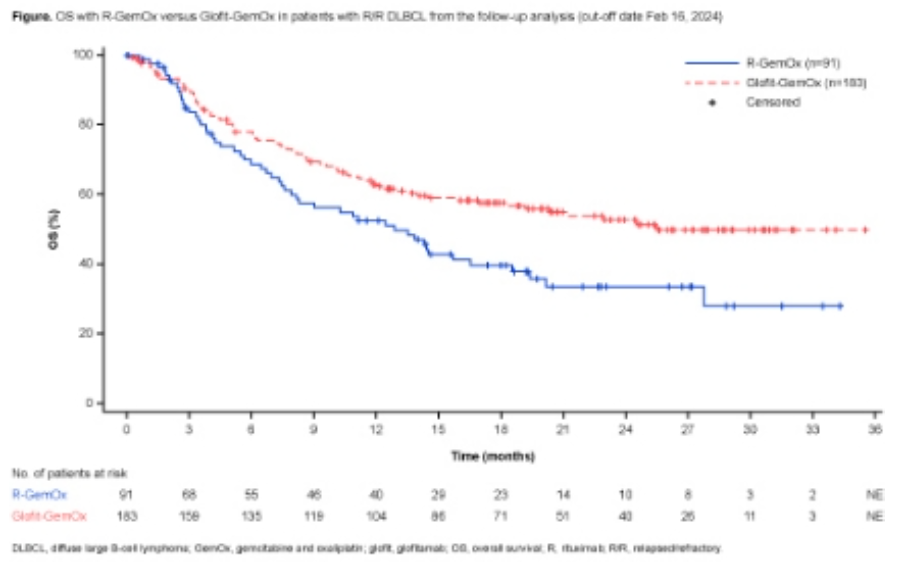
▲As of February 16, 2024, Glofit-GemOx continues to demonstrate superior OS benefits compared to active control drugs (Image source: Reference [1])
Glofit-GemOx demonstrated good tolerability, with safety consistent with the known risks of each drug. As the median number of treatment cycles in the Glofit-GemOx group was higher than that in the active control group (11 vs 4), after adjusting for differences in patient drug exposure, the incidence of adverse events (AE) was similar between the two groups. Among patients receiving glofitamab, cytokine release syndrome (CRS) was the most reported AE (Grade 1: 31.4%, Grade 2).Level:10.5%,3Level:2.3%)。
Glofitamab is a bispecific antibody that can simultaneously target CD3 and CD20.This T-cell-engaging bispecific antibody features an innovative 2:1 structural format, comprising one protein domain targeting the CD3 protein on the surface of T cells and two protein domains binding to the CD20 protein on the surface of B cells. This dual-targeting strategy brings T cells in proximity to B cells and activates T cells to release cancer cell-killing proteins.
According to the press release, glofitamab is the first to receive U.S. FDAAccelerated ApprovalBispecific Antibody with Conditional Marketing Authorization from the European Commission for Fixed-Duration Treatment, for the treatment of R/R DLBCL patients who have received two or more lines of systemic therapy. This approval is based on the positive results achieved by glofitamab as a monotherapy in the pivotal Phase 1/2 study NP30179. The analysis shows,Patients achieved durable remission after glofitamab treatment, with an overall response rate of 56%, a complete response rate of 43%, and a median duration of response of 1.5 years.
Another bispecific antibody targeting CD3 x CD20 available on the market is Epkinly (epcoritamab), jointly developed by AbbVie and Genmab. This therapy received approval from the U.S. FDA in May of last year.Accelerated ApprovalTreatment of R/R DLBCL patients, including DLBCL developed from indolent lymphoma and high-grade B-cell lymphoma (HGBL), who have received more than two systemic therapies.The press release noted that this is the first bispecific antibody therapy approved by the FDA for the treatment of DLBCL patients, and the therapy is also considered by the industry media Evalute to be potentiallyHeavyweight TherapyOne of.In February this year, the two companies announced that the FDA had accepted the supplemental Biologics License Application (sBLA) for epcoritamab and grantedPriority Review Status, for the treatment of adult patients with R/R follicular lymphoma (FL) who have received two or more prior systemic therapies. The PDUFA target date for this application is June 28, 2024.
In addition to bispecific antibodies, antibody-drug conjugates (ADCs) are also gradually showing importance in the treatment of DLBCL.Pfizer announced its CD30-targeted ADC therapy in March this yearAdcetris(Brentuximab vedotin) significantly improved OS in R/R DLBCL patients compared to the active control group in a phase 3 trial. In April 2023, Roche's CD79b-targeted ADC therapyPolivy(Polatuzumab vedotin) has been approved by the FDA for use in combination with rituximab plus cyclophosphamide, doxorubicin, and prednisone (R-CHP) as a first-line treatment for patients with DLBCL.The press release noted that Polivy combination is the first new therapy approved by the FDA for the first-line treatment of DLBCL in nearly 20 years.

▲To learn more about the application of cutting-edge technologies in the biopharmaceutical industry, please long-press and scan the QR code above to access "WuXi Live Studio" and watch live discussions and exciting replays on related topics.
References:
[1] GLOFITAMAB PLUS GEMCITABINE AND OXALIPLATIN (GLOFIT-GEMOX) FOR RELAPSED/REFRACTORY (R/R) DIFFUSE LARGE B-CELL LYMPHOMA (DLBCL): RESULTS OF A GLOBAL RANDOMIZED PHASE III TRIAL (STARGLO). Retrieved June 14, 2024 from https://library.ehaweb.org/eha/2024/eha2024-congress/4136516/jeremy.abramson.glofitamab.plus.gemcitabine.and.oxaliplatin.28glofit-gemox29.for.html?f=listing%3D0%2Abrowseby%3D8%2Asortby%3D1%2Asearch%3Dglofit-gemox
[2] Roche details Columvi OS data in quest for expanded lymphoma approval. Retrieved June 14, 2024 from https://endpts.com/eha24-roche-details-overall-survival-data-on-bispecific-antibody-columvi/
[3] Roche’s Columvi meets primary endpoint of overall survival in people with relapsed or refractory diffuse large B-cell lymphoma in Phase III STARGLO study. Retrieved June 14, 2024 from https://www.roche.com/media/releases/med-cor-2024-04-15
Disclaimer: The content team of WuXi AppTec focuses on introducing the research progress in global biopharmaceuticals and health. This article is for information exchange only, and the views expressed in the article do not represent the position of WuXi AppTec, nor does it imply that WuXi AppTec supports or opposes these views. This article is not a recommendation for treatment plans. For guidance on treatment options, please visit a正规 hospital.
Copyright Statement: This article is from the WuXi AppTec content team. Individuals are welcome to share it on their social media circles, but unauthorized reproduction by media or institutions in any form to other platforms is prohibited. For authorization to reproduce, please reply with "reprint" on the "WuXi AppTec" WeChat Official Account to obtain reprint guidelines.


Share,PointLike,In view, Focus on Global Biomedical Health Innovation