AstraZeneca's Tagrisso Receives FDA Priority Review for Unresectable Stage III EGFR-Mutated NSCLC, as Johnson & Johnson Challenges with Rybrevant

AstraZeneca
Pharmaceutical Technology Research and Development Provider

Johnson & Johnson
Healthcare Product Manufacturers, Health Service Providers
Adult patients with EGFR-mutated non-small cell lung cancer (NSCLC) may welcome a "potential new treatment standard."
Recently, AstraZeneca announced that the supplemental New Drug Application (sNDA) for its epidermal growth factor receptor (EGFR) tyrosine kinase inhibitor (TKI) Tagrisso (osimertinib) has been accepted by the U.S. FDA and granted Priority Review designation for the treatment of adult patients with unresectable Stage III epidermal growth factor receptor-mutated (EGFRm) non-small cell lung cancer (NSCLC) who have received chemoradiation therapy (CRT).
If approved, Tagrisso will be indicated for EGFRm patients whose tumors have exon 19 deletions or exon 21 (L858R) mutations. The FDA is expected to complete its regulatory review in the fourth quarter of 2024.
It is worth mentioning that the FDA had previously approved two indications for osimertinib in the treatment of EGFR-mutated advanced NSCLC: first-line treatment for EGFR-mutated advanced NSCLC, adjuvant treatment for EGFR, and T790M resistance treatment. These indications have been recommended by the NCCN guidelines (version 2024 V2 and later) and the CSCO guidelines (2024 edition), further demonstrating the significant role of osimertinib in the treatment of EGFR-mutated advanced NSCLC.
FDA Grants Tagrisso Priority Review Based on Results from the LAURA Phase 3 Clinical Trial. Detailed results were recently presented at the American Society of Clinical Oncology (ASCO) Annual Meeting and simultaneously published in The New England Journal of Medicine.

New Model for Maintenance Treatment of Advanced Lung Cancer?

Lung cancer is one of the leading causes of cancer-related deaths in humans, accounting for approximately one-fifth of all cancer deaths. Non-small cell lung cancer (NSCLC) is the most common type of lung cancer, and the majority of NSCLC patients are diagnosed at an advanced stage. Among these, patients with EGFR mutations are particularly sensitive to epidermal growth factor receptor tyrosine kinase inhibitors (EGFR-TKIs).
Tagrisso, as an EGFR-TKI, blocks the cell signaling pathways that promote tumor cell growth and has demonstrated clear clinical activity in the treatment of non-small cell lung cancer patients.
LAURA Study is a randomized, double-blind, placebo-controlled, global multicenter Phase III trial. The participants are patients with unresectable Stage III EGFRm NSCLC whose disease has not progressed after receiving platinum-based CRT. Patients receive once-daily oral doses of 80 mg Tagrisso until disease progression, unacceptable toxicity, or meeting other discontinuation criteria.
Results assessed by the Blinded Independent Central Review (BICR) showed that, compared with placebo, Tagrisso reduced the risk of disease progression or death by 84% (HR=0.16; 95% CI: 0.10-0.24; p<0.001). The median PFS for patients treated with Tagrisso was 39.1 months, compared to 5.6 months in the placebo group. The proportion of patients alive and progression-free at 12 months was 74% (95% CI: 65-80) in the Tagrisso group versus 22% (95% CI: 13-32) in the placebo group. Notably, a clinically meaningful PFS benefit was observed across all pre-specified subgroups, including gender, race, EGFR mutation type, age, smoking history, and prior CRT.
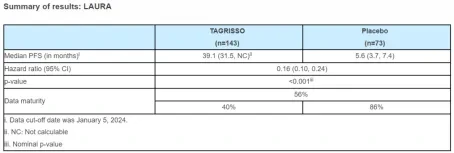
Summary of Efficacy Results from the LAURA Trial
Patients in the Tagrisso group also showed a favorable trend in overall survival. The overall survival rates at 36 months were 84% (95% CI: 75-89) for the Tagrisso group and 74% (95% CI: 57-85) for the placebo group, though this did not reach statistical significance (HR=0.81, 95% CI: 0.42-1.56; p=0.53). However, the data were not yet mature at the time of analysis (data maturity 20%), and the trial will continue to evaluate changes in the secondary endpoint OS.
Safety results and discontinuation rates due to adverse events were as expected, with no new safety issues identified. Among patients in the Tagrisso group and placebo group, 35% and 12%, respectively, experienced grade 3 or higher adverse events caused by various reasons.
Tagrisso is a third-generation, irreversible EGFR-TKI that has been clinically proven effective for NSCLC. The approved indications for Tagrisso include first-line treatment for locally advanced or metastatic EGFRm NSCLC, first-line treatment for locally advanced or metastatic EGFR T790M mutation-positive NSCLC, and adjuvant treatment for early-stage (IB, II, and IIIA) EGFRm NSCLC.
In August 2023, Tagrisso in combination with chemotherapy received Breakthrough Therapy Designation from the U.S. FDA for the first-line treatment of adult patients with locally advanced or metastatic EGFRm NSCLC. In February this year, Tagrisso in combination with chemotherapy was approved by the FDA for the treatment of adult patients with locally advanced or metastatic EGFR-mutated non-small cell lung cancer.
Notably, at the 2024 American Society of Clinical Oncology (ASCO) Annual Meeting, the LAURA research findings were presented in a "Plenary Session (Late-Breaking Abstract)" report, sparking widespread discussion and receiving acclaim from experts in the global oncology field. The publication of this research marks a successful advancement in the targeted treatment model for patients with Stage III unresectable non-small cell lung cancer, potentially reshaping future treatment paradigms. Moving forward, the LAURA study will further explore extending patients' overall survival and the effectiveness of treating metastatic lesions.

Johnson & Johnson "Challenges" AstraZeneca

The efficacy of the new generation of TKIs in the central nervous system has reached unprecedented levels, providing excellent systemic treatment options for brain metastases in certain subtypes of NSCLC patients. These drugs include targeted therapies for classical EGFR mutations (osimertinib), ALK rearrangements (alectinib, brigatinib, and lorlatinib), RET rearrangements (selpercatinib), and ROS1 or NTRK rearrangements (entrectinib), with central nervous system objective response rates (ORR) reaching or exceeding 80% across each patient population.
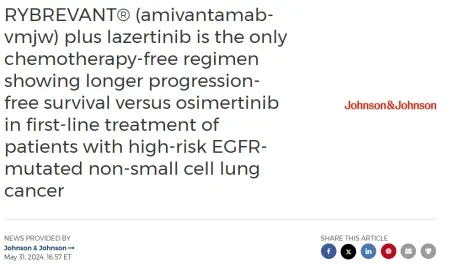
Drug development is a high-risk endeavor with a nine-to-one failure rate. In the post-Osimertinib era, the vast market potential has attracted countless companies to take up the challenge despite fierce competition. Among them, Johnson & Johnson is attempting to challenge Tagrisso's dominance in EGFR-mutant lung cancer with its antibody therapy, Rybrevant.
Early June, Johnson & Johnson presented new data on the injectable version of Rybrevant combined with lazertinib, showing it to be comparable to the approved intravenous version. While intravenous infusion requires several hours and a visit to a medical facility, the injection takes only a few minutes. An exploratory finding from the study showed that, compared to intravenous administration, the injectable version reduced the risk of death by 38%. A year later, 65% of patients receiving the injectable Rybrevant plus lazertinib were still alive, compared to 51% for those on intravenous Rybrevant plus lazertinib.
This may be related to the mechanism of action of the injectable version of the drug, said Mark Wildgust, Vice President of Global Medical Affairs for Oncology at Johnson & Johnson: The injectable version is absorbed through the lymphatic system and presented to the immune system in a way that is completely different from intravenous injection. Subcutaneous injection of Rybrevant may further stimulate the immune mechanism.
Currently, in China, four third-generation EGFR-TKIs have been launched: Furmonertinib, Aumolertinib, Osimertinib, and Befotertinib. Compared with first/second-generation EGFR-TKIs, third-generation EGFR-TKIs can overcome the T790M resistance mutation caused by the earlier generations, and they are better able to penetrate the blood-brain barrier to enter brain tissue, addressing the higher probability of brain metastasis in patients with EGFR mutations. This provides patients with longer progression-free survival (PFS) and overall survival (OS) benefits.
In summary, although it is inevitable for non-small cell lung cancer (NSCLC) patients to encounter the issue of targeted drug resistance, continuous research will bring more treatment options for lung cancer patients, significantly extending their survival period.