Four Chinese Pharmaceutical Companies Ranked in 2024 Global Top 50 Pharma List
Johnson & Johnson
Medical Device R&D and Manufacturer

June 14,Pharmaceutical Executive in the United StatesPharm ExecReleased the 2024 Global Top 50 Pharmaceutical Companies list。
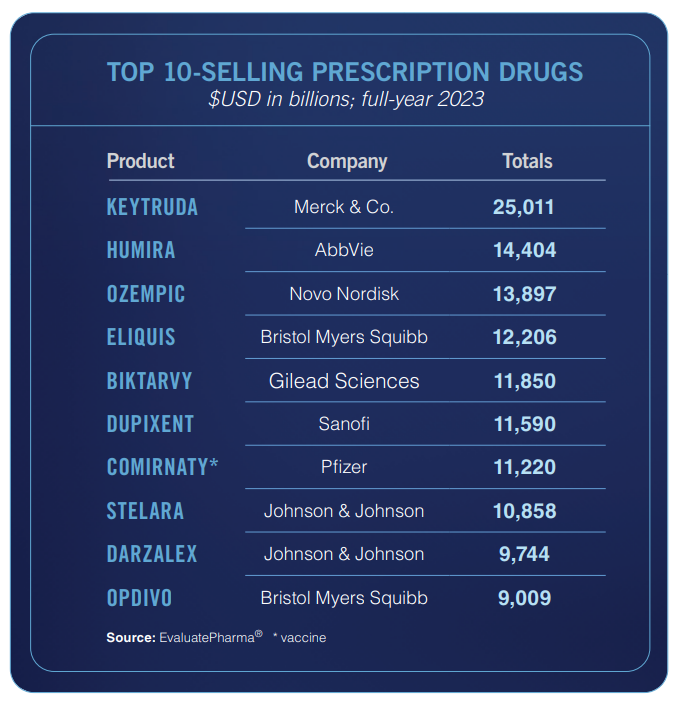
Taking the "Pharm Exec 50" as an example, this is the latest ranking based on the global pharmaceutical companies' prescription drug sales, covering the pharmaceutical revenue data for the entire year of 2023. Provided by Evaluate, these figures once again demonstrate the strength and stability of large pharmaceutical companies. Nevertheless, the top 50 companies in the pharmaceutical industry are facing some extraordinary challenges and changes.
Whether they are long-established innovative companies or newly-minted industry giants, each company is addressing current challenges in its own way, including policy-related issues (such as the Inflation Reduction Act and drug pricing scrutiny), economic pressures (patent expirations and biosimilar competition), operational disruptions (supply chain interruptions and global instability), and regulatory demands (digital transformation and compliance issues). In response, these enterprises have adopted various strategic measures such as mergers and layoffs, product portfolio restructuring, brand expansion, mergers and acquisitions, and product licensing applications.
Despite the pharmaceutical industry’s continued prominence, a deeper analysis of these underlying drivers and trends reveals that the industry is undergoing significant changes. This may pose an unlikely yet real challenge to the age-old adage — "The more things change, the more they stay the same."
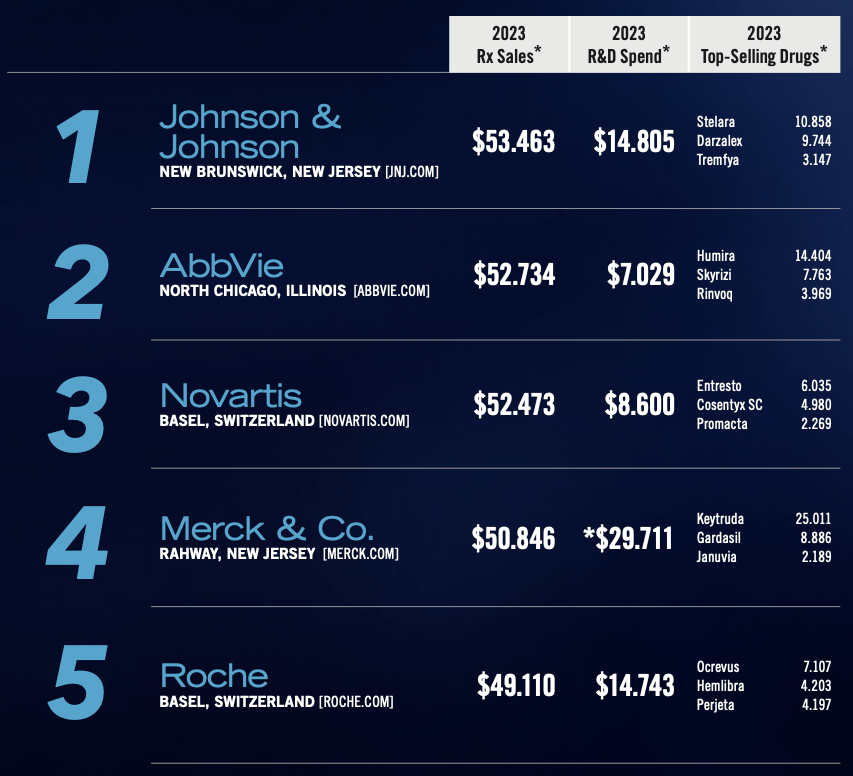
As the demand for COVID-19 vaccines and treatments sharply declined, Pfizer's prescription drug revenue in 2023 dropped by 47.2% year-over-year. Although its mRNA vaccine Comirnaty maintained stable sales of $11.2 billion, it still fell by 70.3% compared to the previous year. Additionally, Pfizer’s antiviral drug Paxlovid (Nirmatrelvir Tablets/Ritonavir Tablets Combination Pack), which generated $18.93 billion in sales in 2022, also experienced a significant decline. This caused Pfizer to fall to sixth place in this year's pharmaceutical company rankings.
Meanwhile, Johnson & Johnson topped the list after surpassing Pfizer with a robustly diversified portfolio, achieving prescription drug sales of $53.46 billion. AbbVie followed again in second place with $52.73 billion in sales, despite a 6.1% drop in its stock price, reflecting the impact of Humira biosimilar introductions in the U.S. market on its performance.
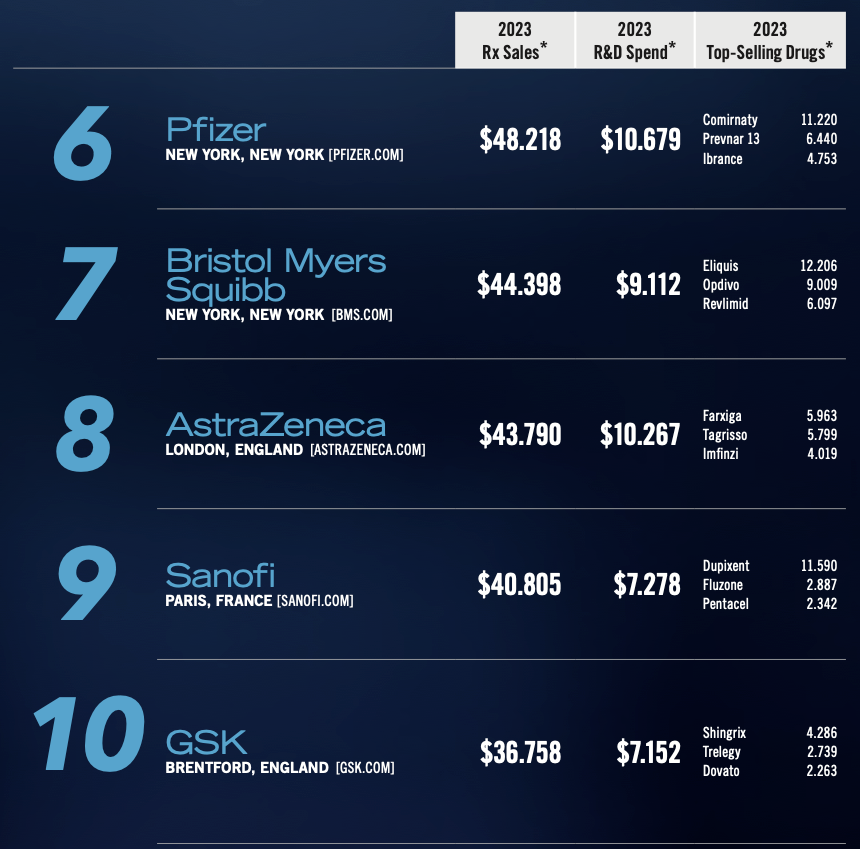
Novartis Achieves 4.8% Growth in 2023, Rising One Rank from the Previous Year; Merck Also Sees 2.5% Overall Growth, with Its PD-1 Antibody Keytruda (Approved for 17 Cancers) Sales Increasing by 19.5%, Successfully Surpassing Humira to Become the Leader in Prescription Drug Sales. Roche Ranks Fifth with a 2.5% Increase, While Bristol-Myers Squibb Follows Pfizer with a Slight 2.2% Decline in Prescription Revenue; AstraZeneca Ranks Eighth with a 1.8% Increase; Sanofi Grows by 1.1%, and GlaxoSmithKline Falls by 3.9%, Both Companies Are in the Top Ten.
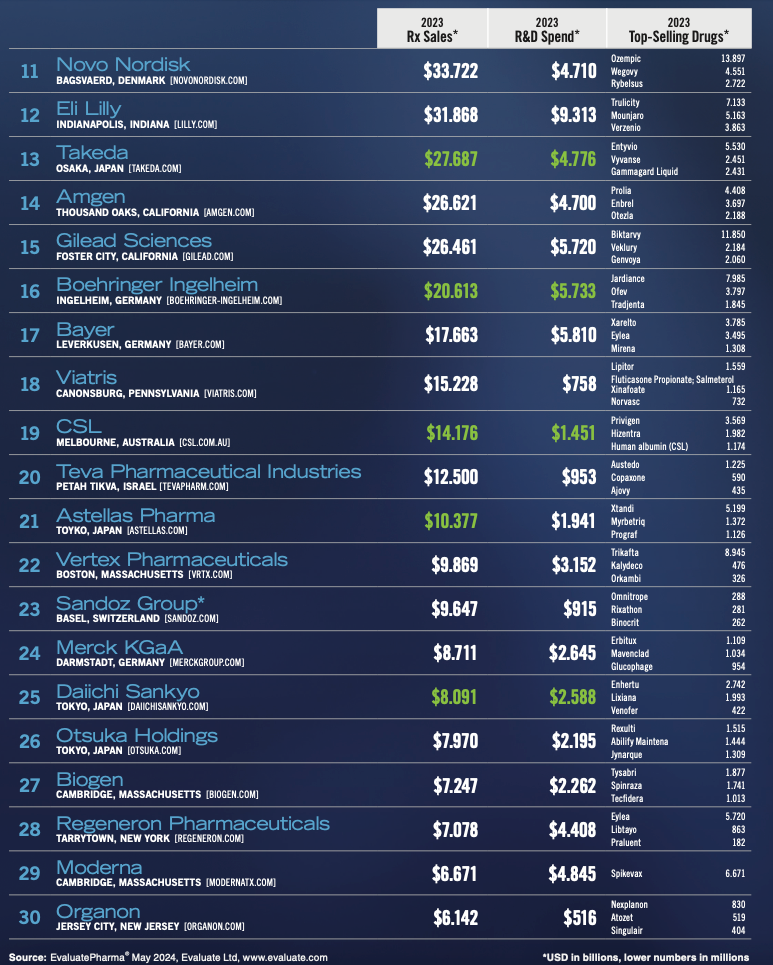
In the GLP-1 drug field, Novo Nordisk and Eli Lilly have engaged in fierce competition, especially in the area of weight-loss indications, which has recently drawn attention from the U.S. and other countries. Novo Nordisk, with a 32.8% surge in prescription drug sales reaching $33.7 billion, climbed from 13th to 11th place. Its product Ozenpic (semaglutide), although approved for treating type 2 diabetes, is often used off-label for obesity treatment, successfully entering a scarce market worth billions of dollars, with prescription sales growing by 62.1% to $13.9 billion. Additionally, Eli Lilly's Wegovy (high-dose semaglutide), approved for weight loss since June 2021, generated revenue of $4.55 billion in 2023.
Despite LillyThe company was surpassed by Novo Nordisk in the rankings, but its performance remained strong, climbing one spot to reach 12th place on the list, with sales soaring 25.2% year-on-year to $31.9 billion. Its GLP-1 drug Mounjaro (tirzepatide), which received FDA approval in May 2022 for diabetes treatment and was later approved in November 2023 for weight loss under the brand name Zepbound, achieved $5.2 billion in sales in its first year on the market, quickly becoming Eli Lilly's second best-selling product. According to Evaluate, tirzepatide’s total sales are projected to reach $17 billion by 2028.
Despite challenges in access, reimbursement, and supply, the rapid growth and success of Wegovy and Zepbound in the weight-loss field have been widely recognized. This phenomenon is quite similar to the rise of the PD-1 immunotherapies Keytruda and Opdivo in 2014, when the two rivals jointly drove the development of immunotherapy. Keytruda later stood out, while Opdivo achieved sales of $9.1 billion in 2023. GLP-1 drugs are expected to replicate this successful trajectory.
Moreover, the potential of these two drugs in a variety of other indications, including respiratory diseases, heart failure, and sleep apnea, as well as the development prospects of the next generation of GLP-1 agonists, are highly anticipated. According to predictions by some experts, the global sales of these two treatments may reach 150 billion US dollars by the early 2030s. Meanwhile, collaboration and transaction activities in the GLP-1 field are also becoming increasingly active.
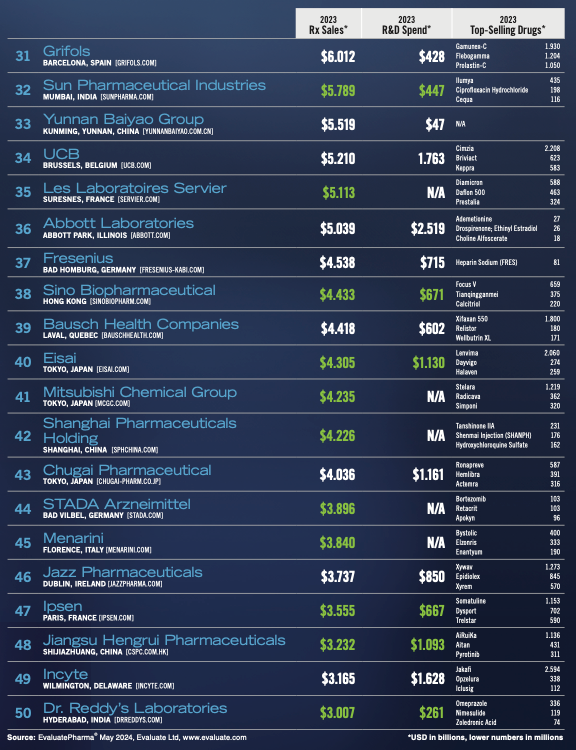
In the latest ranking of pharmaceutical companies, the performance of Chinese pharmaceutical enterprises is remarkable. Yunnan Baiyao ranked 33rd with steady performance. China Biologic Products Holdings, Inc. rose one place to reach 38th due to its continuous growth. Shanghai Pharmaceuticals also showed a good momentum of development, climbing from 41st to 42nd. However, Hengrui Medicine's ranking slightly declined this year, dropping from 43rd to 48th. Notably, CSPC Pharmaceutical Group, which was on the list last year, did not make it into the rankings this year.