

Pfizer and Flagship Pioneering Launch Multi-Billion-Dollar Collaboration to Develop Novel Anti-Obesity Therapies

Pfizer
Pharmaceutical R&D Developer

Flagship Pioneering
Venture Capital Firms
On June 12, 2024, local time, Pfizer and Flagship Pioneering (hereinafter referred to as Flagship) announced that they had identified the first target of their multi-billion-dollar, multi-project collaboration: the New York pharmaceutical giant will partner with Flagship to develop novel weight-loss drugs. The financial details of this collaboration have not been disclosed.
The determination of this goal is based on a collaboration reached by both parties in July 2023. According to the terms of the agreement, Pfizer and Flagship will each provide an upfront investment of $50 million. Through this collaboration, Pfizer will leverage Flagship's rich biotechnology platform ecosystem to jointly explore up to 10 new projects (single assets). Pfizer will provide funding and has the right to acquire these projects. If each project successfully reaches the market, Flagship and its associated companies will be eligible to receive milestone payments of up to $700 million. Therefore, the maximum potential value of this deal is $7 billion.
Pioneering Medicines, a strategic initiative unit under Flagship, is dedicated to conceiving and developing novel therapeutic solutions. According to the agreement between Pfizer and Flagship, Pioneering Medicines will lead the research and development process in collaboration with Pfizer’s R&D team to identify potential investment portfolios. The collaborative projects will focus on addressing unmet critical needs within Pfizer's six core therapeutic areas, including vaccines, rare diseases, inflammation and immunology, oncology, and internal medicine.
In determining collaborative projects, Pioneering Medicines will leverage the extensive resources of Flagship’s over 40 companies, each with its own platforms and technologies. The Flagship ecosystem includes Foghorn Therapeutics, which focuses on targeting genetic mutations in the chromatin regulatory system, and Axcella Therapeutics, which is researching endogenous modulators to reprogram metabolism within the body.
Once Incubated Trillion-Dollar Valuation Moderna, Global Top-Tier VC Rescues Former Glory
Flagship occupies a unique position in the U.S. investment community, not only because of its top-tier reputation but also due to its distinctive operational model that sets it apart from traditional venture capital firms. Flagship creates and incubates startups based on internally developed scientific intellectual property, with external venture investments (investments in companies founded by independent entrepreneurs or third parties) accounting for only a small portion of its business.
In the words of its founder Noubar Afeyan, Flagship is "a fully integrated life sciences innovation enterprise" that is passionate about continuous innovation in unique areas that are "unoccupied." Its innovation is not about iterating and updating existing technologies but providing entirely new solutions for potential future problems and scenarios.
Since its establishment in 1999, Flagship has initiated and nurtured 109 life science companies in fields such as biopharmaceuticals, information technology, agriculture, and energy, with a total value exceeding $1.4 trillion. Among these companies are dozens of well-known innovative firms, including Moderna Therapeutics, Denali Therapeutics, Rubius Therapeutics, Sana Biotechnology, Seres Therapeutics, Syros Pharmaceuticals, and Quanterix.
Flagship incubates startups through four stages: Exploration and Hypothesis, Scientific Validation (ProtoCo), Innovative Company (NewCo), and Growth Company (GrowthCo).
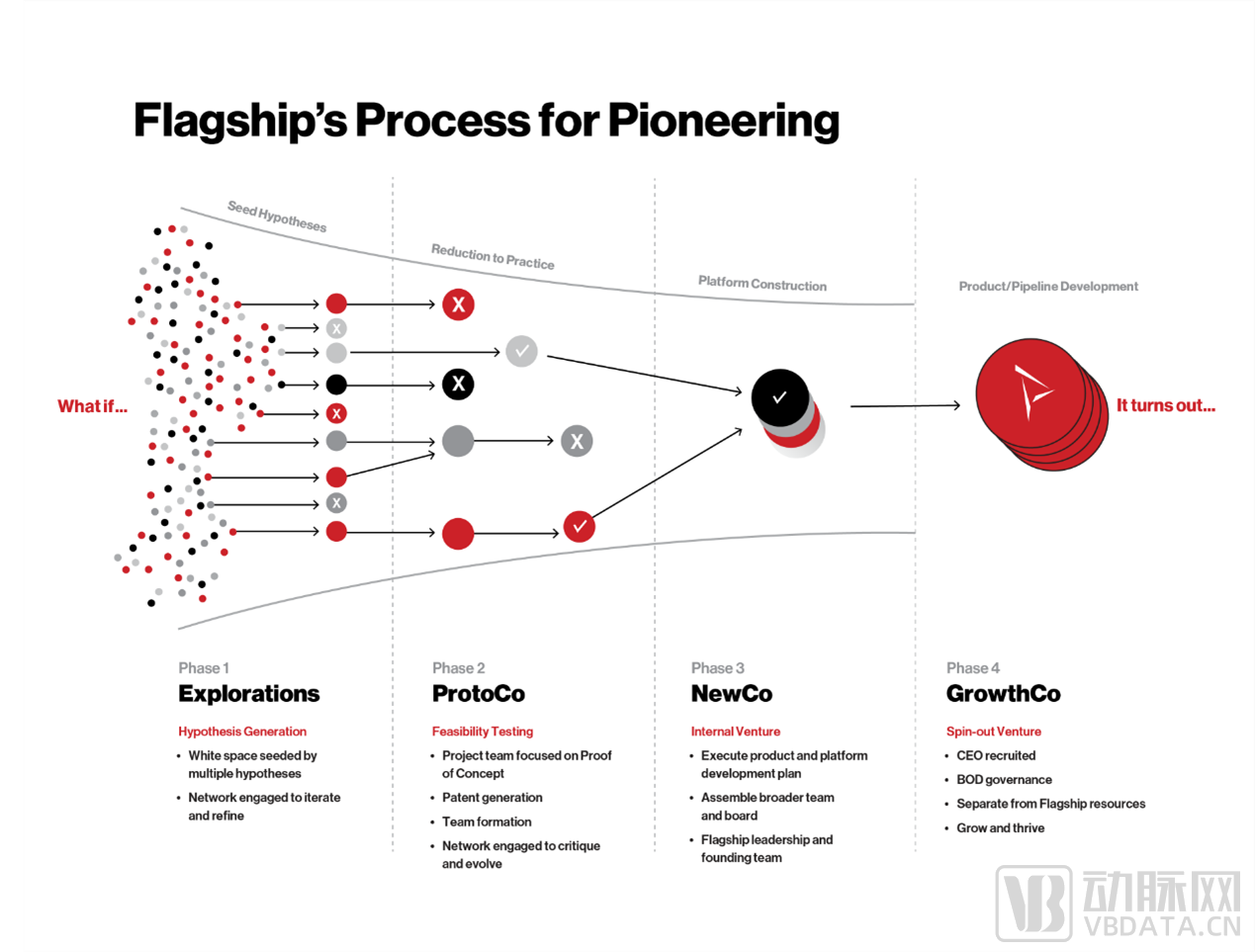
The Four Stages of Flagship's Creation and Incubation of Enterprises, Image Source: Flagship Official Website
First, when the exploration team proposes an innovative idea, it will be treated as a risk hypothesis. Feedback from experts and relevant parties will determine its feasibility. Risk hypotheses that are initially considered feasible will enter the laboratory for scientific validation. During this process, while further confirming their feasibility, a prototype company named after the project number will be created. Subsequently, Flagship will transform the prototype company into an innovation-driven company and proceed to put the experimentally validated prototype product into practice. Finally, the innovation-driven company will transition into a growth company, eventually spinning off from Flagship to enter the market. Among these cases, the most successful example is undoubtedly Moderna, the "Biotech IPO King," which once brought Flagship thousands of times the return on investment.
Flagship has pioneered a unique approach to venture capital investment, while also solidifying its position as a top-tier investment firm in the industry with this distinctive strategy. Compared to all venture capital funds closed in the same year, Flagship's funds are among the best-performing, and they frequently dominate the top spot on the list of the top 100 U.S. biotech venture capital investors.
However, the myth constructed by Flagship was shaken in 2023. According to incomplete statistics from VCBeat, the number of U.S.-listed biotech companies that went bankrupt in 2023 has exceeded 30, of which four were incubated by Flagship. Apart from Axcella Health, a star company in MASH (metabolic associated steatohepatitis), there were also Rubius Therapeutics, a red blood cell therapy company, Codiak BioSciences, an exosome pharmaceutical company, and Evelo Biosciences, a microbiome therapy company.
According to data from Flagship's official website, among the 87 biopharmaceutical companies it has invested in and incubated, nearly 50 encountered bottlenecks between 2022-2023. The main reason for most of these companies' decline can be attributed to one factor: consecutive clinical trial setbacks, coupled with a lack of stable cash flow, which led to mounting financial pressure and ultimately became unsustainable.
At the same time, another commonality among these companies is their admiration for innovation and their attempt to mine in niche tracks; this indeed aligns with Flagship’s mission – a passion for innovating in "unoccupied" fields. Flagship's relentless pursuit of uniqueness could not withstand financial issues. Moreover, Flagship's "nanny-style" incubation system revealed its drawbacks after the funding boom cooled down. Due to the overly meticulous “from cradle to adulthood” incubation system, which encompassed team building, operational management, and financial support, it left no room for businesses to explore independently, thereby weakening their ability to independently face marketization to a certain extent.
However, Flagship did not give up and continued to optimistically support innovation. It proposed a new concept called "parallel entrepreneurship," which involves tapping into cutting-edge biotechnologies from universities and other sources worldwide. These technologies are then fully integrated as internal IPs, with the company's partners installed as key executives. Flagship takes charge of all aspects, including R&D cultivation, team building, and attracting external investments. After extensive funnel-style screening, successful enterprises will spin off to pursue IPOs, but their "roots" remain with Flagship.
In addition, companies previously incubated by Flagship are also actively seeking partnerships. At the beginning of 2024, Novo Nordisk announced separate new drug research collaborations with Omega Therapeutics and Cellarity, both Flagship-incubated companies, to develop epigenetic drugs for obesity management and novel therapies targeting MASH. Novo Nordisk will cover all R&D expenses. Meanwhile, each company’s innovative products are eligible for up to $532 million in upfront and milestone payments, as well as tiered royalties.
How Pfizer, Having Missed the First Wave, Can Turn Around by Adjusting Its Strategic Model
On the other hand, there is Pfizer's anxiety.
On the evening of June 26, 2023, international pharmaceutical giant Pfizer announced that it would halt the development of its obesity and diabetes drug Lotiglipron, which is still in the clinical trial stage. This decision was made because patients who took the drug showed elevated liver enzymes during the mid-term clinical study, a sign of hepatocyte damage. Lotiglipron belongs to a class of drugs known as glucagon-like peptide-1 (GLP-1) hormones. These drugs mimic the GLP-1 hormone produced in the intestines, which signals the brain when a person is full. GLP-1 drugs have previously been used to help patients with type 2 diabetes manage their condition.
Pfizer Missed the First Wave of the Global Weight-Loss Drug Market. Eli Lilly and Novo Nordisk Are Far Ahead with Their Injectable Drugs Zepbound and Wegovy, Respectively. However, Pfizer Has Identified a Problem: The High Production Costs of Injectables Mean Limited Capacity, Thus the First Batch of Drugs Can Only Meet the Needs of a Limited Number of Patients.
After the failure of Lotiglipron, Pfizer focused on another oral GLP drug, Danuglipron, which was progressing more rapidly. However, by the end of 2023, clinical data showed that up to 73% of patients experienced nausea, up to 47% experienced vomiting, and up to 25% experienced diarrhea. The discontinuation rate was high across all doses. From a statistical perspective of clinical trials, a higher discontinuation rate generally indicates significant side effects that prevent patients from continuing the medication. Pfizer once announced that Danuglipron would not advance to Phase 3 clinical trials.
In February 2024, Dr. Mikael Dolsten, Chief Scientist of Pfizer, stated that Danuglipron is well-tolerated by vital organs in the human body and is a safe drug. Patients taking Danuglipron twice daily experienced an average weight loss of 6.9% to 11.7%, while those on placebo gained 1.4% at 32 weeks. Pfizer has discontinued the twice-daily dosing and is attempting to adjust the regimen to once daily.
From the overall strategic layout of Pfizer, against the backdrop of the COVID-19 pandemic, Pfizer regained its position as the top pharmaceutical company by leveraging the mRNA vaccine Comirnaty and the oral COVID-19 treatment Paxlovid. It also became the first pharmaceutical company in history to achieve revenue exceeding 100 billion US dollars. However, hidden concerns lie within this prosperity: from 2025 to 2030, the company faces the challenge of patents worth 17 billion US dollars expiring for key products. As the pandemic gradually eases, income related to COVID-19 business will inevitably be affected.
Thus, the data of Pfizer's experimental weight-loss drug Danuglipron is key to its entry into the weight-loss drug market, where it will compete with Novo Nordisk and Eli Lilly. Pfizer sees a "blue ocean" in the weight-loss drug market and hopes to find another revenue growth point that can boost performance after its COVID-19 drug.
It can be said that Pfizer has pinned its hopes on the fields of cancer and weight loss. On December 14, 2023, Pfizer officially completed the acquisition of Seagen, valued at approximately $43 billion in total. Seagen is considered a pioneer in the ADC field, having previously successfully launched three anti-tumor ADC drugs and one novel targeted small-molecule therapy in the United States. The industry generally believes that ADC technology will be transformative, and the acquisition of Seagen gives Pfizer the opportunity to become a world-class leader in oncology.
By contrast, Pfizer's layout in the weight loss field lags far behind leading companies like Novo Nordisk and Eli Lilly, and Danuglipron still needs to provide more convincing data.
However, Pfizer's CEO is confident about this. Part of this confidence comes from Pfizer's established professional R&D team in the field of metabolic diseases; another part stems from two other molecules developed by Pfizer in clinical trials, one of which is the oral small-molecule GLP-1 receptor agonist PF-06954522, and the other, due to fierce competition, has not yet been publicly disclosed regarding its mechanism of action. In addition, Pfizer is conducting numerous preclinical studies in the weight-loss field.
The cooperation between Pfizer and Flagship is expected to discover and validate innovative proteins in the field of obesity, and Pfizer's experience accumulated in the small molecule drug field is also expected to boost its breakthrough in the weight loss drug field.