

Abbott's Two OTC CGM Devices Receive FDA Approval, Signaling a Major Shift in the CGM Market

Abbott
Diagnostic and pharmaceutical product manufacturers
Recently, Abbott announced that two of its OTC (over-the-counter) CGM (Continuous Glucose Monitoring) systems, Lingo and Libre Rio, have received FDA approval. Among them, OTC is the focus of industry attention.
In the United States, the OTC concept is used not only for drugs but also for medical devices. It is reported that there are significant differences between OTC medical devices and common prescription medical devices in terms of purchase conditions, sales channels, and consumer groups.
Taking CGM as an example, generally, American users must have a doctor's prescription to purchase a prescription CGM. Typically, only diabetes patients undergoing insulin treatment are eligible to receive a prescription. Additionally, in certain states, only those with specific licenses are allowed to sell prescription medical devices, and patients must purchase prescription CGMs through these authorized channels.
However, if purchasing an over-the-counter CGM, no prescription is required. In terms of sales channels, there is no need for licensed specific business entities to sell them; consumers can purchase them through various channels such as supermarkets, pharmacies, and online platforms. Additionally, over-the-counter CGMs are not restricted to specific consumer groups and can be purchased by non-professionals (ordinary consumers).
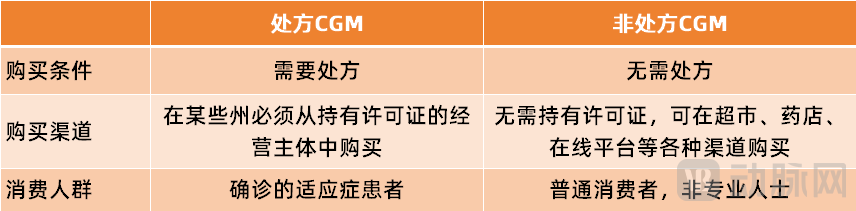
By comparison, it can be seen that OTC CGM has more convenient purchasing methods, richer sales channels, and a broader consumer base. This also means that OTC CGM has a larger market space.
According to public data, only about 7.5 million diabetes patients in the United States use insulin for treatment, while another 25 million people with type 2 diabetes do not use insulin, and an additional 98 million adults are in the pre-diabetic stage. Beyond the diabetes-related population, groups interested in weight loss, fitness, and healthy living also show significant interest in blood glucose monitoring. A rough estimate suggests that the approval of over-the-counter CGM (Continuous Glucose Monitoring) will expand the U.S. CGM market by at least ten times.
It is obvious that Abbott's focus on over-the-counter CGM aims to expand the market. However, the impact of over-the-counter CGM is not limited to market space. How is over-the-counter CGM different from traditional CGM? What are the differences in sales channels, purchase prices, and consumer groups between the two? Will diabetic patients who previously purchased prescription CGM buy over-the-counter CGM? Is it necessary for companies outside the U.S. market to follow up with over-the-counter CGM? These issues need to be discussed one by one.
From the first CGM product to over-the-counter CGM, Abbott's CGM series has undergone multiple iterations.
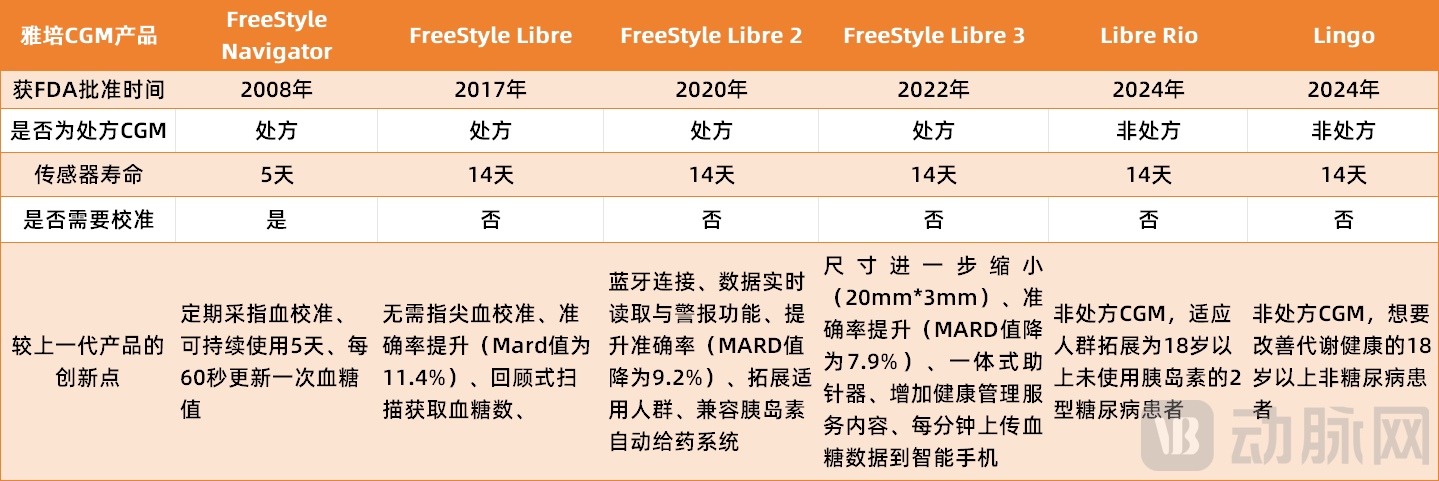
In 2008, Abbott launched its first CGM product, FreeStyle Navigator.The product requires regular fingerstick calibration, with a continuous usage time of about 5 days, updating blood glucose levels every 60 seconds. Its sensor can be implanted on the abdomen or the back of the upper arm. It was reported that in 2011, the project stopped updating. However, Abbott has not ceased its R&D efforts in the CGM field.
In 2017, Abbott's first-generation FreeStyle Libre received FDA approval.According to reports, the product continues the electrode design of the FreeStyle Navigator, using a three-electrode system, including a working electrode, a reference electrode, and a counter electrode. At the same time, Abbott has also made upgrades and optimizations in various aspects:
First, FreeStyle Libre adopts the latest wired enzyme technology at the time, which enables it to meet patient requirements for accuracy without the need for fingertip blood calibration—its MARD value is 11.4%.
Second, the FreeStyle Libre uses a single-sided printed circuit, implanting three electrodes into the sensor with minimized volume. Based on this, the size of the FreeStyle Libre is only as large as a coin, with dimensions of 35mm*5mm, a weight of 5 grams, and an IPX7 waterproof rating.
Third, FreeStyle Libre retrieves blood glucose data through retrospective scanning (NFC) and extends the sensor's usage duration from 5 days to 14 days. Considering cost, FreeStyle Libre has limited storage space, uploading data every 5 minutes and retaining it for 8 hours; if not scanned within 8 hours, only the most recent 8 hours of data are preserved.
Abbott's low-cost strategy has achieved great success. According to statistics from 2022, the price of FreeStyle Libre in China was approximately 440 yuan, while the price of Medtronic's CGM product, Guardian Connect, was about 776 yuan. FreeStyle Libre has successfully captured the majority of the Chinese market share.
In 2020, Abbott's FreeStyle Libre 2 received FDA approval.The product has been optimized in the following aspects: First, it upgrades retrospective scanning (NFC) to Bluetooth connectivity, enabling real-time blood glucose data reading and warning functions; Second, it enhances the sensor and algorithm, improving accuracy and reducing the MARD value from 11.4% to 9.2%; Third, it expands the applicable range, extending the indications from diabetic patients over 18 years old in the previous generation to diabetic patients over 4 years old; Fourth, it is compatible with the automatic insulin delivery system, and when connected, forms an "artificial pancreas."
In May 2022, Abbott's new generation CGM product, Freestyle Libre 3, received FDA approval.Compared with the previous generation product, Abbott claims that the FreeStyle Libre 3 has reduced its volume by 70%, making it the smallest and thinnest CGM in the world. The product further reduces the sensor to the size of a nickel (5-cent coin), with dimensions of 20mm*3mm, and a thickness approximately equal to two stacked nickels.
In addition, Freestyle Libre 3 has made upgrades in blood glucose management, accuracy, and user experience. First, Freestyle Libre 3 has added more health management service features, such as blood glucose data analysis reports, remote sharing of blood glucose data, and reminders for family and friends to help with management. Second, Freestyle Libre 3 has improved the accuracy of blood glucose monitoring, with its MARD being less than 8, at just 7.9%. Third, the data transmission interval of Freestyle Libre 3 has been shortened from every 5 minutes to every 1 minute. Fourth, Freestyle Libre 3 uses a new all-in-one needle applicator, eliminating the need for patients to assemble the sensor and applicator, making the use of CGM simpler.
In 2024, two of Abbott's non-prescription CGM products, Lingo andLibre RioFDA ApprovedAccording to reports, Lingo and Libre Rio use sensors similar to FreeStyle Libre, which are attached to the skin and detect blood glucose levels through micro flexible electrodes.
However, unlike previous generations of products, Lingo is mainly aimed at non-diabetics over the age of 18 who wish to improve their metabolic health. It provides users with information on blood glucose spikes and how their body responds to food, sleep, and exercise. Through real-time feedback and personalized guidance, it helps users better understand their health status; Libre Rio is specifically designed for Type 2 diabetic patients over 18 who do not use insulin. It can monitor extremely low or high blood glucose events, helping patients in a more convenient way to try using CGM.
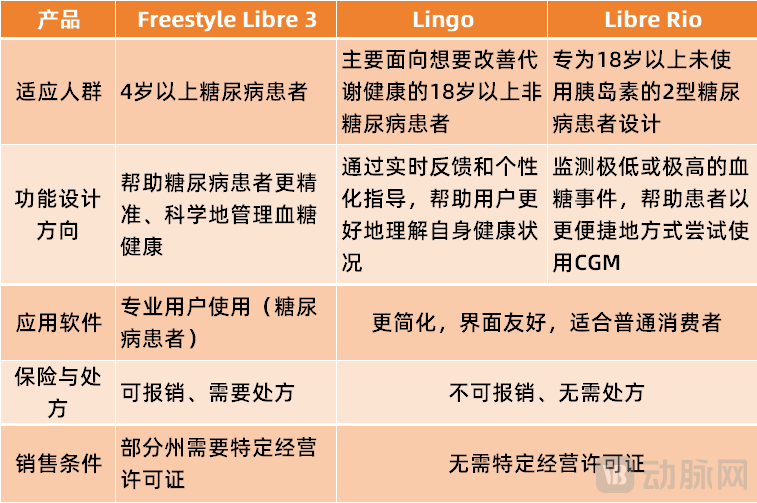
(Differences Between Non-Prescription CGM and Previous Generations of Prescription CGM)
In terms of software, the Lingo app is more streamlined with a user-friendly interface, designed for ordinary consumers (non-diabetes population), featuring functions like Lingo Graph and Lingo Count. Libre Rio, on the other hand, uses an application similar to FreeStyle Libre but with a simpler and more intuitive interface.
Most importantly,Previous generationsFreeStyle LibreThe series of productsRequires a prescription and is covered by most major insurance companies in the U.S.WillProvide reimbursement.And Lingo withLibre RioNo prescription required, and no insurance reimbursementBased on the difference between prescription and over-the-counter, Lingo and Libre Rio have broader sales channels, allowing them to be sold and purchased on online platforms and in business premises without specific licenses.
In fact, it is not only Abbott, but also Dexcom that continuously promotes the optimization and upgrading of its CGM products in terms of sensor life, accuracy, safety, and fingerstick calibration. Its CGM series has been updated from G1 to G7, and in March 2024, it received approval for the first over-the-counter CGM in the U.S.—the Stelo.
As Dexcom and Abbott's non-prescription CGMs have successively received FDA approval, the era of non-prescription CGMs in the U.S. has begun. Like the butterfly that "flapped its wings and caused a storm," these non-prescription CGMs, which have been consecutively approved in the U.S., may also impact the global CGM market.
Although the United States has strict regulations on prescriptions, in many countries and regions around the world, purchasing CGM is not restricted by prescription or non-prescription rules. Therefore, the approval of non-prescription CGM will have the most direct impact on expanding the U.S. market. As for its influence on other regional markets globally, it still depends on the pricing strategy of subsequent non-prescription CGM products.
In the past, the entry barrier for the CGM market was relatively high. However, with the recent approval of over-the-counter CGM, the entry barrier for the CGM market has been significantly lowered. At the same time, a larger market space is expected to attract more device manufacturers and innovative companies to enter the arena, driving down CGM prices.
Generally speaking,The price of over-the-counter medical devices is lower than that of prescription medical devices of the same type.For example, in the U.S. market, the price of over-the-counter hearing aids ranges from approximately $99 to $3,000, while the average price of prescription hearing aids was previously around $4,700.
The ability to lower prices is attributed to two main factors: on one hand, the global top five prescription hearing aid groups occupy over 90% of the global professional hearing aid market share, with a comprehensive gross profit margin of 55%-75%, providing ample room for price reductions. At the same time, following the approval of the first over-the-counter (OTC) hearing aid, a group of innovative companies such as Eargo and Lexie Hearing have also entered the hearing aid market, quickly launching OTC hearing aids and attracting users with lower prices.
On the other hand, traditional prescription hearing aids are sold in a bundled form, where patients need to pay for a package that includes hearing tests, fitting services, and the hearing aid product. Over-the-counter hearing aids, however, have unbundled this sales model. Users can purchase them outside of fitting stores, conduct hearing tests via smartphones or other methods, and then buy or adjust hearing aids accordingly to achieve satisfactory results.
However, over-the-counter CGMs seem to be somewhat different. Currently, Abbott has not disclosed the launch timing and pricing strategy for Lingo and Libre Rio in the United States, and Dexcom has also not revealed the specific launch timing and price for Stelo.
However, Lingo was launched in the UK in January 2024, with a single unit priced at £89 and a set of four priced at £300. Meanwhile, the price of FreeStyle Libre 3 on UK online platforms (prescription required) is £83.99.This means that the unit price of the over-the-counter CGM product Lingo is higher than that of the prescription CGM product.FreeStyle Libre 3。
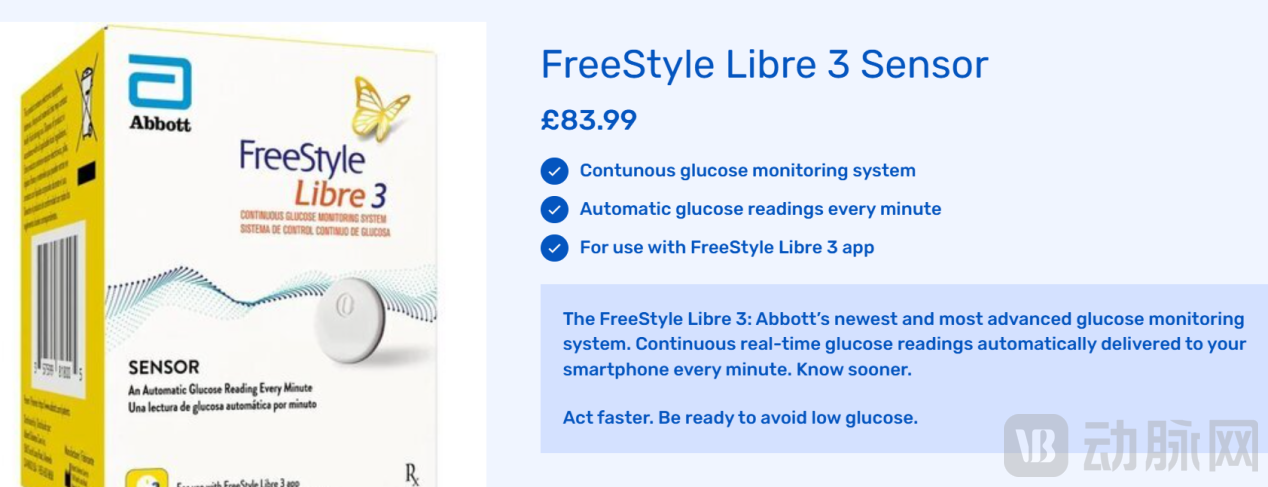
(Image source: UK online prescription drug sales platform)
Previously, industry insiders judged: If the price of over-the-counter CGM products is higher than that of prescription CGM products, it is expected to have little impact on the original diabetes market; if the price is significantly lower than prescription CGM products, perhaps some diabetes patients who originally used prescription CGM may switch to over-the-counter CGM.
At this stage, perhaps because the over-the-counter CGM has just been approved, there are no new brands entering the market to stimulate demand and intensify competition, so the price of over-the-counter CGM is not lower than that of prescription CGM. Going forward, the market needs to keep a close eye on the pricing strategies of Abbott and Dexcom for their over-the-counter CGM products in the U.S.
Higher prices and limited sales of prescription CGMs have slowed the anticipated rapid growth of the over-the-counter CGM market, adding to the complexity and intrigue of the CGM market. However, at its core, the approval of over-the-counter CGMs will inevitably lower industry barriers, attracting more innovative companies to enter the market. Meanwhile, China's CGM market continues to face challenges from increasing competition.
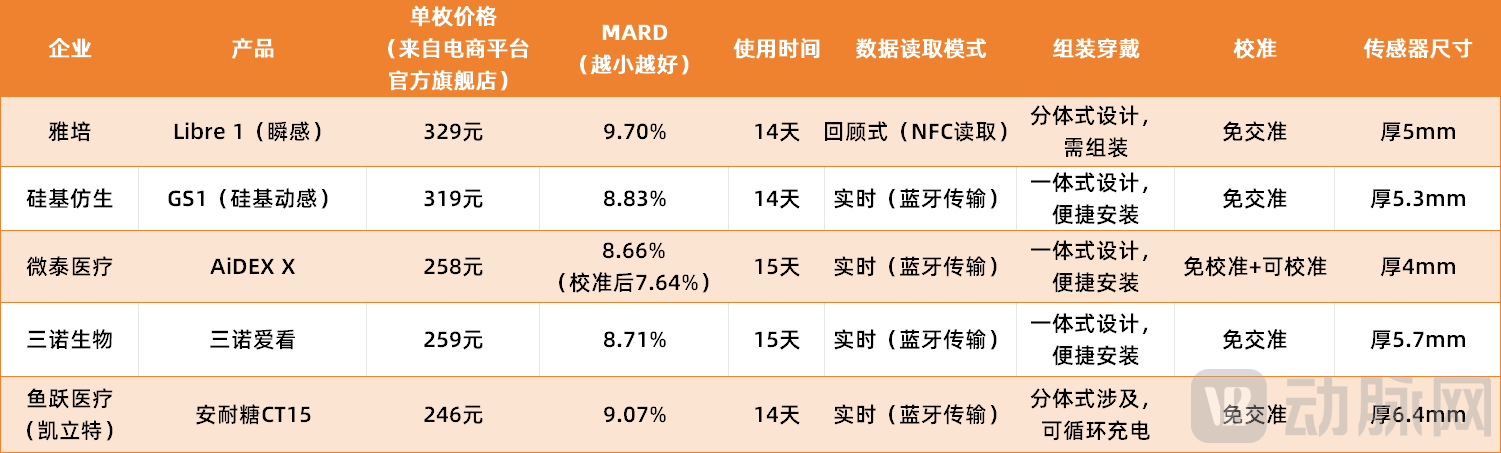
(Prices may vary slightly due to big data recommendations, all searched under the same account.)
In the Chinese market, from the approval of the first domestically produced CGM in 2021 to the present, the number of entrants has been increasing, and the price of CGMs has been decreasing. In 2022, Medtronic's CGM product, Guardian Connect, was priced at approximately 776 yuan, while Abbott's CGM product, FreeStyle Libre, was priced at about 440 yuan. With its low-price strategy, Abbott's FreeStyle Libre has captured the majority of the domestic CGM market.
Later, China-produced CGM represented by Silicon Biotech entered the market and launched large-scale commercialization. Initially, the pricing of Silicon Biotech's CGM was approximately 450 yuan. In 2022, it achieved sales exceeding 100 million yuan, and during the Double Eleven period in 2023, it realized sales of over 67 million yuan, a year-on-year increase of 110%. After the market competition intensified, Silicon Biotech adjusted the current selling price of its CGM product GS1 to 319 yuan.
In 2023, Sinocare and Microtech Medical also made their appearances. Sinocare's CGM product, "Sinocare Aikang," is currently priced at 259 yuan. Due to its price advantage, Sinocare Aikang achieved excellent sales results. According to the list data from Tmall during the 618 period in 2024: Sinocare Aikang Dynamic Glucose Monitor ranked first on the "Tmall Health Must-Buy List" and the "Dynamic Glucose Monitor Best-Seller List." Previously, Sinocare Aikang's sales volume in 2023 ranked second in the CGM category on Tmall and first among Chinese-produced products, acquiring more new users than other competitors.
In April 2024, MicroTech Medical launched its new generation CGM product, AiDEX X, priced at 258 yuan. Clearly, this will attract a large number of price-sensitive users. Additionally, AiDEX X has achieved a breakthrough in accuracy, with a MARD value of 8.66%, and after calibration, it can reach 7.64%. Industry-leading accuracy, lower price, and years of cultivated online sales channels have enabled AiDEX X to easily cross the commercialization threshold. As of now, according to data from MicroTech Medical's Tmall flagship store, AiDEX X has sold over 4,000 orders. These orders include various packaging options such as 1-box, 2-box, 4-box, 6-box, 13-box, and 26-box sets.
It is clear that more players are forcing domestic CGM companies to launch price wars, using "low price," the core factor consumers care about, to capture the market.
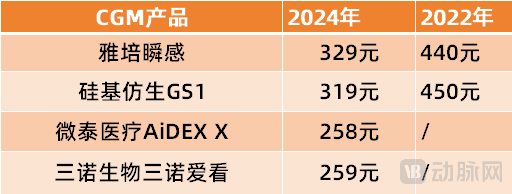
(Prices of CGM Products in China at Different Times)
The price-based internal competition also forces CGM companies in China to continuously innovate and reduce costs. In this aspect, whether over-the-counter CGM comes to the Chinese market or not, and whether domestic companies go overseas to register over-the-counter CGM or not, they all need to develop at a lower cost; otherwise, they will be eliminated by the market.。
In addition to price, the accuracy and user experience of CGM products are also key areas of competition. Initially, the MARD value of Abbott's FreeStyle Libre was 11.4%, but currently, it has been reduced to 9.7%. According to the product release order, the MARD value of Silicon Biotech's GS1 is 8.83%, the MARD value of Sinocare's "Sinocare iCGM" is 8.71%, and the MARD value of MicroTech Medical's recently released AiDEX X is 8.66%, with a post-calibration value of 7.64%.The newer the product, the higher the accuracy, and the more patients and consumers favor it.。
In addition, other important innovation directions for CGM products include compatibility with insulin pumps to form an artificial pancreas system. An artificial pancreas combines CGM with an insulin pump, allowing the pump to adjust and deliver corresponding insulin doses based on CGM readings, ensuring that a patient's blood glucose remains in a healthy and stable state.
In this aspect, overseas giants Abbott and Medtronic have already made their moves. For instance, Abbott's CGM products, Freestyle Libre 2 and Freestyle Libre 3, received FDA approval in 2023 and can form a hybrid closed-loop system together with Abbott's insulin pump and CamDiab’s algorithm. It is reported that MicroTech Medical is also developing the next-generation artificial pancreas product that integrates CGM and an insulin pump.
Overall, regardless of the pricing and development of over-the-counter CGM, domestically produced CGM needs to evolve towards lower costs, higher accuracy, and more comprehensive blood glucose management services. Once domestically produced CGM surpasses over-the-counter CGM in all aspects, it will no longer need to worry about the impact of over-the-counter CGM. Instead, it can explore overseas markets with over-the-counter CGM and seize the fruits cultivated by industry giants.