Top 10 Pharma M&A Deals in H1 2024: Strategic Moves in ADC, Radiopharmaceuticals, and Ophthalmology
Catalent
Integrated Services, Drug Delivery Technology, and Manufacturing Solutions Provider
Novo Nordisk
Insulin Developer and Manufacturer
Vertex
Breakthrough Small Molecule Drug Developer
Alpine Immune Sciences
Immuno-oncology Researcher

Gilead Sciences
Antiviral Drug Developer

Cymabay Therapeutics
Drug Developer
EyeBio
Ophthalmic Disease Therapeutics Developer

MSD
Pharmaceutical R&D and Manufacturer

Novartis
Drug Development and Manufacturing

MorphoSys
Biopharmaceutical Manufacturer

AstraZeneca
Biopharmaceutical Manufacturer
Fusion Pharmaceuticals
Biopharmaceutical R&D and Manufacturing
Ono
Innovative Drug Developer
Deciphera
Chemical Pharmacist
Sanofi
Pharmaceutical R&D Developer

Inhibrx Biosciences
Biological Therapeutics Candidate Developer

Johnson & Johnson
Healthcare Product Manufacturers, Health Service Providers
Ambrx Biopharma
Biologics Developer

Genmab
Differentiated Antibody Therapy Developer
In 2024, dozens of drug patents worldwide will expire, including blockbuster varieties such as Aripiprazole, Dapagliflozin, and Budesonide. To address the patent cliff, some companies are strengthening mergers and acquisitions to supplement their pipelines.
Apart from the impact of patent expiration, as the fields of weight-loss drugs, ADC, and radiopharmaceuticals continue to heat up, some pharmaceutical companies are quickly expanding their presence through mergers and acquisitions to obtain innovative pipeline assets.
In 2023, the total value of the top ten M&A deals in the biopharmaceutical industry exceeded 100 billion US dollars. Now that 2024 is halfway through, which companies are involved in the global pharmaceutical industry's top 10 M&A deals? What are the transaction amounts?
01
Top 10 Pharmaceutical M&A
Table 1 below shows the top 10 pharmaceutical company M&A deals globally in the first half of 2024 (as of June 16, 2024), covering areas such as ADC, nuclear medicine, and ophthalmic drugs. Notably, Chinese companies are included in the top 10.
Table 1 Top 10 Pharmaceutical M&A Deals by Value in 1H 2024
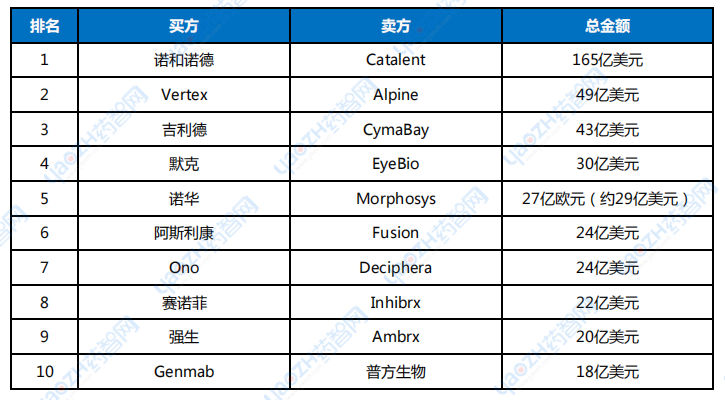
Data Source: Official News from Various Companies
1. $16.5 Billion: Novo Nordisk Acquires Catalent
On February 5, Novo Holdings, the largest shareholder of Novo Nordisk, announced that it would acquire Catalent for $16.5 billion. As part of the deal, Novo Nordisk will acquire three filling plants located in Anagni, Italy; Brussels, Belgium; and Bloomington, Indiana, USA, from Catalent for an upfront payment of $11 billion.
Through this acquisition, Novo Nordisk is expected to expand its production capacity. Starting from 2026, the acquisition is anticipated to progressively increase Novo Nordisk's filling capacity, significantly alleviating the production constraints of semaglutide.
$2.49 Billion, Vertex Acquires Alpine
On April 10, Vertex reached a definitive agreement with Alpine, under which Vertex will acquire Alpine at a price of $65 per share, with a total value of approximately $4.9 billion.
Alpine Immune Sciences is dedicated to the discovery and development of protein-based immunotherapy drugs. Its lead product, Povetacicept, has demonstrated significant potential in patients with IgA nephropathy and has the potential to become the best-in-class. The drug has now entered Phase 3 clinical trials.
Through this acquisition, Vertex is betting on the immunotherapy sector and strengthening its position in this field. The immunotherapy sector is known as the cradle of "blockbuster drugs," and it remains to be seen whether this acquisition will lead to the creation of a blockbuster drug.
$3.43 Billion, Gilead Sciences Acquires CymaBay Therapeutics
On February 12, Gilead Sciences announced that it had reached an agreement with CymaBay Therapeutics to acquire CymaBay at a price of $32.5 per share, with the total transaction amounting to approximately $4.3 billion.
CymaBay's core candidate drug is Seladelpar, a PPARδ agonist for the treatment of primary biliary cholangitis. The drug's marketing application has been accepted by the FDA and included in the priority review.
Through this acquisition, Gilead will further strengthen its product portfolio in the liver disease field.
4. $3 Billion: Merck Acquires EyeBio
On May 29, Merck acquired EyeBio for an upfront payment of $1.3 billion and milestone payments of $1.7 billion, with the total value of the transaction reaching $3 billion.
EyeBio is a biotechnology company focused on the research and development of ophthalmic drugs. Its leading candidate drug, Restoret, is a tetravalent trispecific antibody currently in Phase 2 clinical trials, targeting indications such as wet age-related macular degeneration and diabetic macular edema.
Through this acquisition, Merck's pipeline in the ophthalmology field has been significantly strengthened, particularly in the treatment of retinal diseases.
€2.7 Billion: Novartis Acquires MorphoSys
On February 5, Novartis agreed to acquire MorphoSys for €68 per share and a total price of €2.7 billion (approximately $2.9 billion). Through this transaction, Novartis will further strengthen its oncology pipeline.
Through this acquisition, Novartis will obtain Pelabresib, a BET inhibitor that can be used in combination with Ruxolitinib to treat myelofibrosis, demonstrating good tolerability and safety. In addition, Novartis will also acquire CPI-0209, an EZH1/2 dual inhibitor currently in Phase 2 clinical trials.
$6.24 Billion, AstraZeneca Acquires Fusion
On March 19, AstraZeneca announced that it would acquire Fusion for $21 per share, with a total value of up to $2.4 billion.
Fusion Pharmaceuticals is a company focused on radiopharmaceutical conjugates, with its most advanced drug being FPI-2265, which targets FOLH1 and is currently in Phase 3 clinical trials.
In recent years, large pharmaceutical companies have made it a norm to enter the radiopharmaceuticals sector through mergers and acquisitions, which has become a battleground for global pharmaceutical enterprises. This transaction has also accelerated AstraZeneca's layout and innovative breakthroughs in the radiopharmaceuticals field.
$7.24 Billion, Ono Acquires Deciphera
On April 29, Ono announced the acquisition of Deciphera at a price of $25.6 per share and a total value of $2.4 billion.
This acquisition will strengthen Ono's oncology pipeline and accelerate its business expansion in Europe and the United States.
Ono will obtain Ripretinib, an effective orally active and selective KIT/PDGFR inhibitor indicated for gastrointestinal stromal tumors. The drug has been approved for marketing in dozens of countries, including the United States, Europe, and China.
In addition to Ripretinib, Ono will also acquire several oncology pipelines, including vimseltinib and DCC-3116.
$8.22 Billion, Sanofi Acquires Inhibrx
On January 23, Sanofi acquired Inhibrx for a total amount of $2.2 billion. According to the agreement, $1.7 billion was paid as an upfront payment, $296 million as contingent value rights (CVR), and $200 million as cash obtained by the new Inhibrx.
Inhibrx's core pipeline is INBRX-101, a recombinant human alpha-1 antitrypsin Fc fusion protein for the treatment of alpha-1 antitrypsin deficiency. The drug is currently in Phase 2 clinical trials.
Through this acquisition, Sanofi has begun to accelerate its expansion into the rare disease and inflammation-immunology fields.
9, $2 Billion, Johnson & Johnson Acquires Ambrx
On January 8, Johnson & Johnson completed the acquisition of Ambrx Biopharma for a total amount of $2 billion.
Ambrx Biopharma's core technology involves utilizing an expanded genetic code technology platform to discover and develop next-generation ADC drugs and other engineered therapies, with a pipeline including ARX517 and ARX788, among others. Following this acquisition, the Phase 1/2 clinical study of ARX517 for the treatment of advanced prostate cancer will be accelerated, while advancing a series of new drug candidates.
$1.8 Billion: Genmab Acquires Protheon Biopharma
On April 3, Genmab announced that it would acquire China's ADC Biotech Proforma Biologics for $1.8 billion. This acquisition represents the largest transaction amount for a Chinese company being acquired by a multinational pharmaceutical enterprise to date. Through this acquisition, Genmab will strengthen its pipeline and technology in the ADC field.
Pipeline: Including multiple ADC drugs under research such as PRO1184, PRO1160, and PRO1107, all three of which are in Phase 2 clinical trials. In addition, ProFound Bio has more than ten ADC drugs in the preclinical stage.
02
Why is it so popular?
Why Are Global Pharmaceutical M&A Deals Booming Amid the Industry Downturn, and What Are the Key Characteristics?
ADC Transactions Continue to Heat Up
In 2024, ADC transactions remain in full swing. Facing the enormous commercial value of ADCs, multinational pharmaceutical companies, in seeking the next growth point, have gradually started to acquire high-quality ADC enterprises. Among the top 10 acquisitions mentioned above, two were acquisitions of ADC enterprises. Moreover, in 2023, Pfizer made a staggering $43 billion acquisition of Seagen, the leading company in the ADC field.
The continuous heat in ADC drug deals is inseparable from the rapid growth of the global ADC drug market.
From 2017 to 2022, a total of 12 ADC drugs were approved for marketing worldwide. The market size increased from US$1.6 billion in 2017 to US$7.9 billion in 2022, with a CAGR of 37.3%. In terms of R&D pipelines, there are currently over a hundred ADC R&D projects globally, involving various targets and indications, laying a solid foundation for the rapid expansion of the subsequent ADC market. The global ADC market is expected to continue growing rapidly at a CAGR of 30%, reaching US$64.7 billion by 2030.
The global ADC drug market is experiencing rapid growth, which is also the core driving force for major pharmaceutical companies to focus on ADC pipeline development.
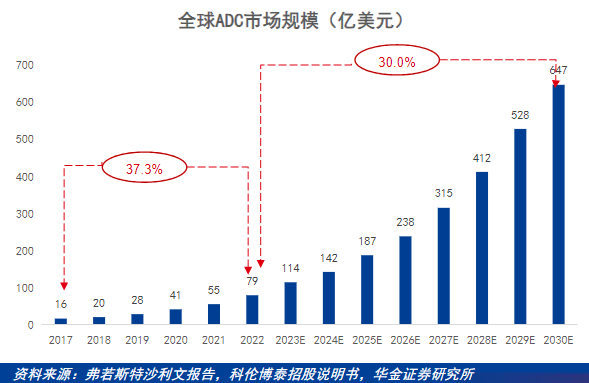
Figure 1 Global ADC Drug Market
Source: Huajin Securities
Nuclear Medicine Gradually Heating Up
In the past two years, there have been frequent transactions in the radiopharmaceuticals field, such as AstraZeneca's acquisition of Fusion Pharmaceuticals, Bristol-Myers Squibb's (BMS) acquisition of RayzeBio, and Eli Lilly's acquisition of Point Biopharma. Many multinational corporations (MNCs) have successively entered the radiopharmaceuticals sector. Moreover, these transactions often come at a premium, demonstrating the enormous potential of the radiopharmaceuticals field.
But due to the high barriers in nuclear medicine, the companies involved in mergers and acquisitions are all foreign pharmaceutical enterprises, and those making strategic moves are generally well-established MNCs.
Four Chinese Biotech Companies Acquired by Overseas Pharmaceutical Enterprises
Notably, among the top 10 global pharmaceutical company mergers and acquisitions in the first half of 2024, a Chinese Biotech was acquired for $1.8 billion, breaking the record for the largest acquisition of a Chinese biotechnology company by an overseas pharmaceutical firm.
Within the first four months of the year, four Chinese biotech companies have been acquired by foreign pharmaceutical enterprises: AstraZeneca/Gracell Biotechnologies, Novartis/Xinrui Pharma, Nuvation Bio/Baoyuan Pharmaceuticals, and Genmab/Profound Biologics.
The recent frequent acquisitions of Chinese Biotech companies by overseas pharmaceutical enterprises indicate a significant enhancement in China's new drug R&D capabilities. An increasing number of companies are being recognized internationally, and future acquisitions of domestic pharmaceutical companies may become commonplace.
03
Conclusion
Driven by the dual allure of the patent cliff and various high-demand fields, major pharmaceutical companies will accelerate their acquisition of pipelines through mergers and acquisitions. The ADC and radiopharmaceutical sectors are rapidly heating up, with numerous multinational corporations (MNCs) actively making strategic moves.
It is worth mentioning that China's Biotech industry has gradually gained international recognition in recent years, with transaction amounts continuously reaching new highs, indirectly reflecting the steady enhancement of China's new drug R&D capabilities.
References
[1] PharmaData
[2]https://www.businesswire.com/news/home/20240410918915/en/
[3]https://www.novartis.com/news/media-releases/novartis-strengthen-oncology-pipeline-agreement-acquire-morphosys-ag-eur-68-share-or-aggregate-eur-27bn-cash
[4] Huajin Securities

Editor: Pea Shooter
Disclaimer: The views expressed in this article are solely those of the author and do not represent the position of Yaozhi Network. We welcome discussions and additional insights in the comment section; if you wish to reproduce this article, please be sure to credit the author and source. If there are any issues regarding the content, copyright, or other aspects of the work, please leave a message on this platform, and we will address them promptly.