

Enveda Biosciences Secures $55 Million in Series B2 Funding to Advance AI-Driven Drug Candidates for Dermatitis and Other Inflammatory Diseases into Clinical Trials
Enveda
Small Molecule Therapy Developer
Compiled by | Liu Yumeng
On June 16, Enveda Biosciences announced the completion of a $55 million Series B2 financing round. This round was participated in by new investors Premji Invest, Lingotto Investment Fund, Microsoft, The Nature Conservancy, along with existing shareholders Kinnevik, True Ventures, FPV, Level Ventures, and Jazz Venture Partners. Building on the previous funding of $119 million, this new round brings the company's total financing to $230 million.
Enveda, founded in 2019, is a biotechnology company headquartered in Boulder, Colorado, with a drug research and development team composed of biologists, chemists, bioinformaticians, and data scientists, aiming to understand and harness the chemical reactions that form the basis of life.
Enveda Uses Its AI Tools to Identify and Characterize a Wide Range of Molecules Produced by Living Organisms (The Vast Majority of Which Have Never Been Scientifically Explored), Creating a New Database of Chemical Biodiversity: The Library of Life. By Developing, Organizing, Translating, and Searching This Unique Library, Enveda Learns from the Solutions of Evolution to Address Today's Urgent Clinical Needs. Currently, the Company’s Database Contains 38,000 Medicinal Plants, Associated with Approximately 12,000 Diseases and Symptoms.
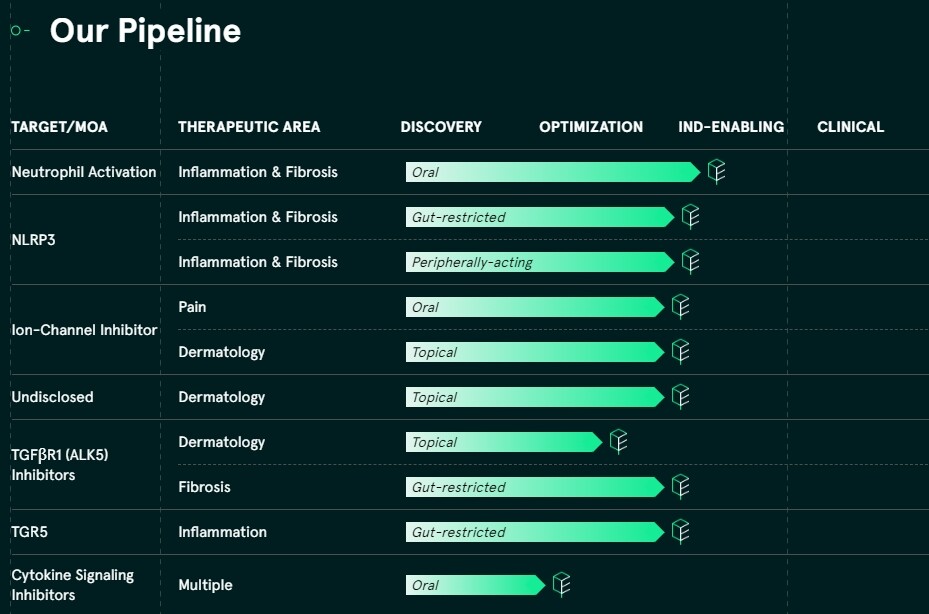
Enveda Drug Pipeline Progress Chart
Microsoft announced its collaboration with Enveda at the end of May, providing not only financial support but also the computational resources needed to support Enveda's novel drug discovery platform. Enveda will use Microsoft Azure to expand its generative AI models, including the newly released model PRISM — the largest machine learning model for small molecule mass spectrometry to date.
PRISM, built on Azure, represents a significant shift in the ability to use AI to interpret mass spectrometry data. Mass spectrometry is the primary method for detecting small molecules in nature. The model has been trained on 1.2 billion high-quality small molecule MS/MS spectra, mastering the basic language and grammar of this data type, which essentially enables the model to "read" the chemistry of life. Additionally, PRISM can be used to support downstream predictions, such as de novo chemical structure prediction by "translating" mass spectra into representations of chemical structures or properties, which forms the basis of Enveda's capability to discover new drugs from nature.
According to the Enveda official website: Among all the properties we predicted, PRISM's predictions showed significant improvement compared to the same model trained on the same data but without using PRISM. To validate that this success was not limited to property prediction, we also tested PRISM’s ability to match unknown spectra to the closest match in a spectral reference library. The relative improvement for this task was 23% compared to a standard ML model pretrained without PRISM.
"Large foundational models trained on vast amounts of raw data are the backbone of modern AI applications. By training PRISM on the largest collection of mass spectrometry data ever assembled, we have created a tool that can help us interpret the language of chemistry and translate it into new, impactful medicines," said Dr. David Healey, Vice President of Data Science at Enveda.
Enveda's drug research and development work is mainly divided into two categories: First, modulating complex phenotypes or disease manifestations, a process that may lead to the discovery of new drug mechanisms of action; Second, conducting research on targets with little or no chemical substrate. According to Enveda, the initial strategy was to explore the field of complex biology, but later shifted to gastrointestinal, dermatology, and pulmonary therapeutic areas due to market trends, especially focusing on major R&D efforts such as inflammation, fibrosis, and changes in the neurosensory system under disease states.
This round of financing will be used to support the further development of Enveda's platform, which recently nominated its sixth New Chemical Entity (NCE) development candidate. The three lead compounds with the most advanced progress at Enveda are expected to enter clinical trials by the end of 2024 and early 2025. Among them, a novel oral first-in-class anti-inflammatory drug for the treatment of atopic dermatitis has demonstrated significant efficacy and safety in preclinical studies.
According to Dr. Viswa Colluru, Enveda's main projects currently are two drugs, one for treating skin conditions, including eczema, and the other for inflammatory bowel disease, with clinical trials expected to begin by the end of this year.
Regarding this round of financing, Dr. Viswa Colluru, CEO and founder of Enveda, stated that the new funding allows Enveda to add long-term strategic partners to its capital table. The company plans to initiate a Series C financing round later this year after the start of clinical trials.
Editor: Hai Ruojing