SoftBank-Backed AI Healthcare Unicorn Tempus AI Raises $4.1B in IPO, Captivating Nearly All Major Pharma Companies

Tempus
Precision Medical Technology Researcher

XtalPi
Computation-Driven Innovative Drug R&D Provider


On June 14, just the second day after XtalPi's IPO,Tempus AI Goes Public on Nasdaq, with the stock code "TEM", surged 15% on its first day.
Tempus AI priced its IPO at $37 per share, the high end of its initial target range of $35 to $37 per share, issuing 11 million shares.
This made Tempus, which originally intended to raise about 100 million US dollars,Exceeded expectations in fundraising$4.107 billion。
This surge has directly pushed the valuation of Tempus AI, an AI + healthcare unicorn, to $60 billion.
XtalPi andTempus AI's Successive Above-Expectation IPOs: Is the IPO Market Making a Strong Comeback?
 Catch the entrepreneurial wave
Interestingly, the founder of Tempus AI is not from a medical background but has crossed over to the healthcare track.
Eric Lefkofsky, the founder of the company, was once the co-founder and investor of Groupon, a famous group-buying website. He became a billionaire after Groupon went public.

Figure:Eric Lefkofsky
As a serial entrepreneur, he has also founded companies in multiple industries such as advertising, healthcare, and logistics.
In 2015, Eric Lefkofsky founded the AI healthcare company Tempus after his wife was diagnosed with breast cancer.
As it happened, in the same year, the United States launched"Precision Medicine Initiative", becoming a new direction in medical development that has garnered global attention.
Tempus is a precision healthcare technology company that leverages artificial intelligence to collect and analyze molecular biology and clinical data, with the goal of improving cancer therapies.
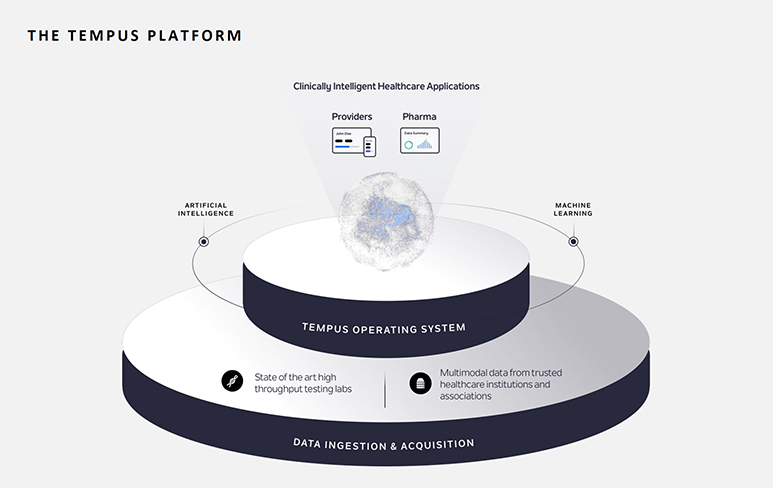
Tempus has built its own CLIA-certified automated laboratory by providing low-cost sequencing services, which can handle over 100,000 patients annually. However, in terms of hardware, the company collaborates with sequencing giant Illumina and has established its own bioinformatics pipeline using machine learning and AI.
Tempus has developed a data network,The platform includes proprietary software and dedicated data pipelines, covering approximately 450 unique databases across more than 2,000 medical institutions.
Thus, Tempus has mastered the core production resource of the AI era: data.
To date, Tempus has built a low-cost, high-quality clinical and genomic database, which the company claims is one of the largest and most comprehensive molecular repositories of cancer patients in the world.
Has accumulated more than900 MillionThis document, covering more than5.6 million copiesAnonymous patient records, which include approximately 1.3 billion pages of rich clinical documentation.
Tempus also includes 1 million records with imaging data, over 900,000 matched clinical records associated with genomic information, and more than 220,000 records with full transcriptome profiles.
Tempus is using this data to train large language models and providing various AI-supported solutions to the market.
And whether for drug development or precision diagnostics, comprehensive patient data remains a scarce resource.
This also allows the company to expand from genomics into data and services businesses, with pharmaceutical companies willing to pay high prices for the databases identified by Tempus.
For example, GSK renewed a 3-year cooperation agreement with Tempus to use its artificial intelligence platform to improve clinical trial design, accelerate clinical registration, and identify drug targets. To this end,Tempus Secures $70 Million Upfront Payment.
Based on the revenue calculated in 2023,Its products have been adopted by approximately 95% of the largest publicly traded pharmaceutical companies., with clients including Pfizer, AstraZeneca, etc.
 The company has accumulated losses of $1.5 billion
Under a powerful business model, Tempus has cumulatively received nine rounds of funding totaling$1.3 billionThe financing, including SoftBank's $200 million investment.
In 2022, Tempus generated revenue of $321 million andIncreased to 532 million US dollars in 2023In Q1 2024, the company achieved revenue of $146 million.
Tempus has three main business models:Genomics, Data and Services, and AI Applications.
In 2023, Tempus generated revenues of $363 million (Genomics), $168.8 million (Data and Services), and $5.5 million (AI Applications) from these three businesses.
That is to say, despite Tempus claiming to be an artificial intelligence + precision medicine company,But the revenue share of pure AI products does not exceed 1.5%.
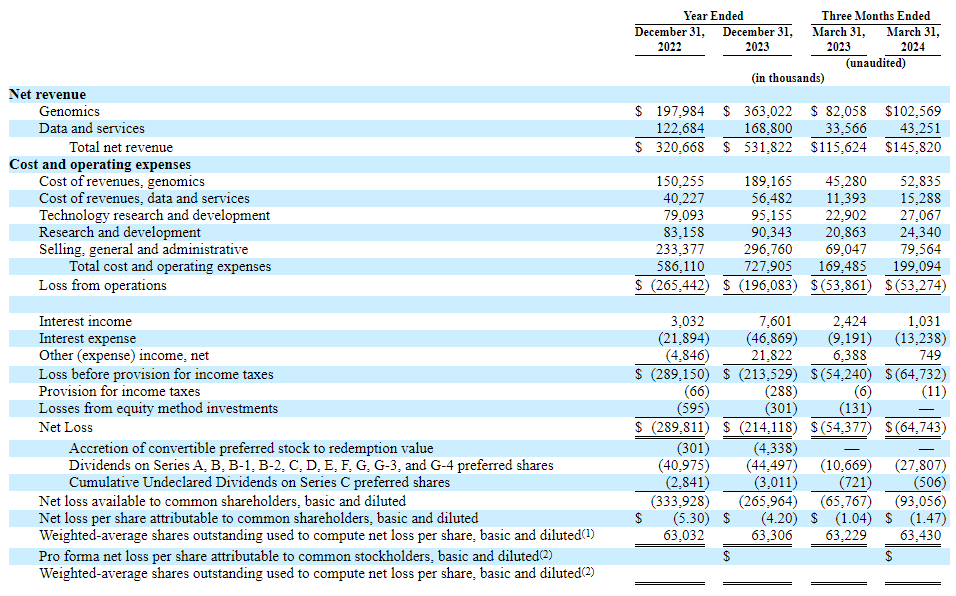
Figure: Tempus Prospectus
Currently, the company has not yet turned a profit, with losses of $290 million in 2022 and $214 million in 2023. As of March 31, 2024, Tempus has an accumulated deficit of $1.5 billion.
However, CEO Eric Lefkofsky said at the time of the IPO: "Because our revenue is growing so fast, we are not reinvesting all of our gross profit growth back into the business. We're getting more leverage every quarter."
He said that the company's cash flow and EBITDA are both expected to be positive next year.
As of December 31, 2023, the company had signed contracts with a remaining total contract value of over $920 million, including approximately $300 million in additional potential future contract options.
Tempus already has about 2,300 employees, according to the prospectus,The company's strategic focus in the future is to extend its capabilities and commercial appeal beyond oncology to other disease categories.
For example, expanding AI diagnostics and personalized medicine in oncology, cardiology, neuropsychology, and radiology.
It can be said that, thanks to the founder's deep accumulation in the commercial field, Tempus identified the pain points and business model from the very beginning.
The company had planned to go public when it received SoftBank financing in 2022, but Eric Lefkofsky believed the IPO market was unfavorable at the time, opting instead to pursue an oversubscribed IPO after the U.S. IPO market rebounded this year.
For Tempus, other business models have been established, but the application of AI still has a long way to go.
—The End—