Recently, BioGeometry, an AI protein design company, announced the completion of a new round of financing. This round of financing was led byZhenGate VenturesLeading investment,Zhipu AI, Shengjing JiahengFollow-on Investment, Existing ShareholderGao Rong VenturesContinued additional investment will mainly be used to accelerate the implementation of generative AI large models in the biomanufacturing field and to advance the development of proprietary products. In recent years, generative artificial intelligence technologies represented by ChatGPT and Sora have developed rapidly. In the field of life sciences, following the revolutionary progress of AlphaFold2, developed by Google DeepMind, in protein structure prediction, this year has seen advancements based on diffusion generative models.AlphaFold3The technology's ability to extend predictions to the structures of all biomolecules and their interactions has garnered widespread attention in the industry. The advancement of artificial intelligence, particularly the emergence of large models, is leading biomanufacturing into a new era of digitization and intelligence. The Central Economic Work Conference held in December last year, as well as this year's Two Sessions, specifically mentioned the need to vigorously develop the digital economy and accelerate the development of artificial intelligence.Create new tracks for several strategic emerging industries and future industries such as biomanufacturing. BioGeometry focuses on building a generative AI protein design platform, empowering the entire biomanufacturing field.Its core team is a pioneer in applying generative AI to molecular generation. As early as 2021, they utilized diffusion models for generating three-dimensional molecular structures, becoming one of the earliest teams to apply diffusion generative models to this field. Their key paper, GeoDiff, was among the top 50 most cited papers in the AI field in 2022. Recently, BioGeometry released the latest large generative AI model for protein design.GeoFlow, which can be simultaneously applied to two key tasks: the prediction of antigen-antibody complex structures and antibody design.
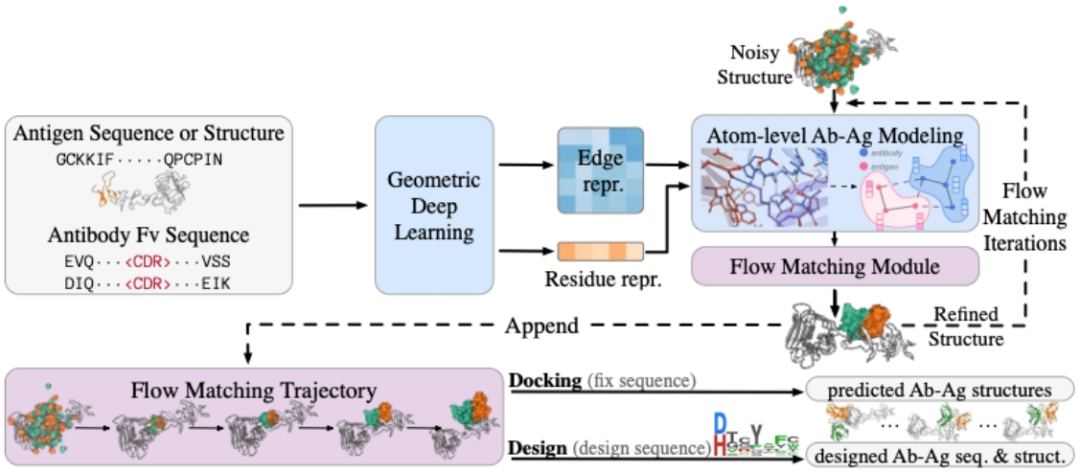
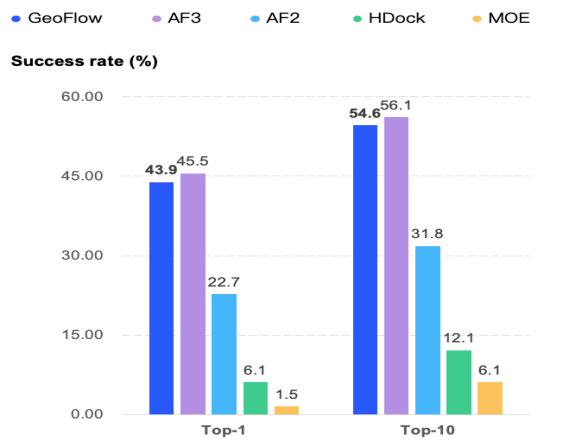
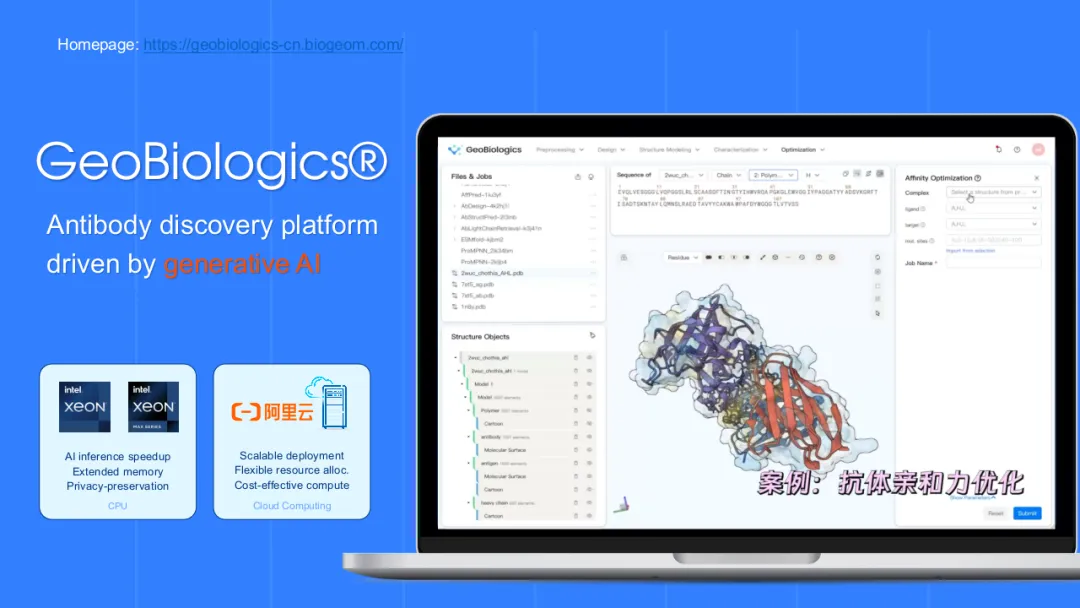
Figure 1: GeoFlow Model Architecture Diagram Unlike existing Transformer architectures, GeoFlow adopts a geometric deep learning foundation model, which is better able to model atom-to-atom relationships in three-dimensional space. In terms of generative model selection, GeoFlow utilizes the latest flow matching model. Compared with diffusion generative models, flow matching generative models are more efficient and robust in both training and inference. In the task of antigen-antibody complex structure prediction,The performance of GeoFlow has reached the same level as AlphaFold3, making it the first generative AI large molecule design model in the industry to approach the level of AlphaFold3. Figure 2: Evaluation results of antigen-antibody complex predictions. GeoFlow is close to the performance of AF3, with accuracy doubled compared to AF2. Based on its self-developed generative AI large model, BioGeometry has developedGeoBiologicsOne-stop protein design platform, which has reached licensing cooperation with multiple pharmaceutical companies both in China and abroad. In addition, BioGeometry has also reached strategic cooperation with multiple upstream and downstream enterprises to jointly promote the implementation of generative artificial intelligence in the field of biomanufacturing, including withAlibaba CloudJointly Build Intelligent Solutions for AI in Biomanufacturing, withSanYou Biotech, BaiJun BiotechJointly build antibody design generative AI large models, and withXiangyao Biotech, Yinka BiotechCollaborative development of recombinant proteins and antibody drug products. Figure 3: GeoBiologics Protein Design Platform In the future, BioGeometry will continue to optimize its generative artificial intelligence protein design platform, empower the biomanufacturing industry, and rapidly advance the implementation of its proprietary products. Dr. Jian Tang, CEO of BioGeometry, stated: "After a year and a half of development, BioGeometry has completed the construction of two foundational platforms: a generative AI large model for proteins and a high-throughput wet lab validation platform for proteins. These have been successfully validated in multiple projects including antibodies, peptides, vaccines, and enzyme design. In the future, BioGeometry will continue to optimize these platforms and accelerate the implementation of our proprietary products." Zhipu AISince the release of Project Z last year, the company has been providing investment and technical support to enterprises in the upstream and downstream of the large model ecosystem. The BioGeometry team has deep professional expertise in the field of protein molecule discovery and design.This field is also a great industrial foothold for large models to exert significant value, and we look forward to continuing in-depth cooperation.。