On June 20, Johnson & Johnson announced positive results from the Phase III GRAVITI study of subcutaneous (SC) formulation of guselkumab (brand name: Tremfya) for induction treatment in adult patients with moderately to severely active Crohn's disease (CD). Based on this study and two otherPositive Results from Head-to-Head Phase III Studies (GALAXI 2 and GALAXI 3) Prompt Johnson & Johnson to Submit Application to FDAGuselkumabMAb Therapy for CD: Marketing Application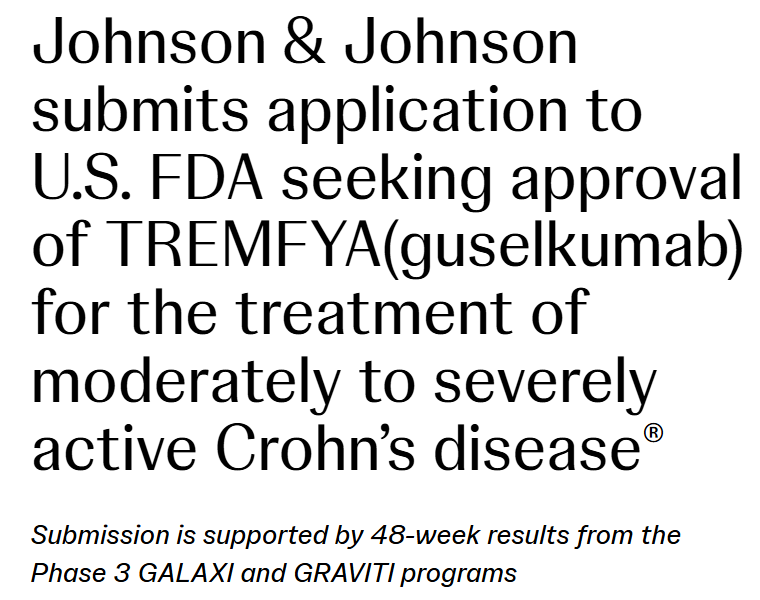 GRAVITI Study is a randomized, double-blind, placebo-controlled clinical trial that evaluated the efficacy and safety of guselkumab (SC) induction therapy in patients with moderate to severe active Crohn's disease (CD) who had an inadequate response or were intolerant to conventional treatments (i.e., corticosteroids or immunomodulators) or biologics (TNF antagonists or vedolizumab). The primary endpoints of the study were the proportion of patients achieving clinical remission at week 12 and the proportion achieving endoscopic response.The results showed that at the 12th week of treatment,Guselkumab (SC) GroupThe clinical remission rate and endoscopic response rate of patients were significantly higher than those in the placebo group.In April this year,Two head-to-head Phase III studies (GALAXI 2 and GALAXI 3) comparing the SC formulation of Guselkumab with Ustekinumab also met the superiority endpoint.The GALAXI series of studies is a randomized, double-blind, placebo- and active-controlled Phase II/III trial that evaluated the efficacy and safety of guselkumab compared to ustekinumab and placebo in both induction and maintenance therapy for patients with moderate to severe active Crohn's disease (CD) who have had an inadequate response or intolerance to conventional therapies (corticosteroids or immunomodulators) and/or biologics (TNF antagonists or vedolizumab).The study consists of two phases: Phase 1 is a Phase II study (GALAXI 1 study) aimed at determining the appropriate induction and maintenance doses; Phase 2 is a Phase III study (GALAXI 2 and GALAXI 3 studies) designed to evaluate the efficacy and safety of guselkumab. The primary endpoints of Phase 2 are the proportion of patients achieving clinical remission at Week 12 and the proportion of patients achieving endoscopic response at Week 48.The results showed that, in terms of the endoscopic response endpoint,The Guselkumab group was superior to the Ustekinumab group.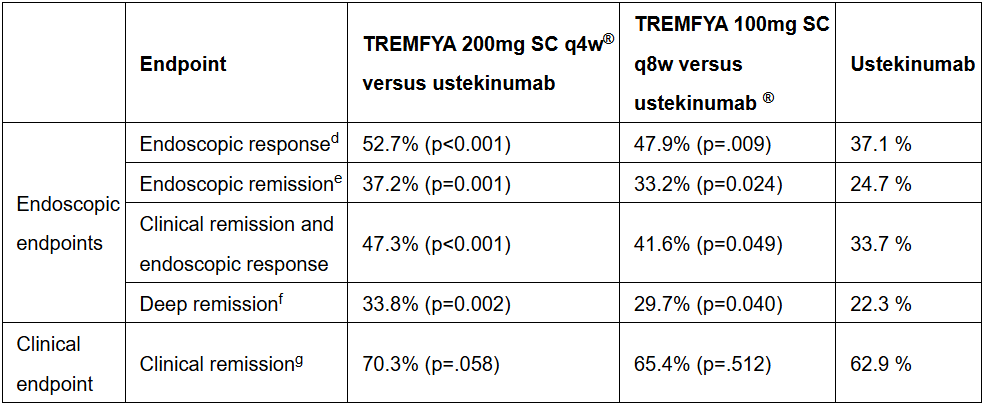
Source: Digestive Diseases Week 2024 ConferenceCopyright © 2024 PHARMCUBE. All Rights Reserved.
Welcome to forward, share, and reasonably cite. When citing, please clearly indicate the source of the article.For reprint, please leave a message or send a message to the WeChat Official Account backend, and indicate the name and ID of the official account.
Disclaimer: The information in this WeChat article is for general reference only and should not be directly used as decision-making content. PharmaCube assumes no responsibility for any loss incurred by any party due to the use of the content herein.
↑Click to scan the code and go directly to the live broadcast room↑



