Hansoh Pharma and Innovent Announce Latest Clinical Results of Small Molecule GLP-1R/GIPR Agonist HS-20094 and GLP-1R/GCGR Dual Agonist Mazdutide at ADA 2024
Hansoh Pharma
Pharmaceutical Research, Production, and Sales

Innovent
High-end Biologics Developer
The highly anticipated 2024 American Diabetes Association (ADA) Annual Meeting was held in Orlando, USA, from June 21 to 24. The conference showcased the latest research findings on new hypoglycemic drugs such as semaglutide and dulaglutide, as well as the latest discoveries in the popular weight loss field, including tirzepatide and masotide, truly a "profusion of flowers."(List attached at the end)。
Hansoh Pharma Small Molecule GLP-1 Drug
>>Research Results
A Randomized, Double-blind, Placebo- and Positive-controlled Phase IIa Clinical Trial to Evaluate the Safety, Tolerability, Pharmacokinetics, and Pharmacodynamics of Multiple Doses of HS-20094 in Subjects with Type 2 Diabetes Mellitus Poster Number: 733-P
>>Study Design:
• A randomized, double-blind, placebo-controlled and active-controlled (semaglutide) Phase IIa clinical trial;
• Aim to evaluate the safety, tolerability, pharmacokinetics, and pharmacodynamics of multiple doses of HS-20094 injection in subjects with type 2 diabetes;
• Study Groups: HS-20094 5mg group, HS-20094 10mg group, HS-20094 15mg group, placebo group, semaglutide group;
• Administration method: Once a week, subcutaneous injection, for a total of 4 doses.
>>Research Results:
A total of 54 subjects received at least one dose, with 36 in the HS-20094 group, 9 in the semaglutide group, and 9 in the placebo group.
In terms of safety:In subjects with type 2 diabetes, HS-20094The overall safety and tolerability were good.; The most common gastrointestinal AEs included bloating, nausea, diarrhea, etc. The severity of AEs was mainly mild to moderate (98%), with only one SAE unrelated to the study drug occurring in the HS-20094 5mg group; no SAEs occurred in the HS-20094 10mg group, HS-20094 15mg group, placebo group, or semaglutide group at any stage of the study. No severe hypoglycemic events occurred in this study; no AEs leading to withdrawal from the trial; no AEs leading to dose adjustment; and no AEs leading to death.
Pharmacokinetics: After four consecutive subcutaneous injections of 5-15mg HS-20094, the average Tmax was 16h-24h, the average half-life T1/2 was 142h-168h, and the exposure (Cmax and AUC) increased approximately in proportion to the dose.
Pharmacodynamics:
>>Hypoglycemic Aspect:
After 4 weeks of administration, the Day 23 OGTT glucose AUC0-2h of each dose group of HS-20094 decreased in a dose-dependent manner compared to baseline. The Day 23 OGTT insulin AUC0-2h and C-peptide AUC0-2h of each dose group of HS-20094 increased compared to baseline. The magnitude of the above changes in each dose group of HS-20094 was significantly better than that of the placebo group. HS-20094The decrease from baseline in the 15mg group was greater than that in the semaglutide group.。
HS-20094: HbA1c levels on Day 29 decreased from baseline in all dose groups, with the magnitude of reduction showing dose dependency and being significantly higher than in the placebo group.。
>>Weight Loss:
During the 4-week study period, the body weight and body mass index of all dose groups of HS-20094 showed a continuous decline. The extent of the decline was dose-dependent and significantly superior to that of the placebo group. The weight loss from baseline in the HS-20094 15mg group was greater than that in the semaglutide group.
>>Research Conclusion:
The above data shows,HS-20094 at all doses showed significantly superior results in blood sugar reduction and weight loss compared to the placebo group. Data comparing HS-20094 with semaglutide will be released later.
Hansoh Pharma has currently launched and is accelerating the advancement of late-stage research on HS-20094 for patients with type 2 diabetes and those who are overweight or obese in China, hoping to bring more good news to such patients.
Innovent Bio's Masitideptide Achieves 14% Weight Loss in 48 Weeks
Mashiduo peptide is a GLP-1R and GCGR dual agonist jointly advanced by Innovent Bio and Eli Lilly. Recently,Data from the first Phase III weight loss registration clinical trial of Masitide, GLORY-1, to be presented as a major breakthrough(Late Breaking)Oral presentation and conference poster presentation.
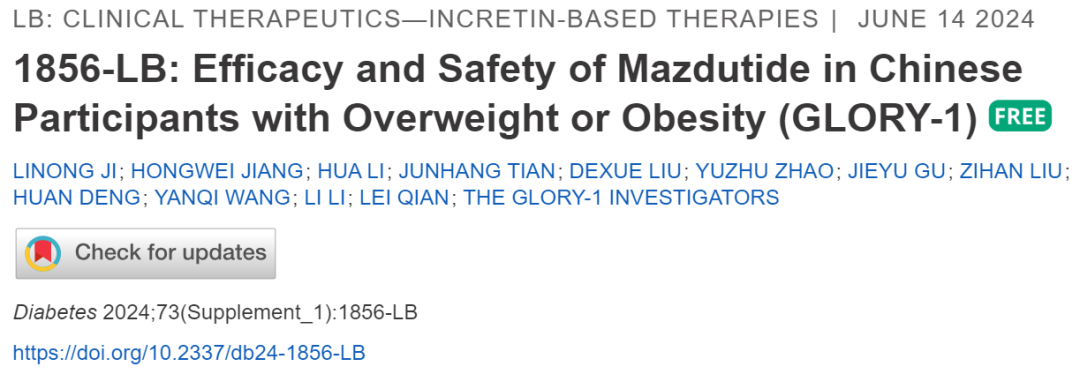
>>Study Design
Randomized, Double-Blind, Placebo-Controlled Phase 3 Trial (NCT05607680)
Evaluate the efficacy and safety of a once-weekly GLP-1R and GCGR dual agonist in Chinese participants who are overweight or obese.
A total of 600 subjects were enrolled and randomly assigned in a 1:1:1 ratio to the mazdutide 4mg group, mazdutide 6mg group, or placebo group for a treatment period of 48 weeks.
The primary endpoint was the percentage change in body weight from baseline at Week 32 and the proportion of participants with ≥5% reduction in body weight from baseline.
>>Research Results:
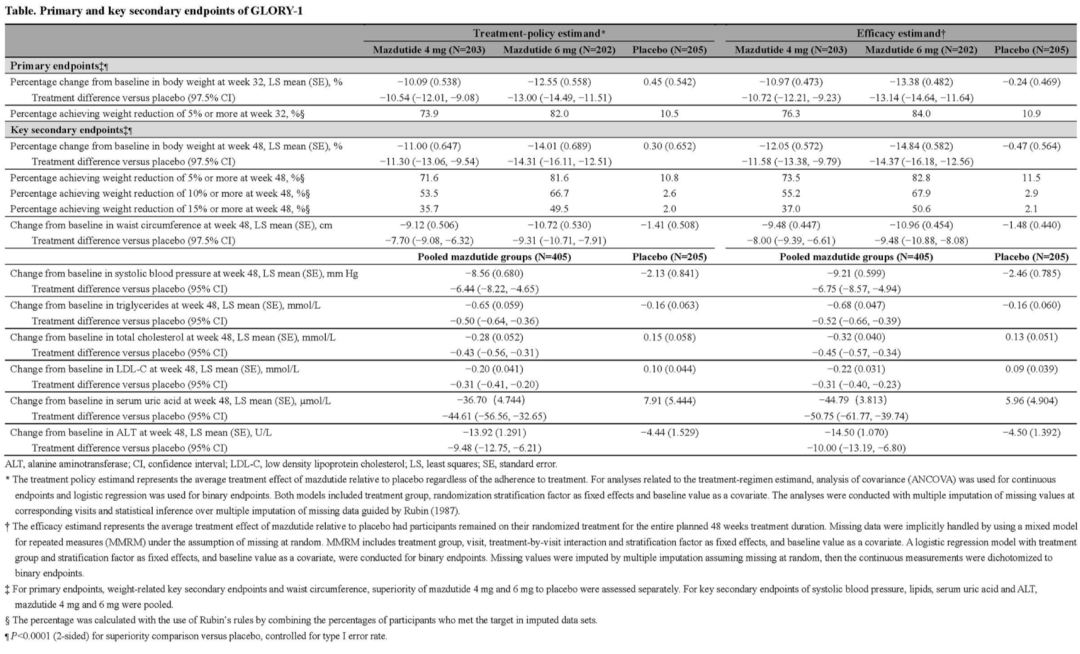
Compared with the placebo group, 4The 3 mg dose group lost 10.72% of their weight, and the 6 mg dose group lost 13.14%.. Key secondary endpoints,Percentage of weight loss after 48 weeks of treatment: 11.58% in the 4mg dose group and 14.37% in the 6mg dose group.At the same time, after 48 weeks of treatment, cardiovascular risk parameters were significantly reduced. Compared with the placebo group, the Mazdutide treatment group showed a blood pressure reduction of 6.75 mmHg, triglycerides decreased by 0.52 mmol/L, total cholesterol decreased by 0.45 mmol/L, LDL-C decreased by 0.31 mmol/L, serum uric acid decreased by 50.75 mmol/L, and ALT decreased by 10 U/L. Mazdutide achieved both the co-primary endpoints and all key secondary endpoints.Superior to placebo in terms of weight change, weight loss goals, and improvement in multiple cardiometabolic risk factors (Table)。
In terms of safetyMasitide was well tolerated, with discontinuation rates of 1.5% and 0.5% in the 4mg and 6mg dose groups, respectively, compared to 1.0% in the placebo group. The most commonly reported adverse events were gastrointestinal events, mostly mild to moderate in severity.
>>ResearchConclusion:
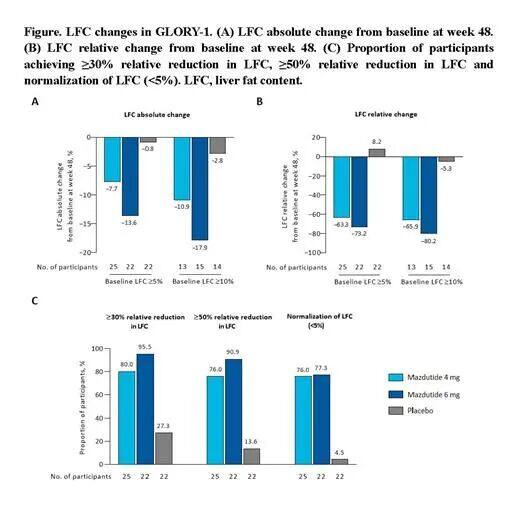
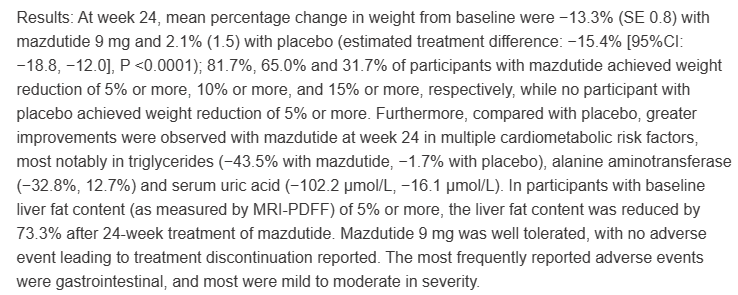
Innovent Bio also announced the latest data from the Phase II clinical trial of Mastytide 9mg high-dose.Weight loss of 15.4% and liver fat reduction of 73.3% after 24 weeks of treatmentMashiduo Peptide 9 mg demonstrated robust weight loss and significant liver benefits.
The detailed data of the Phase III clinical trial GLORY-1 shows that, in addition to significant weight loss effects, Madutide also demonstrates particularly remarkable lipid-lowering effects, which reflectsGCGR TargetThe advantage.
Recently, Eli Lilly and Company inNature MedcinePublished onGLP-1R/GCGR/GIPRPhase IIa Study Data of Receptor Triple Agonist Retatrutide for MASLD. Retatrutide shows excellent results in reducing liver fat content in MASLD patients, with a maximum reduction of up to 86%.
Boehringer IngelheimGLP-1R/GCGR Dual AgonistThat is, to simultaneously advance the phase III clinical trials for glycemic control, weight loss, and NASH.
To support the development of GIP, GLP-1, and GCG-related drugs, Gemple Biotech has constructed various overexpression cell models of GIPR, GLP-1R, and GCGR based on the cAMP signaling pathway, enabling the screening of in vitro GIPR, GLP-1R, and GCGR agonists and antibody drugs.
2024 ADA Major Research Announcement
References:
2024 ADA、Medliveetc.





Previous Review