

Tupai Medical's Beiming Swept-Source OCTA Chosen as the Sole Chinese-Made Device in Singapore's BIOCIS Study on Dementia Biomarkers

TowardPi
High-end Ophthalmic Medical Device Developer

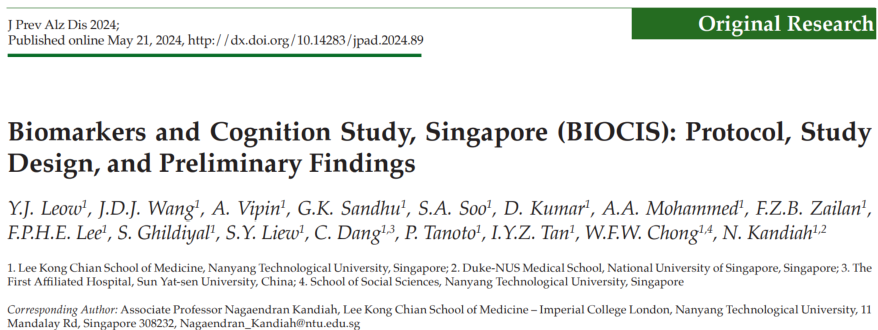
In the field of dementia, we have a profound understanding of the early recognition of Alzheimer's disease (AD) and other dementias, pharmacological and non-pharmacological treatments for dementia, as well as modifiable risk factors for slowing and preventing cognitive decline.
Previous studies have shown that biomarkers already appear in the early stages of cognitive impairment, with plasma, brain imaging, retina, and microbiome serving as markers of accelerated neurodegeneration occurring before cognitive decline. This provides a critical window of opportunity for the early diagnosis of cognitive impairment. Therefore, characterizing fluid and neuroimaging biomarkers, disease progression, neuropsychological and clinical outcomes to study the underlying pathobiology of cognitive impairment holds significant clinical value.
The Biomarkers and Cognition Study, Singapore (BIOCIS) is a 5-year longitudinal study initiated by the Lee Kong Chian School of Medicine at Nanyang Technological University in Singapore, with participation from multiple institutions including Duke-NUS Medical School, the First Affiliated Hospital of Sun Yat-sen University, and the School of Social Sciences at Nanyang Technological University.The goal is to study the underlying mechanisms of cognitive impairment and dementia by collecting fluid biomarker profiles, neuroimaging and retinal changes, neuropsychological and clinical outcomes from multi-ethnic populations in Southeast Asia. The research plan and other content have been published in the internationally top-tier journal JPAD, the *Journal of Prevention of Alzheimer's Disease* (Impact Factor 6.4).
Among them,Data collection of the fundus retina will use TowardPi's self-developed technology.400,000-speed ultra-widefield swept-source OCTA was used to collect information on retinal and choroidal structures, as well as blood flow. This marks the first time that TowardPi's technology has been included in an overseas research project.。
BIOCIS is a 5-year longitudinal study that evaluates participants annually. A total of 2,500 participants aged 30 to 95 will be recruited from communities in Singapore. Participants will undergo assessments through neuroimaging, fluid biomarkers, cognitive evaluations, behavioral and lifestyle factors, retinal scans, and microbiome indices to identify biomarkers for dementia.
In the first year of the project's research, both blood tests and neuroimaging examinations showed positive findings. Compared with the healthy control group, the cognitively impaired group exhibited higher levels of blood lipids and glucose. The levels of biomarkers in the blood (i.e., GFAP, P-tau181, Oaβ, aβ 42, and aβ 40) were significantly elevated, surpassing those in the cognitively unimpaired (CU) group. Regarding APOE genotypes, the proportion of the APOE ε2 gene was slightly higher in the healthy control group. Conversely, the APOE ε4 gene was more prevalent in the mild cognitive impairment and dementia groups. This suggests that the APOE ε2 allele may offer some protective effect against the onset of dementia, while APOE ε4 is associated with earlier onset and a higher likelihood of dementia.
Neuroimaging examinations show that as the lesion group progresses, white matter lesions worsen and hippocampal atrophy becomes progressive. White matter abnormalities can disrupt neural communication and exacerbate cognitive deficits, making them a key focus for early detection and intervention. Upon completion of data collection, the BIOCIS project can be compared with Western longitudinal studies such as the Alzheimer's Disease Neuroimaging Initiative (ADNI) and the UK Biobank to investigate phenotypic differences across ethnicities.
Ocular information was collected using TowardPi's 400,000-speed全域扫频OCTA to capture retinal information, combined with a laser speckle flowgraphy system (LSFG) for real-time assessment to gather retinal hemodynamic information.
The BIOCIS longitudinal study will help identify new biomarkers, pathological trajectories, epidemiology of dementia, and reversible risk factors in Southeast Asian populations. Completion of the BIOCIS longitudinal study can enhance our understanding of risk stratification in Asian populations and may inform public healthcare and precision medicine, thereby benefiting patients in the prevention of Alzheimer's disease and dementia.

Associate Professor, Director of the Centre for Cognitive Neuroscience at the Lee Kong Chian School of Medicine, Nanyang Technological University, Singapore. Senior neurologist specializing in cognitive neurology and vascular neurology. He also serves as a Clinician Scientist at the National Medical Research Council of Singapore.

Content Writing:Li Xin TowardPi Medical
Content Review:Jian Zhou, TowardPi Medical

— Scan the QR code to follow us —


WeChat Official Account
WeChat Video Channel
