

Tides Weekly | Global Peptide and Oligonucleotide Therapeutics News Roundup
Sirnaomics
RNA Interference New Drug Developer
Recently, Eli Lilly published the Phase IIa study (NCT04881760) data of GLP-1R/GCGR/GIPR agonist Retatrutide (LY3437943) for the treatment of Metabolic Dysfunction-Associated Steatotic Liver Disease (MASLD, formerly known as Nonalcoholic Steatotic Liver Disease (NASLD)) in the journal *Nature Medicine*. Overall, Retatrutide showed excellent results in reducing liver fat content in MASLD patients, with a maximum reduction of up to 86%.
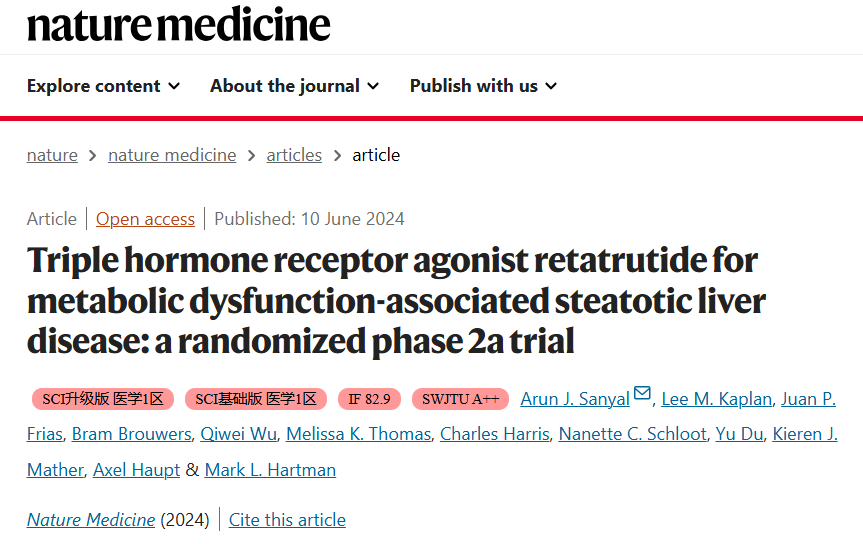
From May 20, 2021, to November 22, 2022, a total of 338 patients were enrolled to receive Retatrutide (1/4/8/12mg, once weekly) or placebo treatment. Among them, 98 patients (29.1%) had liver fat content ≥10% (assessed by magnetic resonance imaging proton density fat fraction [MRI-PDFF]).) were included in the MASLD sub-study. The efficacy and safety analysis population of the sub-study included 98 patients, with a baseline mean liver fat content of 19.1%.
About GLP-1 Receptor Agonists
GLP-1 is a naturally occurring incretin in the human body that exerts therapeutic effects by activating widely distributed GLP-1 receptors, but it degrades very easily. However, the discovery of GLP-1 has provided a completely new approach for diabetes and obesity. Through relentless efforts, researchers have developed clinically usable GLP-1 receptor agonists (GLP-1RA) / GLP-1 analogs. As a new type of hypoglycemic drug, GLP-1 receptor agonists (GLP-1RA) / GLP-1 analogs are partially or completely homologous to the amino acid sequence of natural GLP-1 in the body, possess the same biological activity, are not easily degraded by enzymes, and their effects last significantly longer, thus better meeting clinical treatment needs.
About Eli Lilly and Company
Eli Lilly and Company is a globally leading pharmaceutical company engaged in the research, development, production, and sale of medicines, committed to improving human health through innovation. Eli Lilly and Company was founded over a century ago, established in 1876 by Colonel Eli Lilly in Indiana, USA, with the founder dedicated to producing high-quality medicines to meet real medical needs.
On June 14, 2024, Sirnaomics Ltd. announced that the group had published significant progress on its novel oligonucleotide-drug conjugate (ODC). The ODC demonstrated potent anti-tumor activity in various tumor cell lines and a mouse model of pancreatic cancer. This research was published in the latest issue of the Journal of Cancer Research and Treatment (June 2024: p1-16, Vol. 9, No. 02). This breakthrough work lays a solid foundation for the company’s RNAi-based cancer therapeutic program, which utilizes a proprietary antibody-oligonucleotide-drug conjugate (AODC) platform.
The published results are an extension of prior research (NAR Cancer, 2020, Vol. 2, No. 3, p1-12). Using a proprietary anticancer ODC agent, this anticancer ODC agent contains double-stranded siRNA targeting CHK1 mRNA, with gemcitabine incorporated into its sense strand in place of cytidine. Gemcitabine, a small-molecule anticancer drug, has a synergistic effect with CHK1 inhibitors, increasing the combined IC50 by approximately 100-fold across different cell lines. In the latest study, the ODC construct includes chemically modified bases to enhance stability, and this structure improves the potency and efficacy of anti-CHK1 gene expression. In vitro testing demonstrated the significant antitumor activity of gemcitabine-containing CHK1-specific siRNA using pancreatic, NSCLC, TNBC, and ovarian cancer cell culture models. This construct also...Efficacy against pancreatic tumors demonstrated in mouse xenograft models — tumor elimination upon intravenous administration using Sirnaomics' proprietary peptide nanoparticle formulation.
About Sirnaomics
Sirnaomics is an RNA therapeutics biopharmaceutical company with its pipeline candidates in clinical and preclinical stages, focusing on exploring and developing innovative drugs for the treatment of indications with significant medical needs and large market opportunities. Sirnaomics is the first clinical-stage RNA therapeutics biopharmaceutical company to hold a significant market position in both Asia and the United States.
On June 14, 2024, Puli Pharmaceuticals received an official response document from the U.S. FDA approving the initiation of human clinical trials for its Class 1 new drug, the antimicrobial peptide PL-3301 oral gel, allowing the conduct of human clinical research and validation for this product.

About the antimicrobial peptide PL-3301 oral gel
The mechanism of action of antimicrobial peptide PL-3301 involves targeting the fungal cytoplasmic membrane to kill fungi, causing loss of cell membrane integrity or rupture, which leads to fungal cell death. Antimicrobial peptide PL-3301 demonstrates highly effective fungicidal advantages against various oral Candida species and antibiotic-resistant Candida strains. Its antimicrobial activity has been effectively validated in preclinical in vitro tests and animal models. If successful in clinical development, this product will provide a promising treatment for oropharyngeal candidiasis.Treatment of candidiasis and current medical practice provide new options. This project belongs to first-in-class and first-in-concept drugs, and is the first antimicrobial peptide anti-oral fungal infection drug created in China.
AboutPulai Pharmaceuticals
Pulai Pharmaceutical is a high-tech biopharmaceutical enterprise mainly engaged in the research, development, and production of innovative peptide drugs. The company owns internationally leading platforms for de novo design of antimicrobial peptide drugs and innovative peptide formulation platforms. Its pipeline of drug candidates under development is extensive, including several first-in-class varieties of antimicrobial peptides and antitumor peptide mimetics, as well as various forms of innovative peptide formulations such as sprays, suppositories, gels, inhalants, and injectables. The company’s industrial base is equipped with world-leading production lines for peptide sprays and peptide suppositories, holds dozens of invention patents, and has received support from multiple projects under China's National Science and Technology Major Project for "Key New Drug Creation."
On June 18, 2024, Ascidian Therapeutics announced a potential collaboration agreement with Roche to develop RNA exon editing therapies for neurological disorders. Ascidian will receive an upfront payment of $42 million and is eligible for up to $1.8 billion in research, clinical, and commercial milestone payments, as well as royalties on global commercial sales.
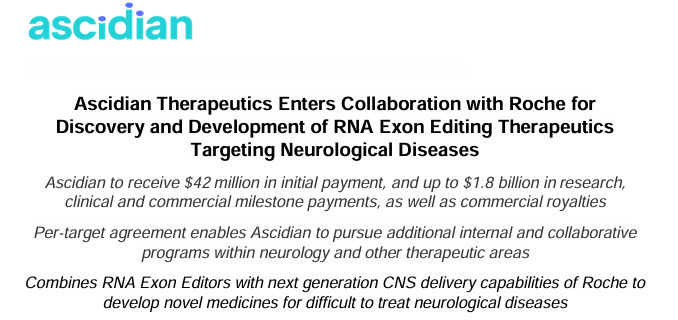
According to the agreement, Ascidian will grant Roche exclusive rights to its RNA exon editing technology for a specific undisclosed neuroscience target. Ascidian will collaborate with Roche on drug discovery and certain preclinical research, while Roche will be responsible for certain preclinical studies as well as further clinical development, manufacturing, and commercialization of the candidate drugs.
Ascidian's RNA Exon Editing Platform is an innovative RNA exon therapy designed by combining advanced computational biology with high-throughput molecular biology screening. The designed RNA exons contain the correct RNA sequence and can interact with the target precursor messenger RNA (pre-mRNA), replacing the cell's own mutated exon through trans-splicing to achieve therapeutic effects. Ascidian's RNA Exon Editing Platform is capable of targetingTargeting large genes and highly variable genes while maintaining natural gene expression patterns and levels, supporting RNA exon editing on the kilobase scale.
AboutAscidian Therapeutics
Ascidian Therapeutics is a biotechnology company dedicated to advancing its technology for medical and clinical gene therapy applications while further developing its pipelines in ophthalmology, neurology, neuromuscular, and rare diseases. Ascidian is currently focused on advancing its lead program, the ABCA4 exon editor, into clinical trials to treat retinal disorders, including Stargardt disease (STGD1), which causes fundus flavimaculatus.
June 20, 2024Silence Therapeutics Co.Sirnaomics' siRNA TherapyZerlasiran(SLN360) for the treatment of patients with elevated lipoprotein(a) levelsIIPhaseWeek 48 Results of the ALPACAR-360 Study.
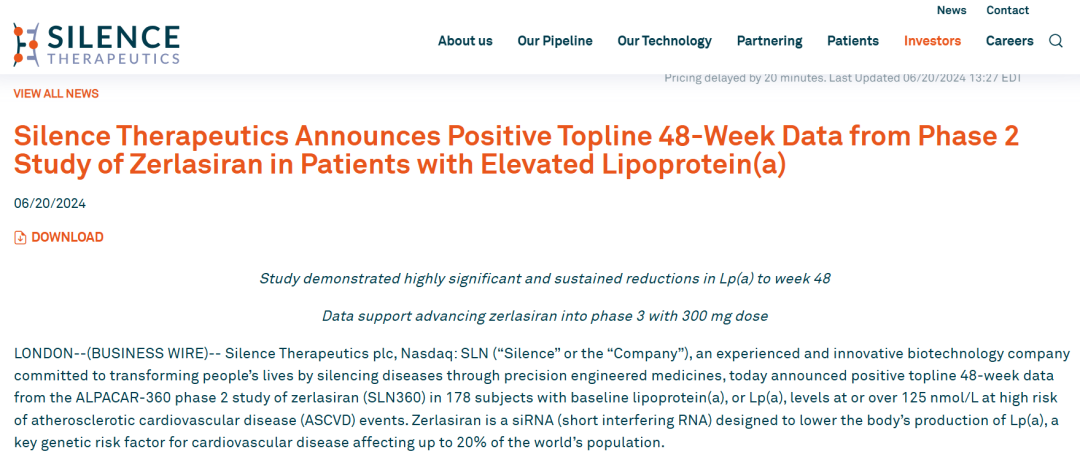
This study is a multicenter, randomized, double-blind, placebo-controlled clinical trial (n=178) that evaluated the efficacy and safety of Zerlasiran (300mg every 4 months or 450mg every 6 months) in high-risk populations with elevated lipoprotein(a) levels and atherosclerotic cardiovascular disease (ASCVD). The primary endpoint was the change in lipoprotein(a) levels from baseline (≥125nmol/L) at week 36.
TheThe study reached its primary endpoint in March this year. The results showed that at week 36 of treatment, the level of lipoprotein(a) in patients in the Zerlasiran group decreased by more than 90%.
The 48-week results of this update are consistent with the 36-week results, and the reduction in lipoprotein(a) levels in patients in the Zerlasiran group still maintained an effect of over 90%.
June 2024On the 20th, Huadong Medicine's wholly-owned subsidiary, Hangzhou Zhongmei Huadong Pharmaceutical Co., Ltd. (hereinafter referred to as "Zhongmei Huadong"), announced that its self-developed innovative oral small molecule GLP-1 receptor agonist HDM1002 tablets achieved positive results in Phase Ia and Ib clinical trials in China.

The Phase Ia study announced this time enrolled 79 healthy subjects, aiming to evaluate the safety, tolerability, and pharmacokinetics of single oral doses of HDM1002 with dose escalation. The results showed that postprandial blood glucose levels in subjects who took HDM1002 tablets significantly decreased compared to placebo after 2 hours, showing a dose-dependent effect. Meanwhile, HDM1002 tablets exhibited linear pharmacokinetics at doses ranging from 10mg to 600mg, with good safety and tolerability, and all adverse events were grade 1 or 2 in severity.
Phase Ib Study Aims to Evaluate the Efficacy and Safety of HDM1002 Tablets in Overweight and Obese Adult Subjects, Enrolling 60 Patients. Results Showed that by Day 28, the Weight Loss in Subjects Receiving 100mg or Higher Doses of HDM1002 Tablets was Significantly Superior to the Placebo Group, Demonstrating a Dose-Dependent Effect. Within the Target Dose Range, Subject Weight Decreased Compared to Baseline.The line decreased by an average of 4.9% to 6.8%. Common adverse events in the study were gastrointestinal-related, with the majority being mild nausea and vomiting.
AboutHDM1002 Tablets
HDM1HDM1002 is an innovative small-molecule drug independently developed by Sinopharm Huadong, with global intellectual property rights. It is a potent, highly selective, orally active full agonist of the GLP-1 receptor. Preclinical studies have shown that HDM1002 can strongly activate the GLP-1 receptor, induce the production of cyclic adenosine monophosphate (cAMP), and has significant effects in improving glucose tolerance, lowering blood sugar, and reducing weight, while demonstrating good safety.
About Huadong Medicine Co., Ltd.
Huadong Medicine Co., Ltd. (Stock Code: 000963) was established in 1993, with its headquarters in Hangzhou, Zhejiang. It was listed on the Shenzhen Stock Exchange in December 1999.
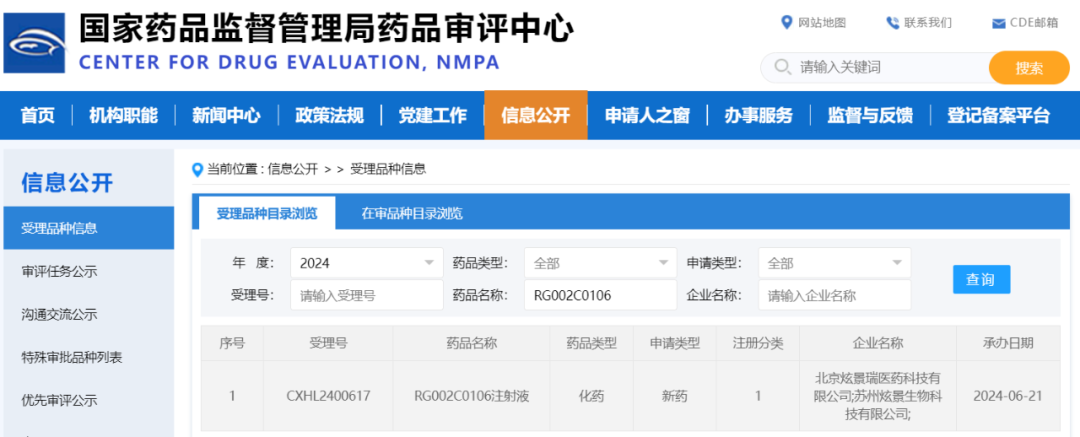
On June 21, 2024, Sirnaomics announced that its self-developed small nucleic acid (siRNA) Class I innovative drug "RG002C0106 Injection" for the treatment of complement-related diseases has been officially accepted by the Center for Drug Evaluation (CDE) of the National Medical Products Administration (NMPA).
RG002C0106 Injection is an siRNA drug developed by Xuanjing Biotechnology based on its proprietary core technology platforms such as RIHOST®, RICMO®, and LICOD®. It is efficiently delivered to hepatocytes through second-generation N-acetylgalactosamine (GalNAc) conjugation technology, inhibiting the expression of complement factors in the liver to treat complement-mediated related diseases. Preclinical studies have demonstrated that RG002C0106 exhibits excellent efficacy, safety, and long-lasting effects, validated across various preclinical animal models, including rodents and non-human primates. Particularly, significant dose-dependent improvements in a series of clinical trial endpoints were observed in cynomolgus monkey disease models, showing great potential to become the world's first-in-class (FFirst-in-Class) drug.
About Sirnaomics
Suzhou Xuanjing Biotechnology Co., Ltd. and Beijing Xuanjing Rui Pharmaceutical Technology Co., Ltd. (Xuanjing Bio) were established in 2022. The company focuses on the research, development, and industrialization of innovative small nucleic acid drugs, rooted in China while targeting the global market ("In China, For Global"). It is committed to becoming a leading innovator and transformative force in the field of nucleic acid pharmaceuticals.