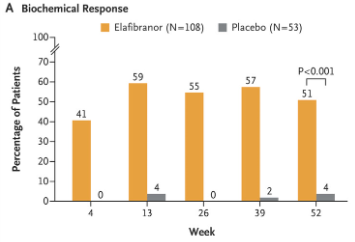
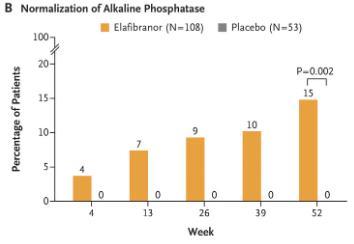
Primary Biliary Cholangitis is an autoimmune liver disease in which small bile ducts are destroyed. As a result, the amount of bile and toxins in the liver increases, potentially leading to cirrhosis, portal hypertension, and liver failure [1]. This disease causes elevated levels of alkaline phosphatase, γ-glutamyl transferase, and bilirubin. Patients with this autoimmune condition experience pruritus and fatigue, impacting their quality of life. Ursodeoxycholic acid is a crucial treatment for improving survival rates in patients with this disease. However, many patients may not respond to this medication.In June 2024, the French biopharmaceutical company Ipsen announced that the new drug Elafibranor (Iqirvo) received accelerated approval from the U.S. Food and Drug Administration (FDA) for the treatment of patients with primary biliary cholangitis [2]. This first-in-class drug, developed by Genfit, is an agonist of peroxisome proliferator-activated receptors (PPAR) α and δ, which reduces bile acid production. Primary biliary cholangitis patients who do not respond to ursodeoxycholic acid can receive combination therapy with ursodeoxycholic acid and Elafibranor. Patients who are intolerant to ursodeoxycholic acid can only receive Elafibranor. Patients with decompensated cirrhosis should not take this medication.The drug was approved based on the results of the Phase 3 clinical trial ELATIVE. This clinical trial recruited 161 patients with primary biliary cholangitis who either responded poorly to ursodeoxycholic acid or experienced unacceptable adverse reactions. Among them, 108 patients received Elafibranor treatment, while 53 patients received a placebo [3]. The dose of Elafibranor was 80 milligrams, taken orally once daily by the patients. Researchers evaluated whether patients achieved a biochemical response after taking the medication. To achieve a biochemical response, a patient's alkaline phosphatase level should be less than 1.67 times the upper limit of the normal range, and their alkaline phosphatase level should decrease by 15% or more compared to before the study began. Additionally, the patient’s total bilirubin level should also remain within the normal range. The results of this clinical trial were presented at the 2023 American Association for the Study of Liver Diseases (AASLD) Annual Meeting.Among patients receiving Elafibranor, 51% exhibited a biochemical response, compared to 4% of those receiving placebo. In the Elafibranor group, 15% of patients showed normalization of alkaline phosphatase levels, whereas none of the patients in the placebo group experienced normalization. Common adverse reactions caused by Elafibranor include abdominal pain, vomiting, and weight gain.Percentage of patients achieving biochemical response [3]Percentage of patients with normalized alkaline phosphatase levels [3]The new findings from this clinical trial were presented at the European Association for the Study of the Liver (EASL) 2024 Annual Meeting. Patients were required to complete the 5-D Itch and PBC-40 questionnaires after taking the medication. At week 52, the clinical trial showed that Elafibranor improved pruritus compared to placebo based on the PBC-40 itch domain and 5-D Itch scores [4]. According to the 5-D Itch score, 58% of patients receiving Elafibranor and 27% of patients receiving placebo experienced improvement in pruritus. At 78 weeks of treatment, 13 patients continued on placebo, and 30 patients continued on Elafibranor. Seventy percent of patients treated with Elafibranor showed a biochemical response, while none of the patients treated with placebo exhibited a biochemical response.Elafibranor had previously received breakthrough therapy designation from the FDA for the treatment of patients with primary biliary cholangitis who respond inadequately to ursodeoxycholic acid. In a 12-week Phase II clinical trial, 45 patients with primary biliary cholangitis were assigned to receive either 120 mg of Elafibranor, 80 mg of Elafibranor, or a placebo [5]. Compared to the placebo, this drug significantly reduced patients' alkaline phosphatase levels [6]. It also improved patients' anti-inflammatory markers and γ-glutamyl transferase [7]. In later-stage clinical trials, Elafibranor proved ineffective for another liver disease. In the Phase III clinical trial RESOLVE-IT, 19.2% and 14.7% of non-alcoholic steatohepatitis patients treated with Elafibranor and placebo, respectively, showed resolution of their condition [8]. Similarly, the drug improved fibrosis in 24.5% of patients, while the placebo improved fibrosis in 22.4% of patients.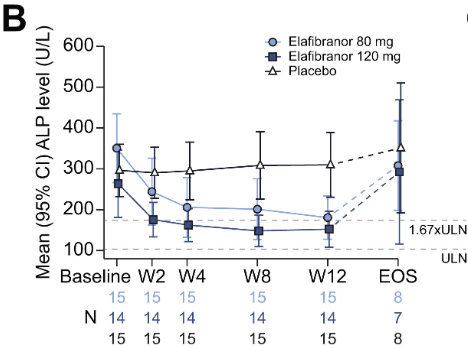 Decrease in Alkaline Phosphatase Levels in Patients Treated with Elafibranor and Placebo [5]FDA had previously approved obeticholic acid (Ocaliva) in 2016 for the treatment of this disease [9]. The drug is a bile acid analog that activates the farnesoid X receptor (FXR) in hepatocytes. In a phase 3 clinical trial, 73 patients with primary biliary cholangitis were assigned to receive 10 mg of obeticholic acid, 73 patients were assigned to receive a placebo, and 71 patients were assigned to receive 5 mg of obeticholic acid (which could be increased to 10 mg) [10]. The primary endpoint of the clinical trial was that patients' total bilirubin levels should be below or at the upper limit of the normal range, and their alkaline phosphatase levels should decrease by 15% or more compared to before the start of the clinical trial. Patients' alkaline phosphatase levels should also be less than 1.67 times the upper limit of the normal range. Among patients treated with 10 mg of obeticholic acid, 47% reached this primary endpoint, and among those treated with 5 mg of obeticholic acid, 46% reached this primary endpoint. In contrast, only 10% of patients receiving the placebo reached this primary endpoint. Compared with the placebo, obeticholic acid significantly reduced the levels of conjugated bilirubin and γ-glutamyl transferase.
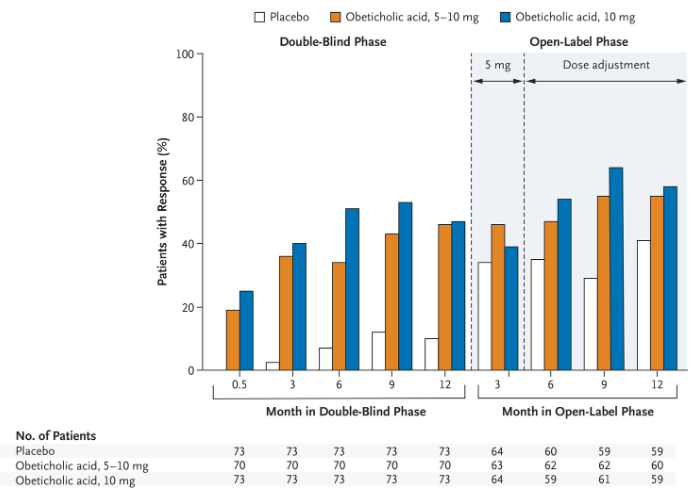 Number of patients reaching the primary endpoint [10]In summary, Elafibranor can effectively control disease progression and improve pruritus symptoms in patients with primary biliary cholangitis. The drug is well-tolerated by patients.
References:
[1] Tanaka, A. (2024). New Therapies on the Horizon for Primary Biliary Cholangitis. Drugs, 84(1), 1-15.
[2] Ipsen (2024, 10 June). Ipsen’s Iqirvo® receives U.S. FDA accelerated approval as a first-in-class PPAR treatment for primary biliary cholangitis. https://www.ipsen.com/press-releases/ipsens-iqirvo-receives-u-s-fda-accelerated-approval-as-a-first-in-class-ppar-treatment-for-primary-biliary-cholangitis/
[3] Kowdley, K. V., Bowlus, C. L., Levy, C., Akarca, U. S., Alvares-da-Silva, M. R., Andreone, P., ... & Schattenberg, J. M. (2024). Efficacy and safety of elafibranor in primary biliary cholangitis.New England Journal of Medicine, 390(9), 795-805.
[4] Ipsen (2024, 5 June). Ipsen presents long-term elafibranor efficacy and itch-related quality of life data in patients with primary biliary cholangitis. https://www.ipsen.com/press-releases/ipsen-presents-long-term-elafibranor-efficacy-and-itch-related-quality-of-life-data-in-patients-with-primary-biliary-cholangitis/
[5] Schattenberg, J. M., Pares, A., Kowdley, K. V., Heneghan, M. A., Caldwell, S., Pratt, D., ... & Luketic, V. (2021). A randomized placebo-controlled trial of elafibranor in patients with primary biliary cholangitis and incomplete response to UDCA.Journal of hepatology, 74(6), 1344-1354.
[6] Naffouj, S., & Wang, J. (2023). Current and future opportunities for the management of primary biliary cholangitis.Frontiers in Gastroenterology, 2, 1241901.
[7] Genfit (2019, 18 April). GENFIT announces FDA Grant of Breakthrough Therapy Designation to Elafibranor for the Treatment of PBC. https://ir.genfit.com/news-releases/news-release-details/genfit-announces-fda-grant-breakthrough-therapy-designation
[8] Genfit (2020, 11 May). GENFIT: Announces Results from Interim Analysis of RESOLVE-IT Phase 3 Trial of Elafibranor in Adults with NASH and Fibrosis. https://ir.genfit.com/news-releases/news-release-details/genfit-announces-results-interim-analysis-resolve-it-phase-3
[9] FDA (2016, 31 May). FDA approves Ocaliva for rare, chronic liver disease. https://www.fda.gov/news-events/press-announcements/fda-approves-ocaliva-rare-chronic-liver-disease
[10] Nevens, F., Andreone, P., Mazzella, G., Strasser, S. I., Bowlus, C., Invernizzi, P., ... & Shapiro, D. (2016). A placebo-controlled trial of obeticholic acid in primary biliary cholangitis.New England Journal of Medicine, 375(7), 631-643.
Editor's WeChat
(Business Cooperation, Important Matters)


Editor Zhao's WeChat (Group Assistant)
Note: When adding WeChat, please indicate your nickname + organization + research.
Comprehensive Life Sciences Communication QQ Group: 681341860WeChat Academic Groups: Virology Group, Neuroscience Group, Clinical Medicine, Oncology Group, Master & Doctor Exchange Group, and Pharmaceutical Investment Exchange Group (The WeChat group review requirements are relatively high. After adding Editor Zhao, please actively indicate your institution and research direction in the remarks.)