

Eli Lilly Becomes World's Most Valuable Pharma Company Amid R&D Surge and Revenue Challenges
Eli Lilly
Global Pharmaceutical R&D and Production Company
In less than a week, Eli Lilly and Company made two shocking announcements.
On June 6, 2024, Eli Lilly and Company announced positive results from a Phase II clinical trial of its GLP-1 product tirzepatide for the treatment of Metabolic Dysfunction-Associated Steatohepatitis (MASH) at the annual meeting of the European Association for the Study of the Liver (EASL). Following this news, Eli Lilly's stock price surged 12.7% the next day, with its market value surpassing $800 billion.
Following this, the much-anticipated advisory committee meeting for the Alzheimer's antibody therapy donanemab, held on June 10, proceeded as scheduled, with discussion outcomes surpassing expectations. The FDA Peripheral and Central Nervous System Drugs Advisory Committee (PCNS) voted 11-0 in full support of Eli Lilly's donanemab efficacy, unanimously agreeing that its benefits outweigh the risks. As of the U.S. Eastern Time on June 10, Eli Lilly’s stock price surged another 15%, bringing its current market value to $822.1 billion.
Notably, in the past three years, Eli Lilly has experienced seven instances of single-day stock price fluctuations greater than 5%, three of which were related to the drug donanemab: one was the announcement of Phase II results, another was the approval of the competing drug Aduhelm, and the last was on June 10; two were related to the significant weight-loss drug Tirzepatide.
Given Eli Lilly's size, it is difficult to see a dramatic change in market value; moreover, while global pharmaceutical companies are fiercely competing in immunotherapy and oncology, Eli Lilly has broken through with Alzheimer’s disease (AD) and weight loss treatments. Despite not having a first-mover advantage in these two fields, its path to success is worth pondering.
It should be noted that, on the one hand, a review of Eli Lilly's development history reveals that its early pioneering journey was highly synchronized with the history of American pharmaceutical development; on the other hand, its growth strategy is markedly different from other multinational pharmaceutical giants of similar scale. This difference is reflected not only in its counter-mainstream development strategy but also in its unique product selection insight based on market pain points. These two threads are intertwined, jointly shaping the current Eli Lilly.
Closely following historical trends, double-clicking on social pain points + market pain points
Eli Lilly and Company was born at a critical juncture in the history of American chemical pharmaceuticals, and even in American history.
For approximately 200 years, the concept of a pharmaceutical industry and the foundation for large-scale drug production were nonexistent for European settlers along the North American coast. Medical treatment needs were largely reliant on imported medicines and folk remedies. The genesis of North America's pharmaceutical production industry can be traced back to the American Revolutionary War when the compounding efforts of ordinary pharmacists could no longer meet the demands of the military. As a result, laboratories and warehouses were established in Carlisle, Pennsylvania, to supply drugs to the army. Pennsylvania thus became the cradle of American pharmacy: the first hospital in Pennsylvania, the Pennsylvania Hospital, was founded in 1751; the first hospital pharmacy was established in 1752; and the first pharmaceutical college, the Philadelphia College of Pharmacy, was founded in 1821, also becoming the first center for drug production.
During this period, the predecessor of the American patent medicine industry (this "American patent medicine" does not refer to the modern sense but refers to medicines whose producers kept the ingredients secret and exaggerated their efficacy) continued to develop. The lack of professional doctors and delicate doctor-patient relationships, coupled with the rapid rise of the advertising industry, provided a vast market for these "patented formula" products. However, since many drug manufacturers used personal testimonials as evidence of drug efficacy, there were numerous scams involved.
In 1861, the American Civil War broke out. Colonel Eli Lilly, who served both as a pharmacist and a soldier, witnessed the horrific conditions in military camps: due to the prevalence of quack doctors and counterfeit drugs, 30 men from the 156-strong artillery unit he personally organized died from disease before even entering combat. Haunted by his wartime experiences, Colonel Lilly decided to open a pharmacy after retiring from the military—a pharmacy that would produce high-quality medications only recognized by pharmacists and made exclusively by pharmaceutical companies, setting itself apart from the chaotic world of "patent medicine" formulas.
In 1876, Colonel Eli Lilly founded Eli Lilly and Company in Indianapolis. As a family business, Colonel Eli Lilly started with only $1,400 and three employees: himself, his son Josiah, and a bottler. However, Colonel Lilly held firm beliefs and maintained strict management of the company, aiming to uphold integrity and ensure that his company would never be associated with the profit-driven workshops prevalent in the market. The cultural values of Eli Lilly began to take shape during this early period.
It is hard to say that the birth of Eli Lilly and Company was an accident. Around the time of the American Civil War, a group of pharmaceutical companies named after their founders emerged in the United States. Frederick Stearns and E.R. Squibb & Sons (Bristol-Myers Squibb) were established before the war and became major suppliers of medicine to the Union Army. Meanwhile, pharmacists like John Wyeth, William Warner, Louis Dohme, and doctors such as Walter Abbott and William E. Upjohn founded pharmaceutical manufacturing companies, all of which were named after the founders.
The pharmaceutical manufacturing industry in the United States is gradually taking shape, and the timing for the transition from small rural pharmaceutical operations to organized large-scale industries has matured. The emerging industry and the evolving profession are naturally interconnected, with both expressing urgent needs for quality and market expansion, driving the birth of companies like Eli Lilly and Company.
Overall, the following factors contributed to the emergence of the U.S. pharmaceutical production industry: (1) The market's urgent demand for pure and standardized products; (2) The birth of the Erie Canal and multiple railways, which improved the distribution system for pharmaceutical raw materials and final products; (3) Significant population growth and an enhanced quality of life, leading to increasing public health demands. The official establishment of the American Pharmacists Association (APhA) in 1852 helped bring these factors together into alignment.
Eli Lilly and Company began the production of fluid extracts and juices. However, Eli Lilly's early medicines were mainly quinine for treating malaria. Due to poor sanitary conditions at the time, malaria was rampant. Because of the high quality of Eli Lilly's products and its scientific production methods, its performance saw explosive growth in the early days of its establishment, earning a high reputation. Addressing the most urgent and troubling issues in public health became the direction of Eli Lilly’s R&D investment. Later, Eli Lilly launched products for treating syphilis, certain types of rheumatism, and skin diseases. In 1880, sales increased 11-fold, reaching $48,000.
From the late 19th century to the early 20th century, the pharmaceutical production industry in the United States was mainly composed of small and regional companies. Only a few enterprises, such as Squibb and Eli Lilly and Company, had plans to expand nationwide. Compared with other pharmaceutical companies, these two companies focused more on production rather than research and development (which was markedly different from Eli Lilly's later strategy). As early as 1879, Colonel Eli Lilly invited his younger brother to join the company’s sales team to promote their drugs across the United States. This marked the beginning of Eli Lilly's nationwide sales network, and the company gradually moved towards becoming a large, modern pharmaceutical enterprise.
Diversified M&A Is Not the Solution; Focusing on Breakthrough R&D Is the Best Strategy
World War I brought a decisive impact on the American pharmaceutical industry: the United States declared the patents of several German products, such as Salvarsan, Procaine, and Barbiturates, invalid, prompting domestic American companies to start building research and development operations. Initially, R&D was mainly limited to confirming quality, purity, and assay. It was during this time that Eli Lilly and Company followed the trend and established a research institution, aiming to pursue purity and applied research, which then became an unstoppable force.
In 1921, three scientists from the University of Toronto, Macleod, Banting, and Best, successfully extracted insulin from the pancreas of a dog. At the same time, Eli Lilly and Company's precise product selection insight, which has continued since its inception, led it to sign a cooperation agreement with the University of Toronto for the commercialization of insulin the following year. The University of Toronto granted Eli Lilly and Company more than a year of "monopoly period" before allowing other companies to produce and sell insulin.
In 1923, Eli Lilly launched its first insulin product, Iletin. At a time when there was a severe shortage of diabetes medications, the release of this drug caused a significant social impact. With its manufacturing and sales capabilities, Eli Lilly quickly capitalized on the patent window to capture the minds of major hospitals and users across North America, establishing its leading position in the field of diabetes treatment.
In 1928, Eli Lilly collaborated with two Harvard University scientists, Minot and Murphy, to introduce "Liver Extract 343," used for treating pernicious anemia and hematological disorders. In 1930, Eli Lilly again partnered with scientist Whipple from the University of Rochester to launch "Liver Extract 55." These three scientists subsequently won the Nobel Prize.
For the American pharmaceutical industry, the post-war period was a time of rapid expansion. Specifically for Eli Lilly and Company, the benefits brought by new product development were enough to make the company reconsider the investment ratio between production and R&D. After all, with the boost from a Nobel Prize-winning drug, Eli Lilly's sales reached $13 million in 1932, hardly affected by the Great Depression in the U.S.
Given the commercial potential and social demand for new drug development, after the 1950s, Eli Lilly and Company further increased its investment in drug research and development and vigorously expanded its global sales network. Following its public listing in 1952, Eli Lilly launched several blockbuster products in antibiotics, insulin, polio vaccines, analgesics, and oncology.
Eli Lilly's insistence on "breakthroughs" in new product development might be related to its previous setbacks from unclear focus in diversified development. In the 1970s, affected by the oil crisis, the pharmaceutical and chemical industries fell into depression. The pressure to make profits once led Eli Lilly to follow the trend of mergers and acquisitions, but with unfavorable revenue, forcing the company to increase R&D investment and take a less-traveled path.
At that time, Eli Lilly chose to abandon high-risk efforts to follow up on FIC targets. Instead, it focused on making improvements during the generic drug development process, aiming to create better drugs—me-better drugs. By concentrating resources on developing me-better drugs that could surpass breakthrough products, Eli Lilly achieved a much higher R&D efficiency compared to its peers.
From the 1970s to the 1980s, Eli Lilly and Company experienced a boom in pharmaceutical production: In 1971, it produced the antibiotic Keflex; in 1977, it launched the cardiac drug Dobutrex; in 1979, it introduced Ceclor, which became the world's best-selling oral antibiotic; additionally, there were the leukemia drug Eldisine, the anti-arthritis drug Oraflex, and the analgesic Darvon. Moreover, Eli Lilly and Company was one of the first pharmaceutical companies to enter the biotechnology field, launching the world’s first recombinant DNA-based drug—synthetic insulin—in 1982.
In 1986, Eli Lilly launched Prozac, a revolutionary product in the field of depression, marking another blockbuster in the company’s development history. With annual sales exceeding $2 billion, it was hailed by Fortune magazine as the "Drug of the Century." In the early 1990s, this division contributed nearly 20% of Eli Lilly's revenue, and this figure gradually increased to one-third of the company’s total revenue. After strategic refocusing, Eli Lilly achieved targeted innovation.
At the turn of the new millennium, the global pharmaceutical market experienced rapid growth. In order to quickly capture market share, a wave of mergers swept through the pharmaceutical giants. Despite the skyrocketing sales and thriving overseas operations of Eli Lilly and Company, the company remained indifferent to this trend. Instead, it continued to increase investment in research and development, becoming an outlier in the market at that time.
R&D Ratio Far Ahead, Boosting the Next Late-Mover Hit Product
Eli Lilly, a leader in the fields of depression and diabetes, has set its sights on Alzheimer's disease — an issue that has come into public view due to the worsening global aging problem and has become a public health concern where previous attempts have repeatedly failed. In 2022, research published in the *American Journal of Managed Care* indicated that the estimated medical costs associated with Alzheimer’s disease treatment were $321 billion. In response, Eli Lilly launched donanemab and quickly initiated Phase I clinical trials.
Eli Lilly reported the failure of the primary Phase III trials for solanezumab, its Alzheimer's drug candidate, in 2012 and 2016, during the peak of the last wave of interest in amyloid-clearing drugs. Subsequently, in 2013, Eli Lilly initiated a trial involving a 10-year follow-up of patients who had taken solanezumab.
In the United States and Japan, Eli Lilly conducted Phase I clinical research from May 2013 to August 2016. The subjects were patients with mild Alzheimer's disease, and each patient underwent a positive amyloid PET scan. The results showed that the higher dose reduced protein plaques in the brain by 40%. Immediately implementing Plan B following the failure of solanezumab demonstrates Eli Lilly's persistence in this field.
During this period, Eli Lilly and Company embarked on a relatively conservative business development (BD) strategy compared to other multinational giants. The company announced a collaboration with Hanmi Pharmaceutical to co-develop and commercialize Hanmi's Phase I drug, HM71224, a Bruton's tyrosine kinase inhibitor; partnered with Innovent Biologics to co-develop and commercialize at least three of the latter’s therapeutic solutions; and restarted its collaboration with Pfizer on the Phase III trial of the non-opioid analgesic Tanezumab.
The Phase II trial of donanemab differed in methodology from Phase I, with changes in duration, injection dosage, and the number of patients. Notably, despite the lack of detailed data analysis, the results were encouraging as the clinical trial met its primary endpoint; moreover, according to the Integrated Alzheimer's Disease Rating Scale (iADRS), the scores were similar to those of the placebo group, with no significant differences.
Behind the good results is Eli Lilly's continuously increasing R&D investment. Between 2000 and 2017, Eli Lilly's average R&D investment accounted for 21.03% of its sales, significantly higher than the average level of major pharmaceutical companies, with a cumulative investment reaching $70.02 billion. In terms of product revenue structure, Eli Lilly excels at betting on blockbuster drugs, with the top three best-selling drugs accounting for nearly 50% of total sales.
In 2021, the FDA granted accelerated approval to Biogen's Aduhelm (aducanumab) for the treatment of Alzheimer's disease patients, breaking nearly 20 years of silence in new AD therapies. However, the industry raised doubts, stating a lack of evidence proving its clinical efficacy.
Thus, while Eli Lilly maintained its own pace, the market atmosphere gradually became tense, making 2022 a critical year. AbbVie and its partner Alector announced the termination of the development of AL003, an investigational new drug for Alzheimer's disease, which served as a sobering reminder that despite the accelerated approval of Aduhelm a year earlier, neurodegenerative diseases still faced a harsh landscape in drug development. On the other hand, investigational drugs like gantenerumab from Roche and lecanemab from Biogen were seen as hopeful prospects within the industry, with the former being a prime example of perseverance through repeated failures.
What follows is a chase.
Similar to Eli Lilly, Biogen also shows great perseverance. Both companies have similarities in their efforts in the Alzheimer's disease field: after the failure of the first candidate drug, the next one is immediately put into clinical trials.
At the beginning of 2023, based on the results of the Phase IIb proof-of-concept clinical trial (BAN2401-G000-201), the FDA approved the marketing application of lecanemab under the accelerated approval pathway. However, lecanemab treatment can only be administered to AD patients with mild cognitive impairment or mild dementia and confirmed presence of Aβ pathology. Six months later, the FDA's official website showed that lecanemab (brand name: Leqembi), jointly developed by Eisai/Biogen, had successfully converted its accelerated approval for the treatment of Alzheimer's disease into full approval. This also means that lecanemab has become the first new AD therapy to receive full FDA approval in 20 years.
Meanwhile, Eli Lilly's donanemab disclosed Phase III clinical trial results, and despite being a step behind, it is striving to catch up. The voting results in June 2024 increased the likelihood of donanemab’s approval for market entry, and perhaps within 1-2 months, we may see a relatively positive regulatory decision from the FDA. Notably, donanemab is pursuing the standard approval pathway. Previously, lecanemab was first granted accelerated approval by the FDA before transitioning to traditional approval.
Not only that, but Eli Lilly's next-generation Aβ monoclonal antibody remternetug has also entered Phase III clinical trials. The Ib phase study showed that remternetug demonstrated deep plaque clearance ability, with all dose groups showing dose-dependent reductions in amyloid protein.
Another star product of Eli Lilly, tirzepatide, is also expected to achieve a breakthrough this year. Phase III studies are likely to reveal the results, as it competes with semaglutide in weight loss and once again goes head-to-head with Novo Nordisk.
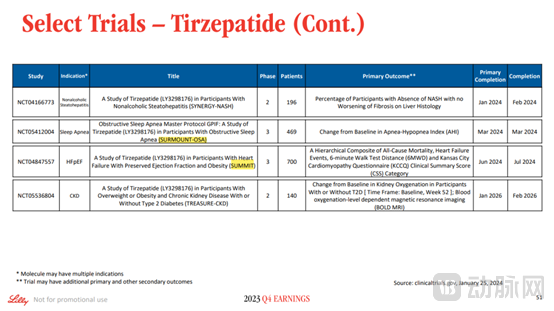
Image source: Eli Lilly and Company Annual Report
Marching to the Beat of Its Own Drum, Breaking Through the Siege
From the 19th century to the present, Eli Lilly, known for its "conservative stereotype," saw a surge in performance and stock price in 2018, accompanied by a flurry of acquisitions. Eli Lilly has deepened its moat in the metabolic field, represented by GLP-1, consolidating its position in the diabetes sector while expanding into the weight-loss track, driving continuous market value growth. In addition, Eli Lilly has been actively advancing in areas such as oncology, immunology, and rare diseases, significantly broadening its pipeline.
Over the past 20 years, the pharmaceuticals market has grown nearly sevenfold, but Eli Lilly's sales have only increased fourfold, failing to outpace the "market average." However, in areas such as diabetes, depression, Alzheimer's disease, and oncology, the company has remained steadfast and continued to deepen its focus, showing an unyielding determination to make breakthroughs. This approach stands out among companies that rely on mergers and acquisitions for growth.
In front of companies like Novartis and Roche, which have grown through reliance on mergers and acquisitions by foreign enterprises, Eli Lilly stands out as a unique presence by consistently increasing R&D investment and adhering to internal growth. This approach, lacking dramatic fluctuations from major business collaborations, may make Eli Lilly seem less theatrical, but it also ensures that its products gain recognition in both academic research and the capital markets.