

Gilead Sciences Submits Lenacapavir NDA for HIV PrEP Following 100% Efficacy in Phase 3 Trial

Gilead Sciences
Antiviral Drug Developer
On June 20 local time, Gilead Sciences (referred to as Gilead), a U.S.-based biopharmaceutical company, announced on its official website that its developed drug "Lenacapavir" has demonstrated 100% effectiveness in preventing the human immunodeficiency virus (HIV). The latest results were disclosed from a Phase 3 double-blind randomized study trial named "PURPOSE1," which aimed to evaluate the safety and efficacy of Lenacapavir and Descovy among more than 5,300 women aged 16-25 at 25 sites in South Africa and 3 sites in Uganda. The results showed zero HIV infection cases among the 2,134 women in the Lenacapavir group.
Based on this positive result, the independent data monitoring committee recommended that Gilead stop the blinded phase of the trial at the interim analysis and offer open-label lenacapavir to all participants. According to the press release, this is the first Phase 3 trial for HIV prevention in which no participants became infected.
Gilead anticipates releasing results from another pivotal trial of the PURPOSE program, PURPOSE 2, by late 2024 or early 2025. This trial evaluates the efficacy of lenacapavir, administered every six months, in preventing HIV infection among male and female individuals of diverse gender orientations. If the outcomes of both PURPOSE 1 and PURPOSE 2 are positive, the regulatory submissions for lenacapavir as an HIV PrEP therapy will include data from these two trials to ensure its approval for various populations in critical need of additional HIV prevention options.
Lenacapavir: FIC Long-Acting Inhibitor
Lenacapavir is a first-in-class, long-acting HIV capsid inhibitor developed by Gilead Sciences. The median half-life of Lenacapavir is 10 to 12 days after oral administration and 8 to 12 weeks after subcutaneous injection, making it a long-acting inhibitor. Lenacapavir has a molecular weight of 968.28, contains 10 fluorine atoms, and has a relatively complex structure.
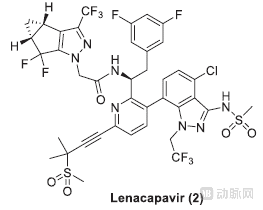
Lenacapavir inhibits HIV-1 replication by interfering with multiple critical steps in the viral life cycle, including the inhibition of HIV-1 proviral DNA uptake, assembly, and release mediated by the viral capsid, as well as the formation of the viral capsid core, with no known cross-resistance to other existing drug classes.
Lenacapavir was granted Breakthrough Therapy Designation by the U.S. FDA in May 2019 for the treatment of heavily treatment-experienced HIV-1 patients with multi-drug resistance, in combination with other antiretroviral drugs.
On August 22, 2022, Gilead Sciences announced that the European Commission (EC) had granted marketing authorization for Lenacapavir injection and tablets for use in combination with other antiretroviral drugs to treat adult patients with multidrug-resistant HIV infections who are unable to construct a suppressive antiviral regimen. The marketing authorization application (MAA) for Lenacapavir was supported by data from the Phase 2/3 clinical trial CAPELLA: 83% (n=30/36) of subjects receiving Lenacapavir in addition to an optimized background regimen achieved undetectable viral load (<50 copies/mL) at Week 52 in a patient population with significant unmet medical needs. The European marketing authorization represents the latest milestone in the global regulatory review of Lenacapavir by major regulatory agencies.
In the CAPELLA study, Lenacapavir, in combination with other antiretroviral therapies, demonstrated sustained virologic suppression and clinically meaningful CD4-positive T-cell recovery in people with multidrug-resistant HIV. Lenacapavir offers an innovative long-acting HIV treatment option that has the potential to transform the clinical landscape. Additionally, Lenacapavir holds the potential for flexible dosing options.
It should be noted that the multi-stage mechanism of action of Lenacapavir differs from other currently approved classes of antiviral drugs. Most antiviral drugs only target one stage of viral replication, but Lenacapavir is designed to inhibit HIV at multiple stages of its life cycle and has no known cross-resistance with existing drug classes. Lenacapavir works by binding to the capsid protein monomer, causing the generated capsid to become a non-functional "defective product." Notably, in 2021, Lenacapavir was selected for the annual small molecule list published by DrugHunter, chosen by industry drug developers—and ranked first on the list.
Specializing in Antiviral Drugs for Thirty Years
Gilead Sciences, founded by Michael L. Riordan in 1987, was originally named OligoGen Inc. and later renamed Gilead Sciences, symbolizing "born to cure," which has remained the company's vision ever since. Initially focused on small nucleic acids, Gilead shifted its research emphasis to antiviral drugs due to technological limitations, targeting diseases such as HIV, HBV (hepatitis B), and HCV (hepatitis C). However, the high costs of antiviral drug development and the long market cycles led to slow progress, causing Gilead to accumulate significant debt and remain in a prolonged state of financial loss.
In 1990, John C. Martin, who had previously worked at BMS, joined Gilead Sciences and was promoted to CEO of the company in 1996. In the same year, after a long period of exploration and incubation, Gilead launched its first antiviral drug—Vistide (cidofovir) for intravenous injection, used to treat cytomegalovirus (CMV) retinitis in HIV patients. A breakthrough was achieved in the method of administration, as competing products on the market, such as foscarnet and ganciclovir, required surgical catheterization for drug delivery.
For a long time thereafter, Gilead focused on antiviral drugs, cutting off R&D pipelines for non-antiviral drugs. In 2001, Gilead's first anti-HIV drug, tenofovir disoproxil (TDF), was approved by the FDA for marketing, becoming a major pillar for its subsequent growth and expansion. The following year, it generated revenue of $230 million, reversing the company’s long-term losses.
It is worth mentioning that in the mid to late 1990s, the main treatment for HIV was the cocktail therapy, which involved the combination of three or more drugs. The advantage of this therapy was its relatively good efficacy and its ability to reduce drug resistance caused by single-drug use. However, cocktail therapy had strict medication restrictions, as the combined drugs required a specific order and time interval for administration. If not taken exactly as prescribed, the treatment’s effectiveness would be significantly reduced, and drug resistance could develop, making subsequent treatments even more challenging.
Anti-HIV treatment is a long-term process, so the convenience and simplicity of medication are crucial for drug promotion. This may explain why one of Gilead Sciences' main strategies is to promote combination therapies that require only one pill per day.
As Gilead Sciences continuously iterates and upgrades its focus on anti-HIV drugs, the company has turned losses into profits and gradually grown into a leader in the HIV field. In 2017, the total sales of Gilead's anti-HIV drugs exceeded $14 billion for the first time.
In 2011, Martin, then CEO of Gilead Sciences, overruled objections to acquire a company that developed hepatitis C drugs, which subsequently generated tens of billions in profits for the company. However, due to the remarkable efficacy of the hepatitis C drugs, the number of patients decreased, causing sales to drop from a peak of tens of billions to less than 2 billion today. This episode led the new CEO, who took office in 2018, to decide that while maintaining Gilead's leading position in HIV, the company should also focus on advancing into the oncology field.
Gradually Controllable "Chronic Diseases" and Rational Treatment
On one side, Gilead Sciences continuously iterates the delivery methods and efficacy of new anti-HIV drugs; on the other side, HIV is gradually becoming a manageable chronic condition.
In a 2014 interview with the World Health Organization, it was noted that advancements in antiretroviral drugs have transformed HIV/AIDS into a manageable chronic condition, similar to other lifelong chronic diseases like hypertension and diabetes. However, HIV differs from diabetes and hypertension — it is an infectious disease that can be transmitted to others if proper protective measures are not used. Starting antiretroviral therapy as early as possible, preferably before the immune system is weakened, can prevent the progression of the disease while reducing the likelihood of transmitting the HIV virus to others.
The World Health Organization (WHO) also emphasized that HIV is completely manageable, and as long as treatment is reasonably adhered to, the life expectancy of people living with HIV is not significantly different from that of the general population. But what constitutes "reasonable treatment"? At that time, WHO’s recommendation was to use "fixed-dose combination" drugs, meaning all drug components are combined into a single pill. This makes lifelong antiretroviral therapy much easier. However, former president of the International AIDS Society, Bekker, also pointed out that traditional HIV prevention methods are highly effective, but the requirement of taking medication once daily could expose some individuals to the risk of discrimination.
Therefore, Lenacapavir, with its twice-a-year dosing regimen, is not only long-acting but also boasts a zero infection rate and 100% efficacy. It powerfully and precisely addresses the key challenges in current HIV treatment: ensuring therapeutic effectiveness while further eliminating stigma and reducing the cost of "chronic disease management." Additionally, since HIV infection can still lead to autoimmune diseases, which significantly increase the risk of HIV infection, Lenacapavir also alleviates potential patients' anxiety about complications to some extent.
According to CNBC, before FDA approval, Gilead still needs to replicate the results of this Phase 3 trial. Due to the lack of interim studies conducted previously by Gilead, uncertainties remain. However, if the replicated clinical results are positive, Gilead could potentially launch Lenacapavir for PrEP (pre-exposure prophylaxis for HIV) by the end of 2025, providing an important new option for HIV prevention.
RBC Capital Markets analysts expect that Gilead's injectable drug will significantly increase the number of people interested in preventive HIV medications, with projected peak sales approaching $2 billion.