SanegeneBio's Second RNAi Drug SGB-9768 Receives IND Approval in China for Complement-Mediated Kidney Diseases

SANEGENEBIO
Small Nucleic Acid Drug Developer
On June 25, 2024, Suzhou SANEGENEBIO Co., Ltd. ("SANEGENEBIO") announced that its self-developed small nucleic acid (siRNA) drug SGB-9768 injection has recently received tacit approval for clinical trial application from the Center for Drug Evaluation (CDE) of the National Medical Products Administration (NMPA) (Acceptance No.: CXHL2400373). It is intended for the treatment of complement-mediated kidney diseases, including adult IgA nephropathy, C3 glomerulopathy, and immune complex-mediated membranoproliferative glomerulonephritis.
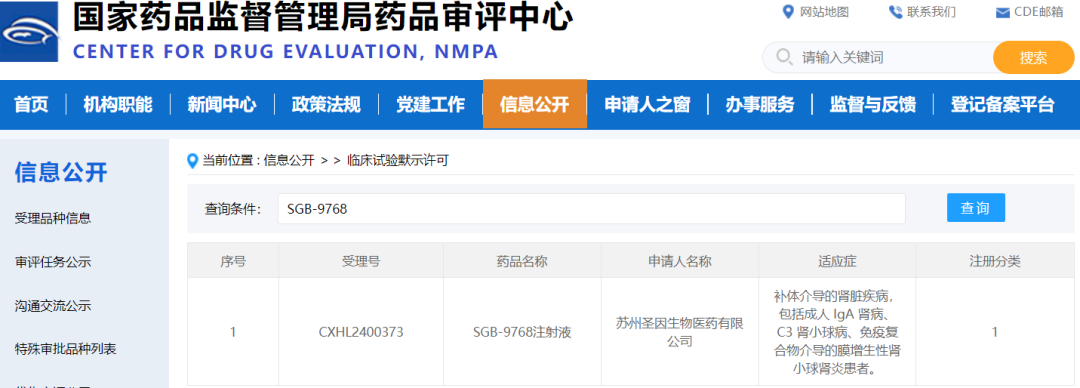
▲Source: CDE Official Website
SGB-9768 is an RNAi therapy independently developed by SANEGENEBIO that targets the Complement 3 (C3) protein. It is the company’s second innovative siRNA drug approved for clinical trials in China and entered Phase I clinical trials in New Zealand in February 2024. The drug utilizes the company's uniquely innovative next-generation LEAD™GalNAc technology to deliver to liver cells, inhibiting C3 synthesis through the RNAi mechanism, thereby suppressing complement activation to treat complement-mediated kidney diseases. SGB-9768 can be administered once every three or six months, offering advantages such as low treatment frequency, good patient compliance, and long-lasting efficacy. Preclinical trial data show that SGB-9768 can effectively and continuously reduce C3 synthesis, demonstrating superior efficacy compared to competitors while maintaining good safety and tolerability. It has the potential to become China’s first and a globally leading siRNA drug targeting Complement 3.
The complement system is an important component of innate immunity, playing a regulatory role in adaptive immune responses and performing crucial immune and physiological functions in the human body, protecting the body from infections and clearing dead cells and apoptotic materials. However, once the complement system is dysregulated or excessively activated, it can induce inflammation and damage self-tissues, causing immune injury, closely related to the occurrence and development of some hematological diseases, ophthalmic diseases, and renal diseases. Chronic kidney disease is a major public health issue globally and in China, with a prevalence rate as high as 10.8% in China.[1], that is, one in every 10 adults suffers from chronic kidney disease. The majority of renal diseases involve complement-mediated pathogenesis. Complement-mediated kidney diseases mainly include IgA nephropathy, C3 glomerulopathy, and immune complex-mediated membranoproliferative glomerulonephritis, among others. Currently, treatment progress for complement-mediated kidney diseases is limited, and many complement-targeting drugs are still in clinical research stages, indicating significant unmet clinical needs in this field. Complement inhibition is expected to become a new therapeutic target for complement-mediated kidney diseases. Complement C3 is a crucial component in the complement system, linking upstream activation pathways with terminal pathways. Inhibition of C3 activity has been proven to have a significant complement-inhibitory effect and can serve as a powerful therapeutic target for such diseases. Therefore, the development of safe and effective siRNA drugs targeting complement C3 holds substantial clinical application value for complement-mediated kidney diseases.
Currently, the treatment options for complement-mediated kidney diseases are relatively limited, representing a significant unmet clinical need in China and globally. A series of studies have shown that SGB-9768, an innovative siRNA drug, demonstrates remarkable potency in inhibiting C3 activity. It has the potential to become a transformative therapy for patients with complement-mediated kidney diseases and is expected to have broader applications in other complement-related disease areas. SANEGENEBIO will also accelerate the clinical trials of SGB-9768 to achieve positive progress as soon as possible, providing more and better treatment options for patients with immune-related diseases at an earlier date.
References:
[1]Zhang,L.,F.Wang,L.Wang,etal(2012).”PrevalenceofchronickidneydiseaseinChina:across-sectionalsurvey.”Lancet379(9818):815-822.

Editor: Baiji
Disclaimer: This article is a reprint from PharmNet. The images and text are the original property of the author, and the purpose of the reprint is to convey more information. It does not represent the views of this platform. If there are any issues regarding content, copyright, or other problems, please leave a message on this platform, and we will address it promptly.