


Image source: Unsplash
After a four-year collaboration, the relationship between the two parties has come to an end.
June 25,Walvax(300142.SZ) Walvax Biotechnology Co., Ltd. announced that it has signed a "Termination Agreement" with Abogen Biosciences to terminate the technical development cooperation for the COVID-19 mRNA vaccine and the shingles mRNA vaccine. After the termination of the cooperation, all parties will settle the relevant expenses incurred during the early-stage research and development and clinical trials.
During the pandemic, Abogen, with its mRNA technology, became a highly sought-after entity in the industry, garnering attention from all sides. In May 2020, Walvax entered into a "Technology Development Cooperation Agreement" with Abogen to jointly develop an mRNA vaccine for the novel coronavirus.
However, after investing billions, the mRNA COVID-19 vaccine jointly developed by both parties yielded no results. To date, Walvax has only one COVID-19 vaccine included for emergency use, which is the mRNA vaccine targeting mutated strains co-developed with Bluebird Bio.
As a leading company in the vaccine field, Walvax is currently in a difficult situation. On one hand, the substantial investment in the COVID-19 vaccine has not yielded commercial returns. On the other hand, its bivalent HPV vaccine has become embroiled in a "price war," causing the company's performance to plummet.
In 2023, the company's revenue declined by 19.12% year-on-year to 4.114 billion yuan, and net profit fell by 42.44% year-on-year to 419 million yuan. In the first quarter of this year, the decline in performance widened, with revenue dropping by 28.02% year-on-year to 600 million yuan, and net profit plummeting by 91.79% year-on-year to 14.13 million yuan.
Termination of 4 COVID-19 Vaccines Within the Year
Walvax has deployed five COVID-19 vaccines in total, of which four have not been successful in China.
The mRNA COVID-19 vaccine (Vaicivax, ARCoVax) whose development has been terminated this time is mainly used to prevent diseases caused by SARS-CoV-2 infection. It was a key project advanced through the cooperation between Walvax and Abogen in May 2020.
At that time, the two parties also drew a "blueprint" in the cooperation agreement — Abogen Biosciences would be responsible for the preclinical research of the vaccine, including mRNA vaccine molecular design, chemical modification, and formulation process development, while Walvax Biotechnology Co., Ltd. would be responsible for the vaccine’s QA, QC, IND, clinical research, NDA, and commercial production.
One month after the announcement of the collaboration, in June 2020, Walvax's mRNA vaccine candidate received the "Clinical Trial Approval" from the National Medical Products Administration. This is one of the fastest-progressing clinical-stage COVID-19 mRNA vaccines in China.
Subsequently, Walvax Biotechnology Co., Ltd. and its subsidiary Yuxi Walvax, in collaboration with Abogen Biosciences, formulated a detailed clinical trial plan for the vaccine's clinical research. They conducted Phase I, II, and III clinical studies of the vaccine. In September 2022, the vaccine received emergency use authorization in Indonesia, but its progress in China has remained at the Phase III clinical stage.
An objective reality is that the market space for COVID-19 vaccines is nearing disappearance, and related vaccine manufacturing companies have indeed reached the stage of wrapping up the aftermath. Prior to this, Walvax had already announced the termination of technical development for three COVID-19 vaccines.
On June 17, Walvax Biotechnology Co., Ltd. announced that it has decided to terminate the clinical trials of the recombinant novel coronavirus vaccine (CHO cell) and the recombinant novel coronavirus variant vaccine (CHO cell) developed by its holding subsidiary, Shanghai Zerun.
These two vaccines were approved by the National Medical Products Administration (NMPA) for Clinical Trial Certificates in June 2021 and August 2022, respectively. After obtaining the clinical trial approval, Walvax Biotechnology Co., Ltd. and Shanghai Zerun formulated detailed clinical trial protocols for the vaccines and conducted Phase I and Phase II clinical studies on these two vaccines.
Recombinant CHO Cell Vaccine Off to a Promising Start, Fueling Walvax's High Expectations. In August 2021, the board of directors of Walvax Biotechnology Co., Ltd. approved its controlling subsidiary, Shanghai Zerun, to establish its wholly-owned subsidiary, Beijing Zerun, in Daxing District, Beijing. Beijing Zerun will serve as the investment entity to develop an industrial project for the recombinant COVID-19 vaccine (CHO Cell), with a planned total investment of 520 million yuan.
Because these two vaccines were behind in the R&D progress, Beijing ZeRun, a subsidiary of Shanghai ZeRun, did not actually invest in the construction of the recombinant novel coronavirus vaccine (CHO cell) industrialization project. It has to be admitted that this saved a sum of money for the company.
Regarding the reasons for termination, Walvax stated that since the research and development of the aforementioned vaccines were initiated relatively early, their antigen design and development primarily targeted the coronavirus strains prevalent at that time. Based on the mutation of the coronavirus, these two vaccines no longer meet China's current requirements for COVID-19 vaccines to be effective against or specifically target the current variants. Continuing the development of these two vaccines would result in low economic and social benefits.
It should be noted that the vigorous development of recombinant CHO cell vaccine research is Walvax's increased investment in COVID-19 vaccines in 2021. Prior to this, the company had already reached a cooperation with Abogen to lay out the mRNA COVID-19 vaccine technology route.
In the same year that Walvax rearranged the layout of its CHO cell vaccine, it also placed a bet on a recombinant novel coronavirus vaccine (chimpanzee adenovirus vector), which has now been announced as terminated.
On April 24, Walvax Biotechnology Co., Ltd. announced the termination of the clinical trial for its recombinant COVID-19 vaccine (chimpanzee adenovirus vector). This COVID-19 vaccine was developed by its wholly-owned subsidiary, Abogen Biosciences, and received the "Drug Clinical Trial Approval" from the National Medical Products Administration in May 2021. Subsequently, Phase I and Phase II clinical studies were conducted. Prior to the announcement of the termination of development, this COVID-19 vaccine was in the data collation and finalization stage of Phase II clinical research.
After terminating the development of the four COVID-19 vaccines mentioned above, Walvax Biotechnology Co., Ltd. now has only one mutated strain mRNA vaccine for emergency use left in its hands. This vaccine represents Walvax's last effort in the field of COVID-19 vaccines.
In January 2022, Walvax entered into a "Technology Development and Commercialization Cooperation Agreement for mRNA Vaccines against COVID-19 Variant Strains" with Blue鹊 Biotech. In September of the same year, the mRNA vaccine (S protein chimera) for COVID-19 variant strains jointly developed by Walvax, Fudan University, and Shanghai Blue鹊 received the "Drug Clinical Trial Approval" from the National Medical Products Administration.
In early December 2023, Walvax received a letter from the vaccine research and development team under the State Council's Joint Prevention and Control Mechanism for Scientific Research. This mRNA vaccine (Omicron XBB.1.5) (code name: RQ3033) targeting a variant strain of the novel coronavirus was approved by relevant national authorities for emergency use.
The commercialization of Walvax's COVID-19 vaccine development has thus come to an end.
Regarding investment, from 2020 to 2023, the company's total R&D investment reached 3.033 billion yuan. In 2021 alone, Walvax spent 326 million yuan on the development of the mRNA COVID-19 vaccine, accounting for 43.24% of the total R&D expenses. In addition, Walvax Biotechnology has established a dedicated mRNA vaccine production plant at the Yuxi High-Tech Zone Vaccine Industrial Park, with an investment of 520 million yuan and an annual production capacity of 200 million doses.
Continue Betting on mRNA Technology: What's Next for the Shingles Vaccine?
Over the past four years, Walvax has been investing resources in the development of mRNA technology. Although it failed in the COVID-19 vaccine, the company will continue its investment in this technology.
Walvax stated in its announcement on the 25th that the termination of the clinical trial for this vaccine will not affect the company's continued development of the mRNA technology platform, nor will it impact the research and development work of other projects currently under development. The company will continue to advance the research, development, and industrialization of other vaccine products on the mRNA technology platform.
On the same day, Walvax announced the adjustment of its organizational structure, in which "mRNA Vaccine BU" has become one of the company's six major business units.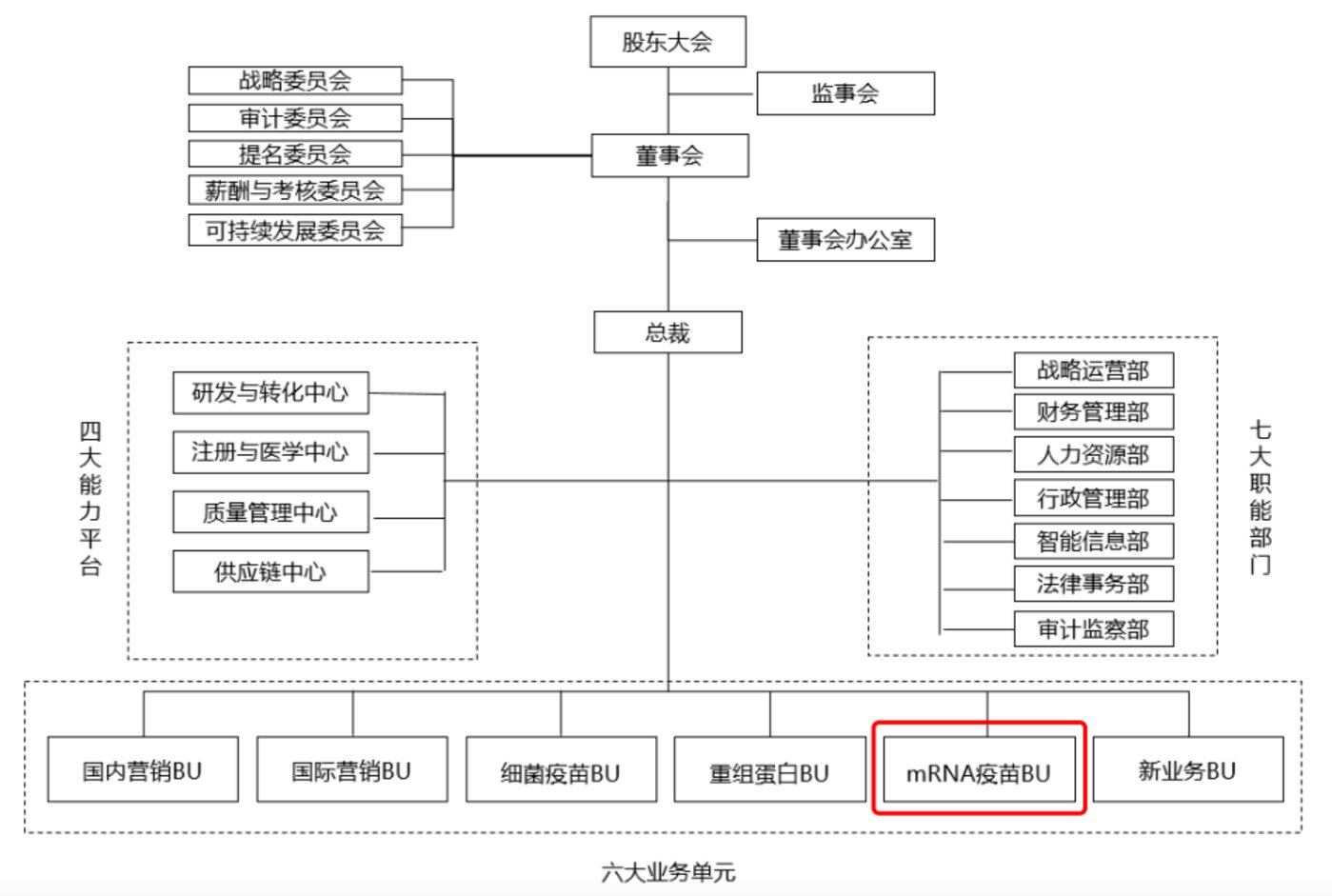
Source: Company announcement
The application fields of mRNA technology are very broad, including preventive vaccines, therapeutic vaccines, and therapeutic drugs.CITIC SecuritiesThe research report once predicted that the non-COVID mRNA market size is expected to reach $28.1 billion by 2025, indicating broad prospects for the mRNA industry chain market.
In the field of vaccines, mRNA technology is widely recognized as the third major technological leap following the first generation of inactivated and attenuated vaccines and the second generation of recombinant protein and vector vaccines.
Marked by the approval and market launch of the COVID-19 mRNA vaccine and the awarding of the 2023 Nobel Prize in Physiology or Medicine to the two scientists, Katalin Karikó and Drew Weissman, for their breakthrough discoveries in mRNA research, mRNA technology has gained significant attention. Major vaccine companies are strengthening their patent and industrialization layout in the field of mRNA vaccine technology. The current research pipeline covers infectious disease vaccines such as Respiratory Syncytial Virus (RSV) vaccines, influenza vaccines, herpes zoster vaccines, and cytomegalovirus vaccines.
Previously, industry experts believed that the next potential opportunity for mRNA technology lies in the influenza vaccine field, as the characteristic of mRNA vaccine development is its strong platform attribute, which allows for the rapid design of products targeting currently circulating strains. In contrast, other technical routes of vaccine development are relatively slower in form and response speed.
Recently, good news about mRNA vaccines has also arrived, with the world's first non-COVID mRNA vaccine having been approved.
On May 31 local time, Moderna, an American vaccine company, announced that its mRNA Respiratory Syncytial Virus (RSV) vaccine (mRESVIA) has been approved for marketing by the U.S. Food and Drug Administration (FDA).
For Walvax, although it did not make a fortune from the COVID-19 vaccine, the accumulation of mRNA technology is particularly valuable. However, it is worth noting that Walvax has also terminated the technical development cooperation with Abogen regarding the shingles mRNA vaccine.
In the research and development technology route of the herpes zoster vaccine, several companies in China are conducting clinical studies on live attenuated vaccines and adjuvant-containing recombinant protein vaccines. The mRNA technology adopted by Walvax represents a rare approach.
Walvax and Abogen reached a cooperation agreement in May 2020 to jointly develop a shingles mRNA vaccine, committing to collaborate on the preclinical research, clinical studies, and commercial production of the shingles mRNA vaccine. There has been no specific disclosure by Walvax regarding subsequent progress on this pipeline’s development, except that it emphasized its strategic focus on vaccines for respiratory syncytial virus, shingles, Group B Streptococcus conjugate, and an mRNA combined COVID-19 and influenza vaccine.
Whether Walvax will abandon the development of the shingles mRNA vaccine remains unknown.
(This article was first published on the Titanium Media App, Author: Yang Yaru, Editor: Sun Cheng)