Recently, Aurion Biotech announced that the U.S. FDA has granted its off-the-shelf cell therapy AURN001 Breakthrough Therapy Designation (BTD) and Regenerative Medicine Advanced Therapy (RMAT) designation. According to the press release,AURN001 is the first to receive both BTD and RMAT designationsRecognitionThe first allogeneic cell therapy in China, used to treat corneal edema secondary to corneal endothelial disease. Corneal edema secondary to endothelial dysfunction is a debilitating, vision-threatening disease that affects millions of people worldwide.Corneal endothelial cells (CEC) do not regenerate after death or degeneration. If not treated in time, the loss of corneal endothelial cells can lead to corneal edema and vision impairment.Although corneal transplantation is an effective treatment, it is limited by the availability of donor organs. Traditionally, a healthy donor cornea can only be used to treat one diseased eye during transplantation.But it is estimated that for every 70 diseased eyes, only one donor cornea is available.Moreover, these surgeries carry potential risks of postoperative recovery difficulties and complications, such as graft detachment, transplant rejection, dislocation, irregular astigmatism, and infection. Patients undergoing corneal transplantation need to lie flat for up to three days after the surgery to allow the transplanted cornea to adhere to the corneal stroma. Given these limitations, there is a significant unmet need for such patients. AURN001 is a combination of a single-dose anterior chamber injection cell therapy and medication, consisting of allogeneic human corneal endothelial cells (neltependocel) and the Rho-associated protein kinase (ROCK) inhibitor Y-27632.This dual designation granted by the FDA for the therapy is primarily based on the unmet medical needs of patients with corneal endothelial diseases and the FDA's review of clinical data related to AURN001. The project includes multiple clinical trials, and participants have completed at least 12 months of follow-up.
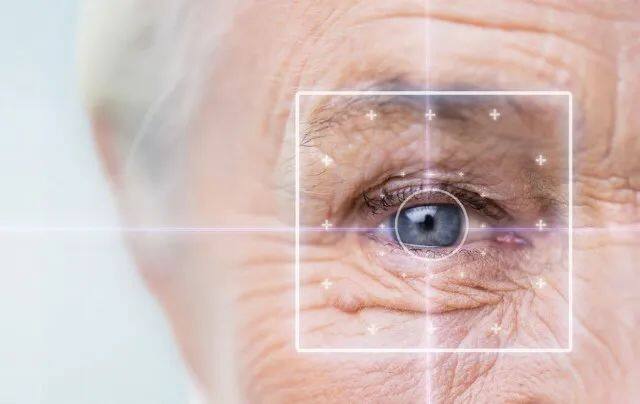
Image Source: 123RF
Aurion Biotech, Inc. recently announced the completion of recruitment and patient dosing for the Phase 1/2 CLARA trial in the United States and Canada.CLARA Clinical TrialThe CLARA clinical trial is a prospective, multicenter, randomized, double-blind, parallel-arm cell dose-ranging study in subjects with corneal edema due to corneal endothelial dysfunction. The study will evaluate the effects of three different doses of neltependocel in combination with Y-27632. Ninety-seven subjects have been randomized at trial sites in the United States and Canada. The CLARA trial aims to assess the safety, tolerability, and efficacy of AURN001 for treating corneal edema caused by corneal endothelial dysfunction. The primary endpoint is the percentage of subjects with a 3-line improvement in visual acuity at 6 months. In 2018, the company published positive results in The New England Journal of Medicine on its developed CEC therapy combined with a ROCK inhibitor for the treatment of patients with bullous keratopathy. Analysis shows,At 24 weeks after cell injection, CEC density exceeded 500 cells per square millimeter (range: 947-2833) in 11 of the 11 treated eyes, achieving the primary endpoint of the trial (100%, 95% CI: 72-100).Notably, the CEC density in 10 eyes exceeded 1000 cells per square millimeter. This result suggests that the cell therapy may effectively colonize the patient's eye.
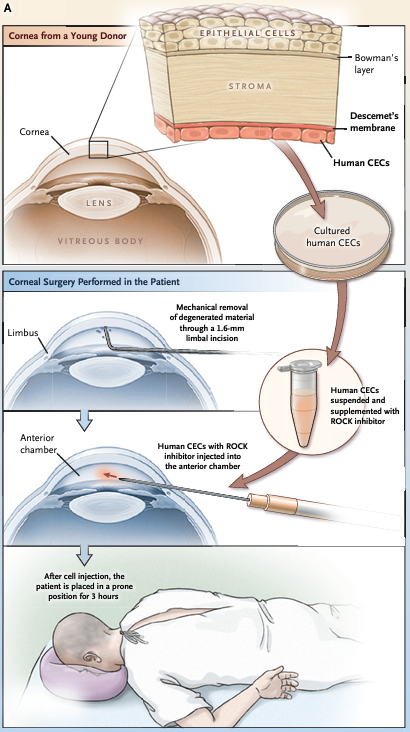
▲Schematic diagram of cell therapy injection, where ROCK inhibitor-cultured human corneal endothelial cells are injected into the anterior chamber (Image source: Reference [3])

It is worth mentioning that in March last year, Aurion Biotech announced itsReady-to-use TypeCell TherapyVyznovaReceived approval from Japan's Pharmaceuticals and Medical Devices Agency (PMDA) for the treatment of bullous keratopathy.According to the press release, this is the world's first approved allogeneic cell therapy for the treatment of corneal endothelial disease.Vyznova is healthy cells derived from donor corneas, cultured through Aurion's proprietary innovative, multi-step process to generate fully differentiated corneal endothelial cells. This process does not involve gene editing.Fully differentiated corneal endothelial cells from a single donor could eventually be used to treat over 100 patient eyes.These endothelial cells are injected into the patient's eye through the anterior chamber, where they reform into a healthy monolayer to facilitate the removal of fluid from the cornea and alleviate corneal edema. The development of off-the-shelf cell and gene therapies has gradually become an industry trend, with recent positive progress also emerging in the field.Recently, IN8bio announced its investigational off-the-shelf γδ T cell therapyINB-100The latest Phase 1 clinical trial results. Leukemia patients received a dose of INB-100 after undergoing hematopoietic stem cell transplantation.Among evaluable leukemia patients, 100% were still alive and maintained complete remission for up to 1 year prior to the data cutoff.This month, Wugen also announced positive results from the phase 2 study of its investigational CD7-targeted, off-the-shelf CAR-T therapy, WU-CART-007, for the treatment of patients with relapsed/refractory T-cell acute lymphoblastic leukemia/lymphoma (T-ALL/LBL). Analysis shows,73% of patients achieved the primary endpoint of composite complete remission rate, with an overall response rate of 91%. In addition, Precigen announced this month that its off-the-shelf gene therapy PRGN-2012 for the treatment of recurrent respiratory papillomatosis (RRP) patients has met the primary endpoint in a Phase 1/2 clinical trial. The company plans to submit a rolling Biologics License Application (BLA) for PRGN-2012 through the accelerated approval pathway in the second half of 2024.The press release noted that if approved, PRGN-2012 could potentially become the first FDA-approved therapy for the treatment of RRP.In May this year, Atara Biotherapeutics submitted the off-the-shelf allogeneic T-cell therapy tabelecleucel to the FDA (tab-cel) BLA, as a monotherapy, for the treatment of Epstein-Barr virus (EBV)-positive post-transplant lymphoproliferative disease (PTLD). The press release noted,If approved, tab-cel will become the first allogeneic T-cell therapy approved by the FDA, as well as the first treatment for EBV-positive PTLD. References:[1] Aurion Biotech Receives Breakthrough Therapy Designation
and Regenerative Medicine Advanced Therapy Designation for Its Drug Candidate
AURN001. Retrieved June 19, 2024 from https://www.businesswire.com/news/home/20240619102413/en[2] Aurion Biotech Announces Completion of Enrollment In
Phase 1 / 2 Clinical Trial. Retrieved June 19, 2024 from https://aurionbiotech.com/aurion-biotech-announces-completion-of-enrollment-in-phase-1-2-clinical-trial/[3] Kinoshita
S, Koizumi N, Ueno M, Okumura N, Imai K, Tanaka H, Yamamoto Y, Nakamura T,
Inatomi T, Bush J, Toda M, Hagiya M, Yokota I, Teramukai S, Sotozono C, Hamuro
J. Injection of Cultured Cells with a ROCK Inhibitor for Bullous Keratopathy. N
Engl J Med. 2018 Mar 15;378(11):995-1003. doi: 10.1056/NEJMoa1712770. PMID:
29539291.[4] Corneal EndothelialCell
Therapy. Retrieved June 19, 2024 from https://aurionbiotech.com/products/[5] Aurion
Biotech Receives Approval from Japan’s PMDA for New Drug Application. Retrieved
June 19, 2024 from https://aurionbiotech.com/aurion-biotech-receives-approval-from-japans-pmda-for-new-drug-application/
Disclaimer: This article aims to convey industry development information and explore the frontier progress of biomedicine. The content of the article represents the author's viewpoint, and does not represent the position of Yi Mai Ke, nor does it constitute any value judgment, investment advice, or medical guidance. If necessary, please consult a professional for investment or visit a正规 hospital for medical advice.