Source: Eye Future ;Editor: SophiaReprint requirements: Can be reprinted 24 hours after the first publication, source must be credited.
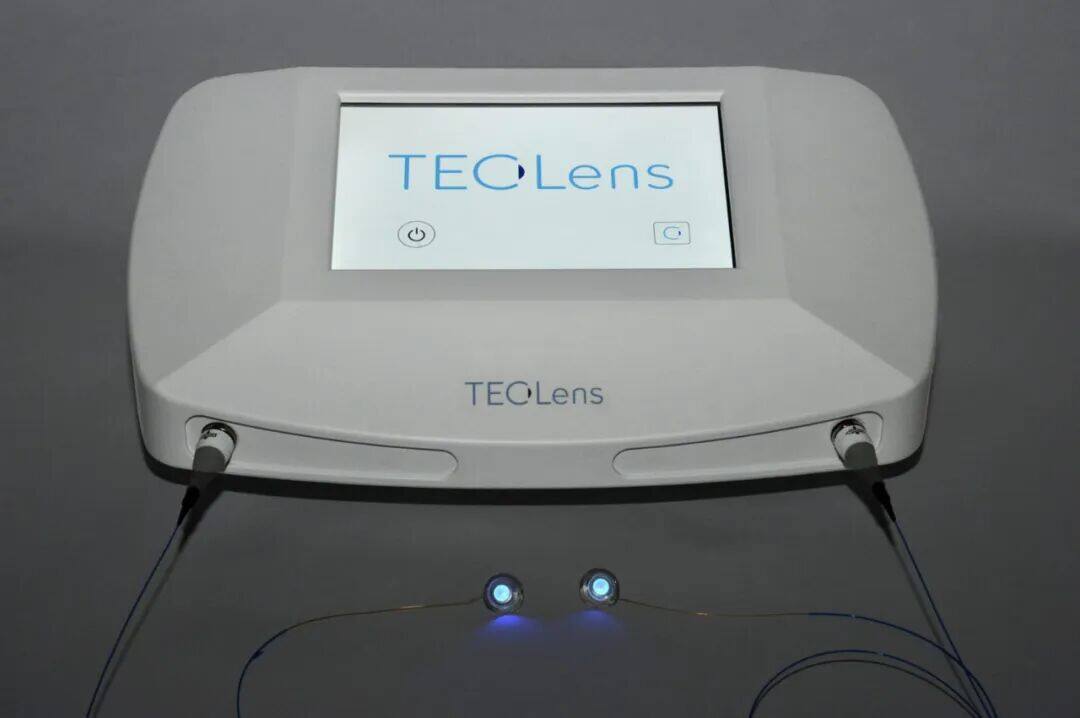
Recently,Johnson & Johnson Vision CareAnnouncementLed the Series A financing of TECLens, which is a company dedicated toA Start-up Medical Technology Company Disrupting the Refractive Surgery Market,The company'sCore TechnologyIs a name calledInnovative Incision-Free Technology of Quantitative Corneal Cross-Linking (qCXL™), can be inNo laser ablation or invasive surgery requiredIn the case ofReshaping the Cornea。This investment also upholds Johnson & Johnson's commitment to advancing smarter, minimally invasive, and personalized medical solutions.TECLens initially set its sights on presbyopia,But plans to expand its clinical research to cover keratoconus, low myopia, hyperopia, and astigmatism.. The company foreseesItsNon-invasive, clinic-based treatments will become the preferred choice for patients seeking refractive correction.。TECLens is currently planning its disposable vision correction treatment.Conduct the First Refractive Correction Clinical Study。 # Research and Development BackgroundCorneal Cross-LinkingIs currentlyTreatment of corneal diseases such as keratoconusAn important surgical method, mainly includesDe-epithelializationAndRetained EpitheliumTwo types,Its therapeutic effect is influenced by factors such as riboflavin concentration, irradiation energy, and irradiation time.Therefore,How to Make Riboflavin Penetrate Quickly into the Corneal Stroma TissueIt has also been a hot topic of discussion in recent years.
Insufficiency:Mainstream technology usedCross-linking instruments are relatively large in size., Using overhead ultraviolet light to irradiate the cornea, the ultraviolet lamp is mounted on a movable arm bracket, which not onlyTakes up a lot of space,MoreoverRequires doctors to continuously control the lightTo ensure accurate targeting.
The patient needs to be on the operating table, with the help of an eyelid speculum.Lie still for about half an hour.。
# qCXL——A Revolution in Refractive Technology
The core technology of TECLens is a namedQuantitative Corneal Cross-Linking (qCXL™)TheInnovative Incisionless Technology, can beWithout laser ablation or invasive surgeryin the case of corneal reshaping.The company stated,This technology can not only address keratoconus but also correct vision problems in healthy eyes., such as the recovery of presbyopia patients' reading vision, the control of progressive myopia in children, and the correction of adult vision errors, such as hyperopia and low-degree myopia, etc.TECLens's qCXL™ TechnologyScleral Contact Lens Connected by Optical FiberDeliver UV light directly to the eyes, combined withCustomized Riboflavin (Vitamin B2) Dosage, the treatment process is carried out under real-time ultrasound monitoring until the onboard sensors and algorithms determine certain aspects of the corneal stroma.Biomechanical properties have been adjusted to the pre-planned values.。
The patient does not need an eyelid speculum., you can open and close your eyes with contact lenses.Eye and head movements do not affect the treatment outcome.,Eliminates patients' motion artifacts, as well as the need for complex eye movement tracking hardware and algorithms.。In addition, this technology is equipped with a dedicated riboflavin reservoir system that can automatically enter the vaulted space formed between the contact lens and the corneal surface.After administration of vitamin B2 (riboflavin),CXLens acts directly on the scleral surface of the eye.(Above the cornea), the process of emitting specific ultraviolet light for corneal cross-linking;
Ultraviolet irradiation continued, with ultrasound transmitted through the ultraviolet beam.The built-in ultrasound transducer provides real-time elastography feedback during the cross-linking process to measure real-time quantitative cross-linking (qCXL) parameters.Including increased corneal stiffness, collagen fiber tightening, and changes in corneal thickness;
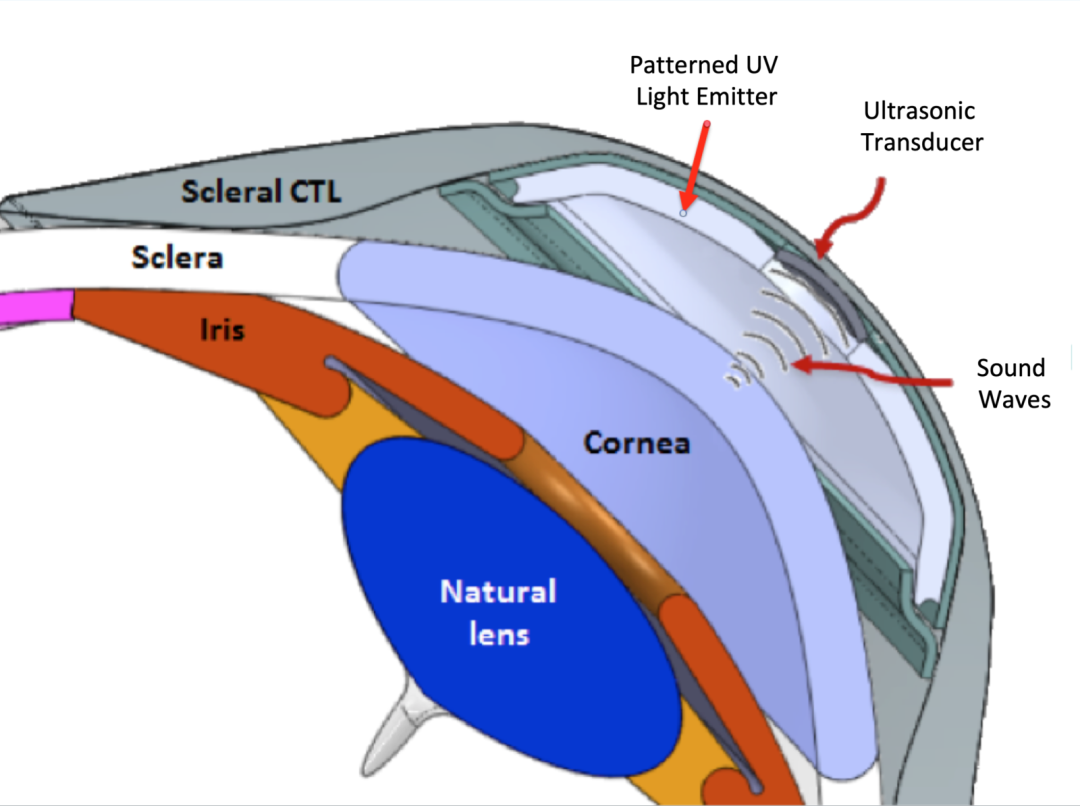
CXLens Lens Cross-Section
CXLens Through this closed-loop drug delivery model (selective hardening of the corneal surface),Achieved control over precise and permanent corneal shape changes (refractive correction).
The unique cross-linking solution provides a comfortable, high-oxygen environment to accelerate cross-linking.Supplemental oxygen can accelerate the reaction, stored in the reservoir of the scleral lens, providing an ultrasonic conduction path and carrying up to 60% by weight of oxygen. Both ultraviolet light and ultrasound are able to penetrate.
CEO of TECLensTom Dunlap Said: "For decades,In the field of eye health,This is an important collaboration with Johnson & Johnson."Innovative technologies will be able to bring significant positive impact."Johnson & Johnson Vision Peter MenziusoSaid: "As a company committed to providing eye care products to more than 40 million people each year, promoting early innovation, collaborating with experts, and leveraging new technologies are some of the ways we continue to improve patient outcomes."TECLens has conducted a successful pilot study for patients with keratoconus.,Participants in the pilot clinical studyDr. Juan BatlleIndicates:“The device is easy to use and well-tolerated by patients."I was able to perform corneal collagen cross-linking for the first time with almost no discomfort after the surgery, and while stabilizing the patient's corneal expansion, I was able to see a significant improvement in visual acuity and refractive outcomes."# About TECLens
TECLens The company was founded in 2013 and is developing aCross-linking technology can accurately address vision problems in healthy eyes and treat keratoconus.. Allowing presbyopic patients to regain the ability to read at a distance, controlling progressive myopia in children, and correcting vision problems such as adult hyperopia and mild myopia.TECLens has raised so far$5.6 millionThe main members of the company's management team are as follows:Tom DunlapServe asTECLens, Inc.CEOHe has previously led startups and divisions of global healthcare companies worth billions of dollars.
He has worked at HOYA Surgical Optics, Centricity Vision, Allergan Medical Optics,Bausch + Lomb、CoHerent Medical, Surgilase, etc. He has also served on the boards of several ophthalmic companies.
David Acker It is TECLensCo-Founder, who has founded multiple medical device companies, including one acquired by Johnson & JohnsonReceivePurchased "Biosense" (now "Biosense Webster, Inc."), and he also holds 33 U.S. patents for medical devices in the field of minimally invasive surgery.Pat Lopath It is TECLensCo-founder,In the medicalWith over 20 years of experience in the medical device and pharmaceutical development fields, as well as a background in management consulting and operational leadership for both medical device and pharmaceutical companies, along with 17 U.S. medical technology patents.