
2023 marks the first year of commercialization for RSV vaccines, with GSK's Arexvy and Pfizer's Abrysvo successively gaining approval for market launch, thereby setting in motion a massive RSV vaccine industry worth tens of billions of dollars.
Driven by huge market demand, RSV vaccines had a dream start in their first commercial year, with combined revenue of over $2.4 billion from two products, causing excitement across the entire field. Both companies regard this as one of the main growth drivers for their performance.
But the competition on the business side is brutal. Although the approval times for GSK and Pfizer's products were less than a month apart, the gap in sales revenue is significantly large.GSK's Arexvy generated $1.55 billion in sales in 2023, nearly twice that of Pfizer's Abrysvo.
It can be seen that in the first round of competition for RSV vaccines, Pfizer lost while GSK took a temporary lead.
A recent document released by the UK's NHS shows that Pfizer has secured a large order for "5 million doses of Abrysvo," which could potentially reverse its disadvantage in the competition with GSK.
01. Pfizer Secures "Mega Deal" at GSK's Home Ground
In 2023, GSK's Arexvy and Pfizer's Abrysvo were approved for marketing just 28 days apart. In their first year, the combined sales reached over $2.4 billion, but the former was almost twice as much as the latter, which was "clearly unsatisfactory."
And from the sales markets of the two vaccines, the United States has absorbed the vast majority of sales. This also means that one of the main competitive points for the two companies in the future will be the expansion into new markets. As large multinational pharmaceutical companies, they will obviously exert their maximum efforts to carve out more market share from each other.
Recently, Pfizer has achieved a crucial victory in market competition.
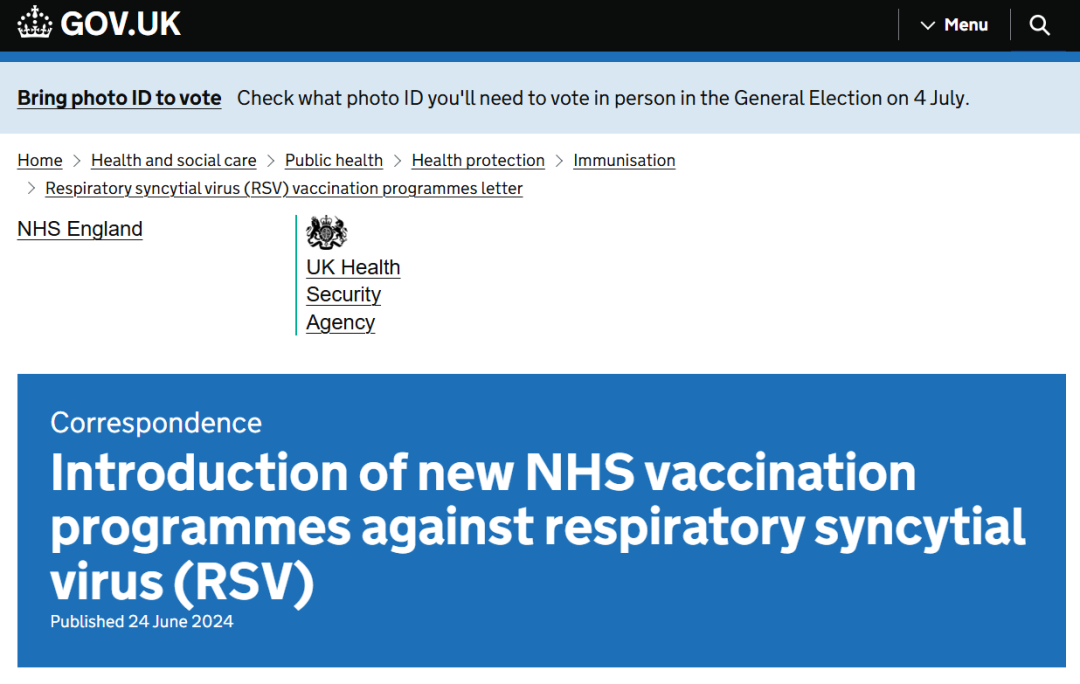
On June 24, the UK government announced the launch of the RSV vaccination program, in which it was mentioned that Pfizer has been selected as the supplier. Pfizer will provide 5 million doses of the RSV vaccine Abrysvo over the next two years.
This announcement did not disclose the total amount or the unit price. If we estimate based on the price of Abrysvo in the United States at $295 per dose, the total amount is already close to 1.5 billion US dollars, a solid "super big order."
In terms of this order, from the perspective of volume, it is clear that Pfizer has achieved a significant victory in its competition with GSK; from the perspective of "location," Pfizer has certainly enjoyed a major triumph. What could be more satisfying than "stealing the home turf" right in the competitor's backyard (GSK being a British pharmaceutical company)?
02, GSK, Pfizer RSV Vaccine Competition Key: Expanding User Population
In the RSV vaccine race, a fast start does not mean long-term victory.
As mentioned above, in 2023, the sales of GSK's Arexvy were nearly twice those of Pfizer's Abrysvo. In terms of total amount, Arexvy obviously took the lead.
However, looking at individual quarters, Arexvy's sales in the fourth quarter of 2023 were approximately $670 million, showing a decrease from the third quarter. In contrast, Pfizer's Abrysvo reported sales of about $515 million in the fourth quarter of 2023, marking a significant increase from $375 million in the third quarter.
GSK's Arexvy and Pfizer's Abrysvo took completely opposite trajectories in the fourth quarter of their first commercial year. Looking at the quarterly results, Pfizer has already closed in on GSK, with a gap of just $150 million. For RSV vaccine products still in the early stages of sales growth, this difference is clearly not significant.
The most fundamental reason Pfizer achieved this success is the expansion of the user population—specifically, in August 2023, the FDA approved the use of Abrysvo in pregnant women between 32 and 36 weeks of gestation. Consequently, Abrysvo became the first RSV vaccine for pregnant women to protect newborns.
It is the expansion into the pregnant population that has enabled Pfizer to gain a competitive edge in the "blue ocean" demographic, allowing it to take a different stance from GSK in the fourth quarter of 2023.
Like Pfizer, GSK is also actively expanding the label's target population. Earlier this month, GSK’s Arexvy received FDA approval to expand its eligible population to include high-risk adults aged 50-59, gaining an early advantage in the competition with Pfizer.
Pfizer, of course, is not willing to lag behind. In early April, Pfizer announced the success of the Phase 3 clinical trial of Abrysvo for high-risk populations aged 18-59, hoping to expand the age indication of Abrysvo to include individuals aged 18-59.
Although Pfizer's proposed extended age range is broader, it lags behind GSK at the regulatory level. Whether the competitive landscape of the two vaccines will undergo more drastic changes this year remains to be seen based on market outcomes.
03. Accelerated Divergence of RSV Vaccines
Due to the vast market potential, latecomers in the RSV vaccine field still have the opportunity to capture a share of the market. However, newcomers who wish to gain entry and continuously carve out market share must either offer a better product or achieve differentiation.
Recently, a new competitor has entered the commercialization race for RSV vaccines: Moderna's world-first RSV mRNA vaccine has been approved for marketing to prevent lower respiratory tract infections caused by RSV infection in adults aged 60 years and above.
As a result, three RSV vaccines have been approved for marketing globally. However, in China, no RSV vaccine has been approved yet, and the progress of the three marketed RSV vaccines in domestic research and development remains relatively slow. For instance, GSK's Arexvy applied for clinical trials in China in March 2023 and received implied permission for clinical trials from the CDE in June of the same year. Pfizer's Abrysvo, on the other hand, only filed for clinical trials in China on June 1 this year.
Facing the significant unmet clinical demand for RSV infection prevention in China, dozens of domestic pharmaceutical companies are making strategic moves.
Among innovative pharmaceutical companies in China, ADV110 by Aidiweixin is currently the domestically produced RSV vaccine with the fastest clinical research progress, now in Phase 2 clinical trials. It is intended to protect children aged 6 months to 5 years and adults over 65 years old. Clover Biopharmaceuticals and Daimeng Bio are close behind, currently in Phase 1/2 clinical trials.
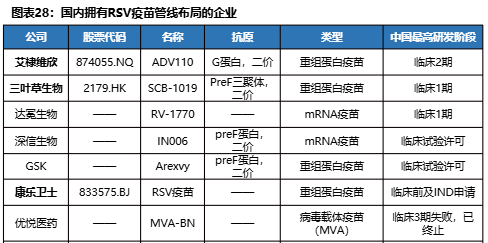
Source: AVIC Securities
In addition, since the beginning of the year, several China-produced RSV vaccine clinical trial applications have been accepted in China. For instance, the RSV mRNA vaccine from Shiyao Group applied for clinical trials in mid-April, and the RSV mRNA vaccine from Innovent Biologics received implied permission from the CDE on June 5th.
Overall, among the RSV vaccines currently under development in China, there are many homogeneous products, but there are also products with differentiated competitiveness. In terms of target populations, the current focus is primarily on the elderly and adult groups. However, the risk of infection among infants and young children is also very high, and the market potential is equally significant. Therefore, developing RSV vaccines targeting infants and young children could be a major direction for differentiation, but it is also precisely where the challenge lies.