VCBeat Health
Contact Us
Home
China Healthcare Select
Insights
MNC China Lens
Vertical Industries
Services
Partnership Development
Market Entry Advisory
Ecosystem Engagement Advisory
About VCBeat
Why VCBeat
Log In
Home
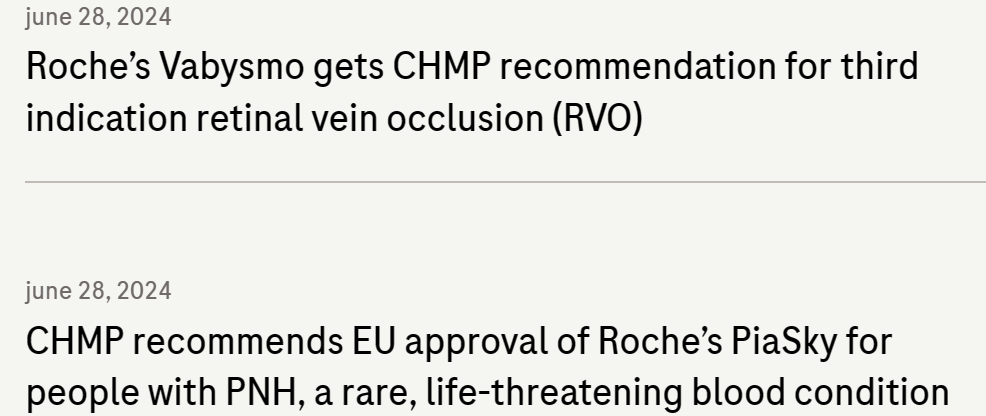
Roche Receives Positive CHMP Opinion for Two New Drugs: Vabysmo for RVO-Related Macular Edema and PiaSky for Paroxysmal Nocturnal Hemoglobinuria
Jun 29, 2024 08:03 CST Updated 08:03

Share:
Roche
Oncology Drug Research, Development, and Manufacturing

June 28,
Roche
Announce that the marketing applications of two new drugs have received positive opinions from the European Medicines Agency (EMA) Committee for Medicinal Products for Human Use (CHMP).
See, including
Vabysmo
(Faricimab) for
Treatment
Macular Edema Secondary to Retinal Vein Occlusion (RVO)
New Adaptation for Vision Impairment Caused by
Indications and
PiaSky
(Covalumab) New drug application for the treatment of patients with paroxysmal nocturnal hemoglobinuria (PNH). The European Commission is expected to make a final decision on these two approvals in the near future.
▌
Vabysmo (Faricimab)
Vabysmo (Faricimab)
It is Roche.
A bispecific monoclonal antibody targeting angiopoietin 2 (Ang2) and vascular endothelial growth factor A (VEGFA).
September 19, 2022
Has been approved for two indications in the EU, respectively
Treatment
Neovascular (Wet) Age-Related Macular Degeneration (nAMD)
And vision impairment caused by diabetic macular edema (DME).
This is the third indication being filed, and if approved,
Vabysmo
Will be the first and only bispecific antibody therapy available for nearly 1 million RVO patients in the EU.
The decision of the CHMP is based on
Phase III
The full 72-week data from the BALATON and COMINO studies, which evaluated the efficacy of Vabysmo in more than 1,200 patients with macular edema caused by branch and central retinal vein occlusion (BRVO and CRVO). In both studies, Vabysmo demonstrated early and sustained vision improvement, with effects non-inferior to
Aflibercept
, and continuously maintain retinal dryness. Vabysmo is well-tolerated, with safety consistent with previous studies.
RVO is the second most common cause of blindness. Based on the site of vascular occlusion, it can be divided into two types: branch retinal vein occlusion (BRVO) and central retinal vein occlusion (CRVO), with the former accounting for over 80%. After the retinal vein becomes occluded, blood reflux is impeded, leading to exudation from retinal vessels, macular edema, and intraretinal hemorrhage, causing vision loss. Globally, approximately 28 million adults (mainly those aged 60 and above) are affected by RVO. Current treatments mainly include laser therapy, anti-VEGF therapy, and surgical treatment.
Currently, there are a total of 5 ocular injection formulations available globally for treatment.
RVO
, the other four are Aflibercept (
Regeneron
/
Bayer
), Conbercept (
Kanghong Pharmaceutical
)、
Ranibizumab
(Roche/
Novartis
) and
Ozurdex
(AbbVie), all of which, except for Ozurdex, are VEGF/VEGFR-targeted drugs.
▌
PiaSky (Covarilimab)
PNH is a rare and life-threatening blood disease that affects approximately 20,000 people worldwide.
Red blood cells in PNH patients are destroyed by the complement system (a part of the innate immune system), leading to symptoms such as anemia, fatigue, and thrombosis, and may result in kidney disease.
C5 inhibitors can block part of the complement system cascade and have been proven effective in treating PNH.
PiaSky(
Covalemonab
)
It is a recombinant humanized IgG1 subtype monoclonal antibody targeting complement protein C5, which can specifically bind to complement protein C5, thereby inhibiting the cleavage of C5 into C5a and C5b, preventing the formation of the terminal complement complex C5b-9, and suppressing the immune response of the complement pathway.
PiaSky can circulate in the blood, allowing the drug to bind and inhibit the C5 protein multiple times, and exert a longer-lasting effect in the body even with a small amount of the drug.
Initial intravenous infusion and weekly during the first month of treatment
Subcutaneous Injection (SC)
Loading Dose
Thereafter, once every 4 weeks SC.
If this approval from the European Commission is granted, PiaSky will become the EU
The First Monthly Subcutaneous Injection for PNH Treatment,
After appropriate training, patients can choose to self-manage.
。
This may be for currently requiring regular intravenous (IV
)
Providing another option for patients infused with C5 inhibitors, which may help reduce the treatment burden and impact on the lives of PNH patients and their caregivers.
Interference.
The CHMP recommendation is based on the results of the Phase III COMMODORE 2 study conducted in PNH patients who had not previously received C5 inhibitor treatment. The study results showed that administering PiaSky once every four weeks via SC injection achieved disease control and was well-tolerated. The safety profile of PiaSky is consistent with
eculizumab
Similarly, eculizumab, an existing C5 inhibitor, is administered intravenously every two weeks. The incidence of adverse events in patients treated with PiaSky was similar to that in patients treated with eculizumab (78% vs. 80%, respectively). The submission package also includes supportive data from two additional Phase III studies: the COMMODORE 1 study, for PNH patients switching from previously approved C5 inhibitors, and the COMMODORE 3 study, for newly treated patients in China receiving C5 inhibitors.
PNH patients.
PiaSky
As of this year
Achieved the world's first batch in China on February 7 and was approved for marketing by the U.S. FDA on June 22 this year.
Copyright © 2024 PHARMCUBE. All Rights Reserved.
Welcome to forward, share, and reasonably cite. When citing, please clearly indicate the source of the article.
For reprint, please leave a message or send a message to the WeChat Official Account backend, and indicate the name and ID of the official account.
Disclaimer: The information in this WeChat article is for general reference only and should not be used directly as decision-making content. PharmaCube assumes no responsibility for any loss incurred by any party due to the use of the content herein.