

Johnson & Johnson's Nipocalimab Achieves Primary Endpoint in Phase 3 Trial for Generalized Myasthenia Gravis, Regulatory Submission Imminent

Johnson & Johnson
Healthcare Product Manufacturers, Health Service Providers
▎WuXiEdited by Kant Content Team
Johnson & Johnson announced today that its investigational antibody therapy nipocalimab, targeting the neonatal Fc receptor (FcRn), has achieved positive results in the Phase 3 Vivacity-MG study involving patients with generalized myasthenia gravis (gMG). The trial met its primary endpoint, with patients receiving nipocalimab in combination with standard of care (SOC) showing greater improvement in gMG disease metrics, specifically the Activities of Daily Living (MG-ADL) score, compared to those on placebo plus SOC. Johnson & Johnson will present detailed data at the 2024 European Academy of Neurology (EAN) Congress and plans to submit the data to regulatory authorities later this year. According to the press release,This therapy is the first FcRn blocker that, when used in combination with standard treatment in gMG antibody-positive patients (anti-AChR+, anti-MuSK+, anti-LRP4+), demonstrates superiority over placebo in improving patients' MG-ADL scores.

This double-blind, placebo-controlled study enrolled a broad population of patients who were anti-AChR+, anti-MuSK+, and/or anti-LRP4+, accounting for approximately 95% of the gMG patient population. Compared to baseline, during weeks 22, 23, and 24,Patients receiving nipocalimab combined with SOC treatment showed an average improvement of 4.70 points in MG-ADL scores, significantly higher than the 3.25 points in patients receiving placebo combined with SOC treatment (P=0.002).For gMG patients,A 1 to 2-point change in MG-ADL score may indicate a progression from normal eating to frequent swallowing difficulties, or from shortness of breath at rest to requiring a ventilator.
In addition to achieving this primary endpoint, the trial also met key secondary endpoints:
In Week 22 and Week 24,Quantitative Myasthenia Gravis (QMG) score measurements show,Compared with placebo combined with SOC,Nipocalimab combined with SOC showed significantly greater improvements in strength and function across different muscle groups (P<0.001).
At weeks 22, 23, and 24, nipocalimab combined with SOC showed a significantly higher MG-ADL response (≥2-point improvement from baseline) compared to placebo combined with SOC (P=0.021), further highlighting the potential of nipocalimab treatment in reducing the impact on daily life for patients with gMG.
In the trialnipocalimabThe safety and tolerability were consistent with other trials. The overall incidence of adverse events, serious adverse events, and adverse events leading to discontinuation was similar to the placebo combined with SOC group.
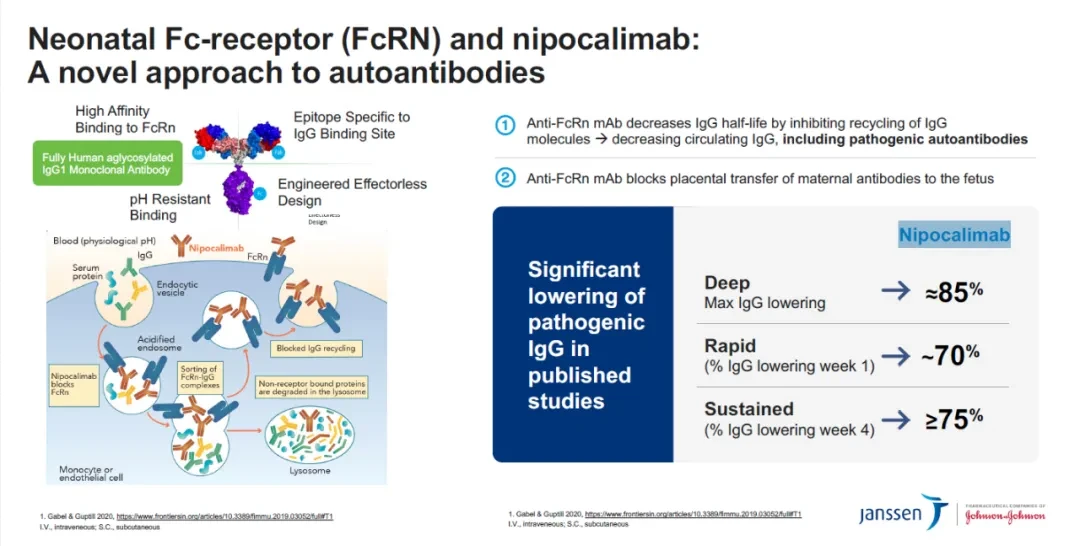
▲Introduction to Nipocalimab (Image Source:Johnson & Johnson Official Website)
Nipocalimab is a potential "best-in-class" antibody therapy targeting the neonatal Fc receptor. By binding to FcRn, it prevents autoantibodies taken up by monocytes and endothelial cells from being released back into the bloodstream, instead degrading them within the cells.Studies have shown that it can reduce IgG levels, including pathogenic autoantibodies in the bloodstream, by more than 75%. This antibody therapy has the potential to treat various autoimmune antibody-mediated immune diseases. The FDA has granted this therapy Breakthrough Therapy Designation for treating pregnant women at high risk of severe Hemolytic Disease of the Fetus and Newborn (HDFN), as well as Fast Track designation for treating HDFN, gMG, warm antibody autoimmune hemolytic anemia (wAIHA), and Fetal Neonatal Alloimmune Thrombocytopenia (FNAIT).This therapy was listed by the industry media Evaluate at the beginning of this year.Top 10 Potential Blockbuster Therapies in DevelopmentOne of.

▲To learn more about the application of cutting-edge technologies in the biopharmaceutical industry, please long press and scan the QR code above to access "WuXi AppTec Live Studio" and watch live discussions and exciting replays on related topics.


Share,PointLike,In view, Focusing on Global Biomedical Health Innovation