6Month13Day, XtalPi officially listed, integrating“ChinaAIThe First Pharmaceutical Stock”And“18CThe First Share”in one, with a market value of nearly180HKD billion, envied by many inIPOLingering in the Doldrumsbiotech。However, behind the charming aura, the door of 18C only opens to leading enterprises in specific industries.The "Specialized Technology Companies" targeted by 18C only cover five major industries: next-generation information technology, advanced hardware, advanced materials, new energy and energy conservation and environmental protection, new food and agricultural technology. In the pharmaceutical industry, only companies in the AI + healthcare and synthetic biology tracks may meet the standards.Moreover, among the numerous listing standards for unprofitable companies, 18C has the highest market capitalization requirements: at least HKD 6 billion for commercialized companies and no less than HKD 10 billion for non-commercialized companies, far exceeding the HKD 1.5 billion required by 18A and the CNY 4 billion required by the STAR Market; the requirements for R&D duration and R&D investment are also stricter.Hong Kong Exchanges and Clearing Limited's Head of Listing, Bonnie Chan, once discussed this market capitalization standard: "The so-called 'unicorns' generally have a valuation of around 1 billion US dollars. Market participants widely consider this market capitalization requirement to be relatively reasonable, representing the scale of companies that most investors may be interested in, and it also helps protect the rights and interests of investors."As the glorious era of biomedicine initiated by 18A moves into the slow lane, 18C appears to be a new signal: the next wave of life sciences may emerge from the intersection of life sciences and cutting-edge hard technology.According to the PharmaCube InvestGo database, PharmaCube Invest has compiled the top five companies in terms of total financing in the two major sectors of AI + healthcare and synthetic biology.They are most likely to grow into "unicorns"; and from the development paths chosen by these leaders, we can vaguely see the direction of transformation in the life sciences industry.
AI + Healthcare
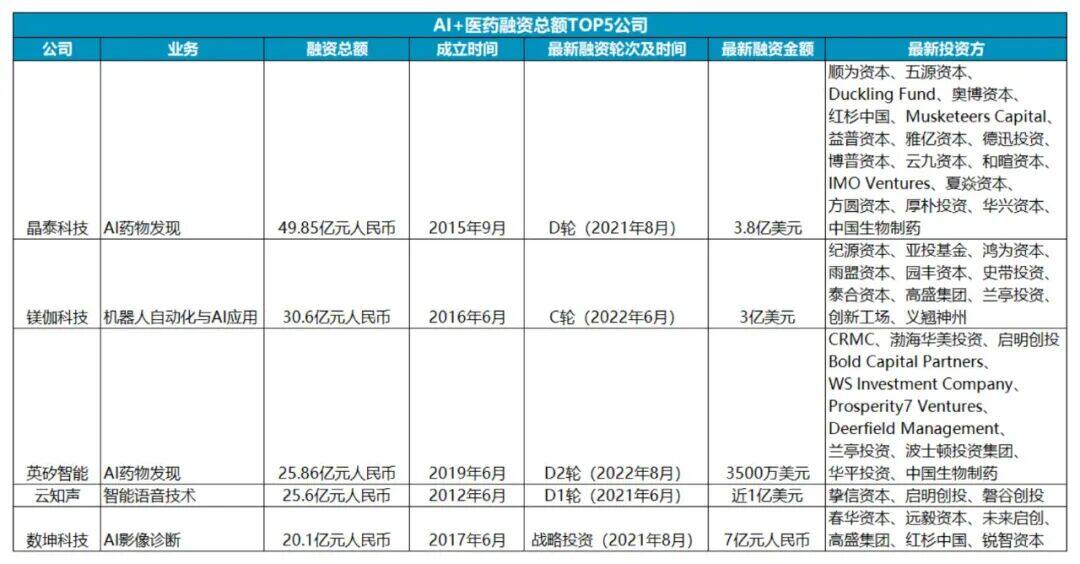
In the AI healthcare track,XtalPiTotal pre-IPO financing of approximately 5 billion RMB, making it the undisputed "fundraising king."Maga TechnologyRight behind it, the total financing exceeds 3 billion RMB, ranking first among current unlisted AI medical companies.Suzhou Maga Technology Co., Ltd. mainly provides comprehensive automation solutions for the life sciences industry. Its workflow automation can integrate AI software, analytical instruments, laboratory hardware, and experimental consumables into a single laboratory system, achieving higher efficiency and more stable experimental results in various life science applications such as antibody selection, cell line development, and molecular screening.The so-called "future industries" development,Intelligence and automation are two sides of the same coin. XtalPi and Suzhou Maga Technology Co., Ltd. are the earliest companies in China to apply AI and robotics in the life sciences field, and currently the two most "general-purpose tool" like companies in the industry.Has expanded from the life sciences field to other industries.Insilico and SHUKUN are more inclined to the "application layer," focusing on AI-driven innovation in drug and device R&D. Insilico has already applied for a Hong Kong IPO under Rule 18A.SHUKUN's second IPO application has also been initiated.Similarly, mastering the underlying technology,Insilico MedicineUnlike XtalPi's horizontal expansion, it delves vertically, shifting from pursuing "innovation" to seeking "practicality," aligning more closely with the needs of the biopharmaceutical industry.This shift occurred in 2021. At that time,Insilico MedicineAnnouncing the world's first entirely AI-driven discovery of a new target for idiopathic pulmonary fibrosis (IPF) — TRAF2 and NCK interacting protein kinase (TNIK), as well as a novel compound, ISM001-055, designed for this target.With this, Insilico Medicine secured a whopping $255 million investment from a super-luxury lineup of investors in June 2021.After the myth of "AI-manufactured drugs" sparked a frenzy, Insilico Medicine established a drug research and development team led by Dr. Feng Ren, former Senior Vice President of the Biology and Chemistry Departments at MedChemExpress and former Director of Chemistry at GSK."After the drug research and development team was established, we actually pulled the pipeline back.Not every project can focus on developing entirely new targets.”At a forum in August 2023, Ren Feng reviewed the strategic adjustment at the time: "The success rate of new targets is generally only 1%. With the support of AI, the success rate can be increased threefold, but it is still only 3% — we still need to make a living. The current strategy is that about 25% is allocated to the research and development of innovative targets, and the rest focuses on creating differentiated molecules for targets that have been validated clinically or pre-clinically."To date, Insilico Medicine has built a product portfolio of 15 drug candidates, six of which have received IND approval. The core product, ISM001-055, is the world's only clinical-stage candidate targeting TNIK for IPF indications. In February 2023, it received FDA Orphan Drug Designation and is currently advancing Phase IIa clinical trials in both China and the U.S.However, this does not mean that Insilico Medicine wants to become a traditional pharmaceutical company."Traditional pharmaceutical companies focus on how to push their products and projects into the later stages of clinical trials and eventually sales. We hope to leverage our early-stage R&D advantages, using AI for target discovery and molecule generation, and advance our pipeline to phase I or even preclinical stages, after which we engage in strategic partnerships and licensing," said Ren Feng.In September of the same year, Insilico Medicine announced an $80 million upfront payment to grant Exelixis, a Nasdaq-listed company, global development and commercialization rights for ISM3091. This is a potential best-in-class small molecule inhibitor targeting the synthetic lethal target USP1 in BRCA-mutated tumors.This is also the first time that an Asian AI+DD (Drug Development) company has completed a license-out transaction.SHUKUNIt is the only device enterprise in the TOP5 of total AI medical financing.SHUKUN has independently developed a "digital doctor" product portfolio that covers the entire process of disease screening, auxiliary diagnosis, and treatment decision-making for major common and chronic diseases such as cardiovascular and cerebrovascular diseases and cancer. By 2020, SHUKUN had already obtained NMPA Class III certificates and MDR CE certifications in the three key areas of heart, brain, and chest, taking an absolutely leading position in the number of registered certificates in the AI medical device field.In July 2021, SHUKUN completed a 700-million-yuan financing round with a constellation of investors, including Goldman Sachs Asset Management, Primavera Capital, Sequoia Capital China Fund, and Yuan Yi Capital.At the 2021 World Artificial Intelligence Conference, almost simultaneously, Neil Shen, Global Managing Partner of Sequoia Capital, explained this investment: "SHUKUN is the world's first technology company to receive regulatory approval for an AI-assisted diagnostic tool for coronary artery stenosis, reducing the time doctors spend on coronary diagnosis from 30 minutes to just 2-3 minutes. Their artificial intelligence products developed for cardiovascular CT diagnostics and liver MRI diagnostics have been deployed in over 800 hospitals, significantly improving the efficiency of radiologists."UnisoundAmong the five companies, it stands out as somewhat unconventional — its "selling point" is not life sciences, but rather as one of the earliest companies in Asia to commercialize large AI language models, providing AI-powered solutions to a wide range of vertical industry clients.Intelligent healthcare is one of the major scenarios covered by Unisound, including AI-enabled solutions such as medical record voice input, medical record quality control, single-disease quality control, and medical insurance payment management.In February 2021, Unisound withdrew its application for a STAR Market IPO, and later chose to go public on the Hong Kong stock market in July 2023, competing for the title of "First Large Model Stock."Interestingly, as of now, Unisound relies on two major businesses—smart living and smart healthcare—to generate revenue, and it is the fastest-growing company among its peers with annual revenues exceeding 500 million yuan.From 2020 to 2022, the revenue generated by Unisound's intelligent healthcare business was RMB 0.72 billion, RMB 1.03 billion, and RMB 1.13 billion, respectively, accounting for 27.5%, 22.5%, and 18.9% of the total revenue. In terms of 2022 revenue, Unisound ranked third in China's smart hospital market.
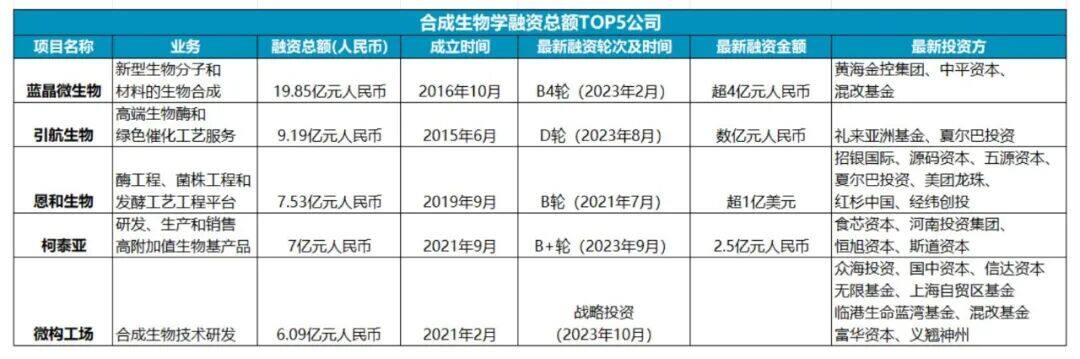
Synthetic Biology Among the top 5 companies in synthetic biology financing,Pilot BioThe earliest established and the first company to have multiple products achieve mass production, including D-ethyl ester, a key intermediate for amide alcohol veterinary antibiotics, and L-glufosinate, the active ingredient of the world's second-largest herbicide glufosinate.In the pharmaceutical field, Pilot Bio has mass-produced 25-hydroxyvitamin D₃ raw materials, as well as intermediates such as enzyme preparations, β-nicotinamide adenine dinucleotide phosphate (NADP+), and β-nicotinamide adenine dinucleotide (NAD+), with an annual production scale reaching thousands of tons.From 2021 to 2023, Pilot Bio successively completed its Series C, C+, and D rounds of financing. Top investment institutions such as Hillhouse Capital, Oriza Holdings, Sherpa Healthcare Partners, and Lilly Asia Ventures have all invested, most valuing the fact that Pilot Bio "has achieved commercial production globally for multiple products ahead of others."Bluepha and MicrobExpress also launched the mass production plan for PHA (polyhydroxyalkanoates) products in 2022, advancing into the commercialization phase ahead of many other synthetic biology "rising stars." In January 2023, Bluepha successfully conducted trial production at its Phase I PHA plant in Yancheng, Jiangsu, with a designed annual capacity of 5,000 tons.Although both companies originated from Tsinghua University and started their ventures with PHA as the main product, their development paths are vastly different.MicrovolutionDerived from the scientific research achievements of Professor Guoqiang Chen's team at Tsinghua University, the team had already overcome production scale-up issues related to strains, processes, and extraction before establishing the company. They successfully conducted a five-ton pilot test and completed the development of the production process for a 200-cubic-meter fermentation tank.In 2021, the company landed in Beijing mainly for the scaled production of PHA. In terms of production methods, it also chose to build a production base in cooperation with other companies, rather than building its own production capacity like Bluepha.Blue Crystal MicrobiologyFounded in 2016, it initially focused on upstream and midstream laboratory development, specializing in upstream and midstream technologies such as strain selection and strain modification. Its business model involves collaborating with downstream factories through technology licensing to jointly produce different types of PHA for application in various products.With the same model, Blue Crystal Microorganisms couldn't help but look at the global leading companies in the industry at that time.——Horizontal Platform-Type Synthetic Biology Leading EnterpriseGinkgo Bioworks,Its automated, high-throughput, and efficient strain optimization platform, combined with big data and machine learning, enables the automated and intelligent modification of chassis cells to quickly meet the demands of downstream products.With this as the goal,From 2021 to 2022, BluephaOn the one hand, promoteThe large-scale production of PHA,On the one hand, build a platformSynBio OS, and rely on the platform to promote the R&D and implementation of new products such as regenerative medical materials, engineering probiotics, and more.In order to support this"T-shaped Strategy": Bluepha Microbes Completes Over 1.5 Billion RMB in Series B Financing in Two Years, Showing a Leading Integrated Trend in the Midstream and Downstream Sectors.The Trend of Synthetic Biology Industry is InevitableFrom traditional reliance on manual methods to the evolution of automation, high-throughput, data-driven, and intelligent processes, building a synthetic biology R&D platform that integrates BT (biotechnology) + IT (information technology) and forms a "Design-Build-Test-Learn (DBTL)" closed loop remains a relatively weak area for Chinese enterprises.Therefore, companies with strong platform R&D capabilities are expected to be favored by the capital market.Enhe BioIt is a typical representative in this field. Founded in 2019, Enhe Bio emerged prominently during the 2021 investment boom in synthetic biology despite its relatively recent establishment.In the first half of 2021, Bota Bio completed a strategic investment by German chemical giant BASF and a $100 million Series B financing round led by Sequoia China, setting a record for the fastest and largest financing in Asia's synthetic biology field at the time. This was all thanks to Bota Bio's R&D platform.At that time, Enhe Bio had preliminarily built a highly integrated automation technology platform, Bota Freeway. This platform combines advanced digital tools with laboratory automation, using computation as the core and foundation. It enables the construction and optimization of enzymes, strains, and production processes, while efficiently completing the DBTL cycle in synthetic biology, reducing iteration cycles by 50%. It further covers downstream process development and the modification of non-traditional engineered microbial strains.BASF is optimistic about its "highly innovative bio-platform accelerating product development," which Shen Nanpeng described as an "industry-leading integrated technology platform."After securing substantial financing, Bota Biosciences plans to further enhance the development of BotaFreeway, its high-precision fermentation platform, and pilot-scale facilities to expand the company’s product pipeline in consumer goods, food, nutrition, and pharmaceuticals.And relatively late establishment ofCOTERAThe certainty that investors see is the "high overall score." As Yuanqi Capital commented at the time, XtalPi is a "star team in China with rare capabilities in R&D, industry experience, and data platform expertise."Dr. Lishan Zhao, the founder of COTYABIO, worked at Amyris, the "pioneer" of synthetic biology, for 14 years, serving as Vice President of R&D and President of the China region. He led the construction and operation of the world's first synthetic biotechnology platform and guided multiple products such as artemisinin, farnesene, and vitamin E from laboratory research to large-scale production and commercialization.Moreover, the core members of the founding team also have an average of over 10 years of industrial experience, and the team collectively possesses commercialization experience in developing more than 20 synthetic biology products from scratch.The power of industry experience is directly reflected in Cotify's development strategy. At its inception, Cotify did not engage in a "head-on" competition with R&D platforms and rivals. Instead, leveraging the team's deep understanding of global synthetic biology, it found opportunities on the industry front.On one hand, CTEYA Bio fully utilizes the team's global vision and resources to deepen cooperation with multiple overseas enterprises. On the other hand, it integrates the most cutting-edge platform technologies from abroad with China's product implementation and scaling advantages to achieve "end-to-end" production and delivery. It has quickly become one of the few synthetic biology companies globally that possess both R&D capabilities and production delivery capabilities.At the same time, within a year of its establishment, CTECH completed three rounds of financing. With this funding, it built the DBTL platform, which has basically achieved full-process digitization and automation. Relying on this platform, CTECH focuses on the biosynthesis of terpenoids, amino acids and their derivatives, and oligosaccharide products, concentrating on the fields of personal care, food nutrition, and pharmaceutical raw materials. Currently, it has launched two products.In the second half of 2023, Cofactor Therapeutics completed two rounds of financing totaling 500 million yuan under the shadow of "giant downfall," stabilizing its position amidst industry turbulence.Efficiency, and More Efficiency —— The Significance of Automation and Intelligent Technologies in the Life Sciences Industry is Now Common Knowledge.FromThe growth history of these emerging "unicorns" shows that cutting-edge technology is a powerful tool, but industrial thinking is the anchor that determines direction.Only by integrating cutting-edge technology into the practical needs of upstream and downstream industries can the "bubble" of innovation truly become a revolutionary force in the industry.Copyright © 2024 PHARMCUBE. All Rights Reserved.Welcome to forward, share, and reasonably cite. When citing, please clearly indicate the source of the article.For reprint, please leave a message or send a message to the WeChat Official Account backend, and indicate the name and ID of the official account.Disclaimer: The information in this WeChat article is for general reference only and should not be used directly as decision-making content. PharmaCube assumes no responsibility for any loss incurred by any party due to the use of the content herein.