

Gilead's HIV 'Wonder Drug' Lenacapavir Shows 100% Efficacy in PrEP Trial for Cisgender Women

Gilead Sciences
Antiviral Drug Developer
In the field of AIDS prevention and treatment, Gilead Sciences has gone all out.
Not long ago (June 20), Gilead Sciences publicly announced the results of a key Phase III trial. The injectable capsid inhibitor Lenacapavir, administered twice a year, showed 100% efficacy with zero infections in a study involving 2,134 cisgender women! (Note: An injectable capsid inhibitor is an antiviral drug that blocks the assembly of the viral protein shell.)
Lenacapavir, developed by the multinational pharmaceutical company Gilead Sciences, was approved in the United States in 2022 for the treatment of HIV/AIDS, although it needs to be used in combination with other antiviral drugs.
During the same period, among 1,068 women using Truvada and 2,136 women using Descovy, there were 16 and 39 cases of infection respectively. These participants were from regions such as Africa and Uganda. (Note: Both drugs are also used for HIV treatment and pre-exposure prophylaxis, with the main components being emtricitabine and tenofovir; the latter is an upgraded version of the former.)
Researchers believe that this result demonstrates that lenacapavir has achieved both the primary and secondary endpoints for pre-exposure prophylaxis (PrEP) of the human immunodeficiency virus (HIV).
In this regard, Dr. Merdad Parsey, Global Chief Executive Officer of Gilead Sciences, stated outright that lenacapavir's performance has already demonstrated its potential as a "significant new tool" to help prevent HIV infection. He further expressed that Gilead will continue striving toward the goal of "ending the HIV epidemic."
"This is a noteworthy milestone in the history of antiviral drug treatment," virology expert Chang Rongshan also told Huxiu.
Many people know Gilead Sciences because of "the people's hope" during the COVID-19 pandemic. Although Remdesivir failed to become the much-anticipated "special drug" for COVID-19, it still left a deep impression on the public.
In fact, in the fight against viruses, Gilead Sciences is often regarded as a "god of medicine." Since its establishment in 1987, this company has not only dominated more than 56% of the market share in the HIV treatment field, surpassing competitors in both the number of new products and sales, but it has also launched products that have "decimated" parts of the industry.
For example: Gilead Sciences' small-molecule drug for treating hepatitis C virus has raised the cure rate to nearly 100%. Under its leadership, the market size of such drugs shrank by two-thirds in just three years. Driven by both market competition and national health insurance negotiations, the cost per treatment course for third-generation products in China has dropped from an initial approximately 70,000 yuan to less than 2,000 yuan out-of-pocket.
Moreover, the anti-influenza "wonder drug" Oseltamivir was originally developed by Gilead Sciences.
Now, this company is showing a strong momentum of extending its "myth" of anti-HCV virus success to the field of AIDS prevention and treatment.
In response, the investment market has already reacted first. Following the release of the aforementioned test results, Gilead Sciences’ stock price on the US stock market surged by 10% in a single day, with its market value increasing by over $6.6 billion (approximately RMB 47.96 billion). Subsequently, the share prices of China-based anti-AIDS drug companies such as Addpharma plummeted (Addpharma’s stock price once dropped by more than 14% in a single day). Behind these movements, investors have already set the tone for the impact this drug will have after its market launch—but will the future really unfold this way?
Not enough to overturn the HIV drug market
According to the information released by Gilead Sciences, the trial of lenacapavir for pre-exposure prophylaxis is still advancing in more populations, including men. If everything goes smoothly, results are expected to be announced by the end of 2024 or early 2025.
At this rate, the widespread use of the "miracle drug" for HIV prevention is not far off.
However, there is still a long way to go before lenacapavir can end the transmission of HIV.
Data shows that since the discovery of the world's first AIDS patient in 1984, about 40 million people globally have died as a result, and nearly 40 million more have been infected. According to UN data, over a million new HIV infections occur annually. China is considered a low-prevalence country, yet it still reports over 100,000 new infections each year, with approximately 3,000 cases among young students alone.
To prevent and control AIDS, a large amount of funding has been invested globally. According to data from the Joint United Nations Programme on HIV/AIDS (UNAIDS), annual HIV prevention and treatment investment in low- and middle-income countries will need to be at least US$29 billion by 2025. Despite a current funding gap, relevant countries and regions are already spending over US$20 billion annually on this issue. The market size for anti-HIV medications alone exceeds US$40 billion.
Moreover, the indirect losses caused by premature deaths each year, depression and anxiety triggered by illness, and the burden of family caregiving are also heavy burdens for the country, society, and families.
As one of the most important means of preventing and treating HIV today, the breakthrough in pre-exposure prophylaxis (PrEP) has undoubtedly added a new variable to humanity's battle against HIV. However, this variable is not decisive.
For disease control, prevention has always been more important than treatment. Chang Rongshan pointed out that the general approaches to preventing infectious diseases are public health measures, including cutting off transmission routes and forming immunization barriers through vaccination. Beyond these measures come medical interventions, including pre-exposure prophylactic drugs, post-exposure blocking drugs, and antiviral "cocktail therapies," among others.
Since the transmission routes of HIV are clear, mainly through blood, sexual contact, and mother-to-child transmission, in this way, as long as everyone takes personal precautions, such as: not sharing needles or toothbrushes with others, using condoms, and limiting the number of sexual partners, the possibility of transmitting the vast majority of infectious diseases can be blocked.
Unfortunately, the development of an HIV vaccine remains fraught with challenges to this day. Not long ago, the last large-scale HIV vaccine development project worldwide ended in failure, making the realization of this protective pathway seem indefinitely far off.
In medical approaches, "pre-exposure prophylaxis (PrEP)" can also function similarly to a vaccine and has always been highly valued. In an article published on the UNAIDS website in 2019, it was noted that oral pre-exposure prophylaxis, as an additional HIV prevention option for men who have sex with men, transgender individuals, and sex workers, has shown significant impact in reducing new HIV infections.
In fact, there were also pre-exposure prophylaxis drugs for HIV before, such as Truvada and Descovy, which belong to this category, and there is also a drug called Cabotegravir. However, their actual effectiveness has been very limited.
Objectively, the accessibility of these drugs has always been an issue. An article on the UNAIDS official website also mentioned that in practice, access to such drugs is hindered. Reasons for this include the drugs being available only at centralized locations, preventive measures being offered only at specialized HIV treatment sites, and the high out-of-pocket costs for the medications.
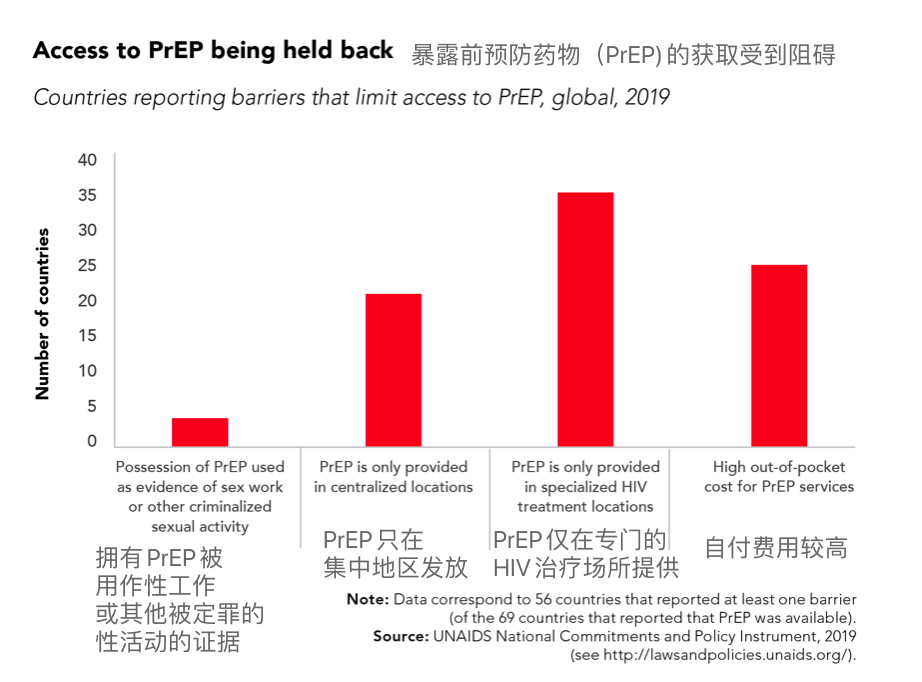
Source: UNAIDS Official Website
It can be seen that pre-exposure prophylaxis drugs previously on the market generally require daily administration, or at longest, injection once every two months. Moreover, they cannot provide 100% prevention. As mentioned earlier, in related trials, the incidence rates were 1.69/100 person-years and 2.02/100 person-years, respectively.
Moreover, the price is extremely high. According to publicly available information, the total annual cost of Descovy is $26,000, and with one tablet per day, the cost per tablet exceeds $70. There is widespread concern in the industry that the price of Lenacapavir will be even higher.
"If the daily cost exceeds $5, it makes no sense," Chang Rongshan told Huxiu. This means that those who truly need it cannot afford it. In southern Africa, where the HIV infection rate is most severe, the positivity rate in many countries is 25%, and the average daily living expenses are only a few dollars.
Besides, the antiviral potency, drug resistance of lenacapavir, and how to address the extremely high mutation capability of HIV are still unresolved challenges. Chang Rongshan pointed out that although the current trial data of the drug looks impressive, the number of participants in this clinical study is still insufficient. "At least tens of thousands of trials are needed to be conclusive."
In other words, based on the current evidence, it is difficult for lenacapavir to be used on a large scale to prevent HIV, let alone end AIDS. Moreover, as a preventive drug, many people are also concerned that "it is a double-edged sword." Chang Rongshan pointed out that constrained by price, it is very likely that the high-risk groups who need the drug the most will be unable to afford it, while those who can afford the drug may become reckless, as they won’t worry about being infected during sexual activity after receiving lenacapavir. This could lead to unprotected sexual behavior, making it easier for those who cannot afford the drug to become infected, which "could very likely exacerbate the spread of HIV."
Seeing the Hope of "Curing" AIDS
"The greatest value of Lenacapavir is that it actually gives people hope for a functional cure for AIDS," Chang Rongshan told Huxiu. Companies should focus on exploring the therapeutic effects of drugs, and from a theoretical perspective, Lenacapavir does have this potential.
The difficulty in AIDS prevention and treatment is caused by multiple reasons.
First, HIV mutates too quickly. Not only is the virus different among individuals, but there may also be significantly varied strains within the same person. Second, HIV undergoes reverse transcription, allowing it to integrate its genetic information into human cells and remain latent for a long time. Third, the development of an HIV vaccine lacks the necessary animal models. "When HIV infects monkeys, many do not develop the disease," Chang Rongshan told Huxiu.
More importantly, HIV attacks the "communication soldiers" (CD4+T lymphocytes) of the human immune system. Coupled with HIV destroying normal anti-infective immunity and anti-tumor immunity, the immune system gradually becomes incapacitated, unable to detect "enemy situations". This leads to infections by fungi that are usually not easy to contract, as well as rare diseases like Kaposi's sarcoma. This is also the reason for many patient deaths.
These not only make vaccine development extremely challenging but also mean that any single antiviral drug may quickly lead to drug resistance. Moreover, even if a drug "eliminates" the virus, its genetic material remains hidden in human cells, ready to rebound at any time. Therefore, combination therapies like the "cocktail therapy," while unable to completely eradicate the HIV virus, can only suppress its active replication. Once the medication is stopped, the CD4+T lymphocyte count immediately drops, leading to immune system collapse and eventual death.
Lenacapavir is a capsid inhibitor. The HIV viral capsid is the protein shell that protects the virus's genetic material. Researchers have found that although HIV is highly variable, the region of its genome encoding the capsid protein is one of the least mutable parts. Lenacapavir takes advantage of this by inhibiting the capsid protein, disrupting capsid assembly, and thereby rendering the virus incapable of infecting host cells.
The drug is administered via subcutaneous injection, and after entering the body, it is slowly released from fat cells, thereby achieving long-term viral suppression.
Chang Rongshan told Hu Xiu that he has seen hope for a functional cure for AIDS in humans from the above-mentioned novel antiviral pharmacology of Lenacapavir.
According to Chen Zhiwei, Director of the AIDS Institute at The University of Hong Kong's Li Ka Shing Faculty of Medicine, in an interview with *Health News*, this "cure," although still unable to completely eradicate HIV from the bodies of those infected, allows patients to stop antiviral treatment, no longer requiring lifelong medication, while still maintaining a certain level of CD4+ T lymphocytes and preserving normal immune function.
Lenacapavir does have a long-lasting effect. Its approved indication in the United States, "in combination with other antiretroviral drugs for the treatment of HIV-infected individuals who have received multiple treatment regimens," is administered twice a year, greatly relieving patients from the daily burden of taking medication. This is even considered the biggest breakthrough of the drug.
Whether it will be possible in the future to enable patients to stop lifelong medication and achieve "functional cure" remains to be further researched and confirmed. In the short term, long-acting treatment drugs may potentially improve the psychological well-being of AIDS patients.
"Research on the Distribution of Suicide Deaths and Related Disease Burden Among HIV-infected Individuals in China" by Hanxi Zhang from the Chinese Center for Disease Control and Prevention points out that in 2020, the burden of mental illnesses in China accounted for one-quarter of the total disease burden. Among this, the prevalence of depression is higher in people living with HIV/AIDS than in the general population, with psychological stress caused by discrimination being a key contributing factor.
In the above article, the researchers mentioned that the mental health of people living with HIV not only affects their own health but may also increase risky behaviors, including reduced medication adherence, unprotected sexual behavior, and suicide. These can lead to premature death of patients and secondary transmission of HIV.
One injection every six months, no need to take medication daily, can indeed prevent forgetting to take medication, reduce the psychological burden of daily medication, and also help control the spread of HIV.
Saved Gilead first?
Lenacapavir Saved Its Own Life Before Completely Solving the HIV Infection Problem.
In fact, just before the release of the key Phase 3 trial results for Lenacapavir in preventing HIV infection, Gilead Sciences had already reported several pieces of bad news in a row.
These include: the failure of a Phase III clinical trial for its anti-CD47 antibody drug, which cost $4.9 billion in R&D; the failure of a Phase III clinical trial for developing a new indication (second-line non-small cell lung cancer) for the marketed ADC product sacituzumab govitecan; and the failure of a confirmatory Phase III clinical trial for the same drug in urothelial cancer. (Note from Huxiu: CD47 is considered by the industry in recent years to be a very promising target for anticancer drugs.)
Behind this, Gilead Sciences, which once increased its total revenue to $33 billion and total assets to $70.28 billion through its hepatitis C small molecule drugs, and briefly ranked among the wealthiest pharmaceutical companies in the world, encountered a bottleneck in its own development after largely "eradicating" hepatitis C. Desperately in need of a new blockbuster drug to save the day, they turned to the currently popular field of oncology.
According to statistics from the industry self-media "Tongxieyi," over the past five years, Gilead Sciences has spent more than 40 billion US dollars searching for effective oncology drugs, but with minimal returns.
An industry insider once lamented that Gilead spent $11 billion to acquire Pharmasset, which developed a hepatitis C small molecule drug with peak annual sales of $19.1 billion, helping its market value soar to over $100 billion. Now, they’ve spent $11.9 billion to buy Kite, the leader in CAR-T, and $21 billion to acquire antibody drug company Immunomedics, with total spending exceeding $32 billion, only to end up with heavy losses.
According to the data released by the company, Gilead Sciences' oncology product revenue grew by 37% in 2023, but the total amount was only $2.932 billion, accounting for approximately 11% of the total revenue ($27.116 billion). As frequent failures in expanding new indications occur, maintaining high-speed growth has become increasingly challenging.
However, its core sector of antiviral drugs, despite having a considerable total volume, shows sluggish growth. Among these, the total revenue from HIV-related products was 18.175 billion yuan, increasing by 6%; the revenue from HCV small molecule drugs was 1.77 billion US dollars, decreasing by 2% year-on-year. Compared to the peak period's 19.14 billion US dollars, it is now less than one-tenth.
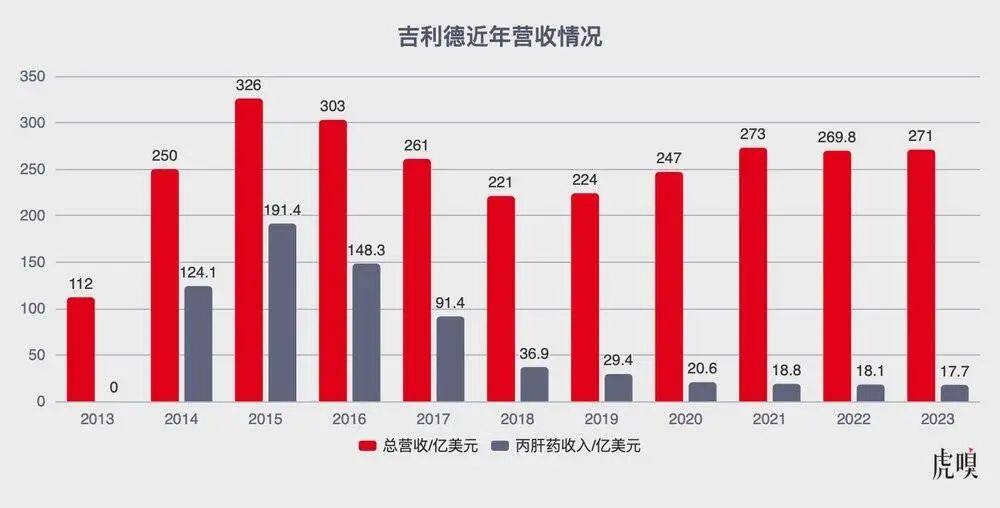
Data source: Gilead announcement and public data / Huxiu graphic
At this moment, another surprise has emerged in the anti-AIDS field, undoubtedly providing a strong boost to both companies and the investment community. Observing the situation in the U.S. stock market, after Gilead Sciences announced its trial results on June 20, the company's stock price surged by 11.72% within three days.
Despite this, Gilead's midlife crisis became evident just after turning 35. If the various issues during the development of Remdesivir were due to their bad luck, then their struggles to make headway in the oncology drug field have forced them to accept the helplessness of "different trades are as different as different mountains."
From the development history of Gilead Sciences, it is clear that the company initially grew through capital operations, with most of its blockbuster drugs being acquired rather than developed in-house. Compared to directly competing in research and development, they are more adept at making full use of resources.
According to the book "Lessons from the Success of Multinational Pharmaceutical Companies" written by Wei Lijun, Wang Lifeng, and Wang Haisheng, Gilead Sciences launched eight combination therapies for HIV within a short span of 10 years, with most of the compounds coming from acquisitions and licensing.
They also want to apply these operations to the field of oncology, but the "secret weapon" seems to have lost its magic. In today’s world where the “low-hanging fruit” has already been picked clean, meticulous cultivation and long-term accumulation are the true "core strengths."
Gilead Sciences' new hope for self-rescue in the field of HIV prevention and treatment this time is precisely based on their long-term accumulation in the antiviral field. They have already reached the extreme in improving "medication adherence" for anti-HIV drugs.
For instance: As previously mentioned, the significant achievement of Lenacapavir this time is its longer-lasting effect and reduction of patients' medication suffering. Tracing back through history, it is not difficult to find that this has always been Gilead's "core competence" in establishing itself in the antiviral field.
To understand, back in the early 2000s when they stormed into the HIV antiviral treatment field, GSK was the dominant player. Gilead Sciences took the lead by reducing dosing frequency and being the first to launch a once-daily combination drug. According to publicly available information from the company, research on lenacapavir began in 2006.
It can be said that it is precisely because of the fierce competition among major pharmaceutical companies that AIDS has become preventable and treatable within just 40 years, no longer a terminal illness. Based on continuous research into HIV, human scientists have been able to respond quickly to sudden infectious diseases like the COVID-19 pandemic, rapidly introducing a large number of vaccines and specific drugs.
At present, the development of anti-AIDS drugs is still focused on long-acting formulations. Perhaps in the next round of competition, only curing AIDS can fulfill pharmaceutical companies' wealth dreams.
According to the commitment made by the Joint United Nations Programme on HIV/AIDS (UNAIDS), the global AIDS epidemic will be eradicated within six years (by 2030). This goal, which seems like a fairy tale, no longer appears out of reach with the help of long-acting or even functionally curative drugs.
However, any "miracle drug" is merely a remedial measure and not a panacea.
Beyond medicine, individuals are responsible for their own health, and relevant departments formulate the most reasonable public health strategies possible to ensure that those in need can promptly and adequately access medicines, testing, protective equipment, and more.