Reprinted fromPeople's Daily Health ClientFrom June 27 to 29, the 2024 Fundus Disease Academic Exchange Conference, hosted by the National Clinical Research Center for Ocular Diseases, was held in Wuxi, Jiangsu. During the conference, TowardPi, a technology transfer enterprise of Tsinghua University, released the "Dialing Cloud" Digital Holographic Intraoperative OCT Navigation Microscope. This microscope features real-time 3D OCT navigation and intraoperative blood flow OCT navigation, as well as 3D-4K digital display capabilities, representing a significant technological breakthrough in the digital and intelligent transformation of domestically produced medical microscopes."In the field of ophthalmic medical devices, high-end surgical microscopes are among the most complex, and until now, China has not achieved a breakthrough in domestic production," Huo Li, an associate professor in the Department of Electronic Engineering at Tsinghua University, told the Health Client of People's Daily. The technology behind this equipment has been accumulated over more than 20 years, with all aspects from top-level design to core components being independently developed by domestic teams. Of the thousands of parts involved in the device, 95% can be supplied by China’s optoelectronic industry chain.
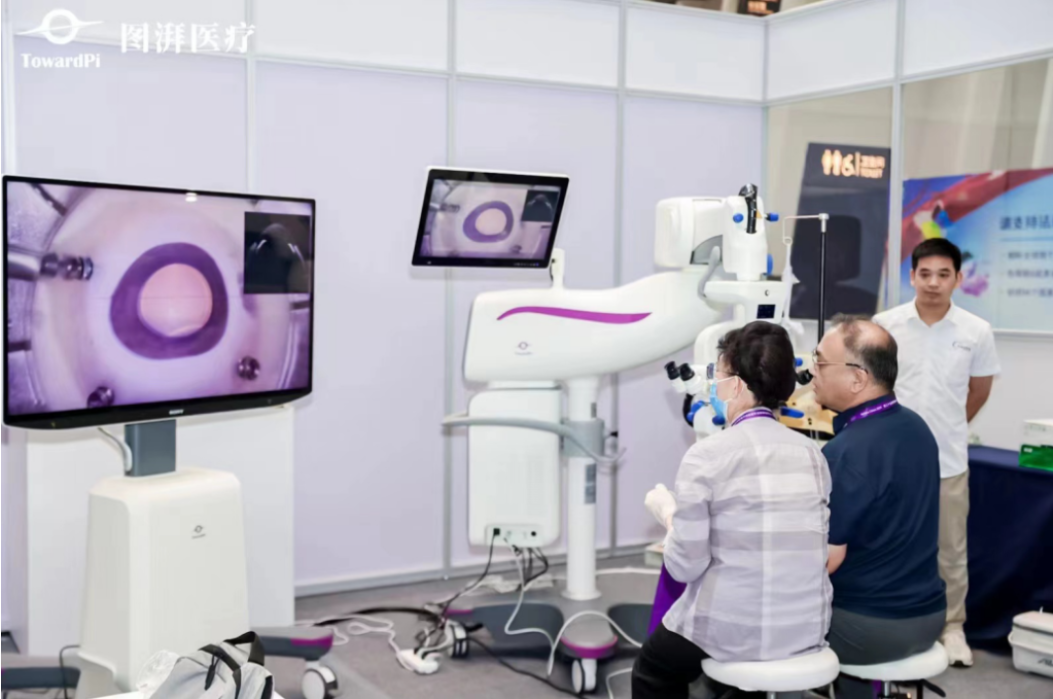 At the release event, several ophthalmology experts experienced a new surgical model of digital holographic intraoperative navigation through animal eye surgery. Photo provided by the organizer.In Huo Li's view, the localization of production does not mean completely imitating foreign ideas but achieving technological breakthroughs and innovations based on China's actual medical needs. He gave an example: the innovative integration of 400,000 intraoperative OCT scans with ophthalmic surgical microscopes is like equipping ophthalmologists with a super X-ray machine, capturing every corner deep within the eyeball, providing doctors with a comprehensive "eye透视图". This will play a crucial role in advancing procedures such as vitrectomy for retinal diseases and subretinal drug injections.Huo Li mentioned that one of the biggest challenges during the R&D process was technology transfer. As it involved many unprecedented functions, the system design of the "Boyun" surgical microscope was entirely new and uncharted. The technology transfer process required a large number of basic components, which were unavailable not only in China's supply chain but also in overseas markets. Against this backdrop, the team carried out extensive "industrial gap-filling" work—collaborating with downstream supply chain industries to co-develop various components compatible with the new equipment. This not only helped overcome product performance bottlenecks but also drove the overall development of China's optoelectronic industry chain.At the press conference, several ophthalmology experts experienced a new surgical model of digital holographic intraoperative navigation through Wet-Lab animal eye surgery. Li Xiaorong, Dean of the Ophthalmology Hospital of Tianjin Medical University, stated that ophthalmic surgeries, especially retina surgeries, have high requirements for equipment, particularly in terms of clarity and depth of field. After using it, the performance of the domestically produced surgical microscope is on par with imported brands. The all-new digital and intelligent intraoperative navigation configuration of "Boyun" also provides possibilities for further exploration of various new surgical methods.
— Scan the QR code to follow us —
Every like and view you give, I sincerely take as a sign of affection.