Ipsen Expands Collaboration with Exelixis to Develop Cabometyx in Advanced Neuroendocrine Tumors Following Positive Phase 3 CABINET Trial Results

Ipsen
Biopharmaceutical Manufacturer

Exelixis
Developer of Novel Small Molecule Therapies

On July 2, according to an announcement by Ipsen, based on the positive results of the CABINET Phase 3 trial, it has been confirmed thatExelixis Expands Collaboration and License Agreement for Development of Cabometyx® in Advanced Neuroendocrine TumorsAllows Ipsen to seek potential marketing authorization for Cabometyx (cabozantinib) in the treatment of advanced pancreatic and extra-pancreatic neuroendocrine tumors outside the United States and Japan.
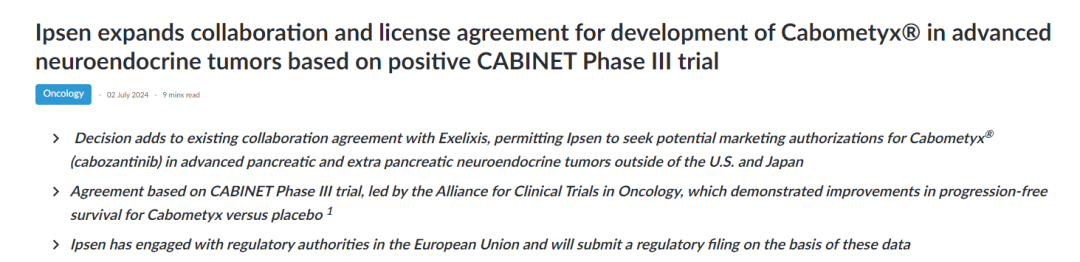
(Announcement Screenshot)
Previously, the two parties reached an exclusive agreement for the commercial and clinical development of Cabozantinib in regions outside the United States and Japan for the first time in 2016.
In the phase 3 trial named CABINET, compared with placebo,Cabozantinib Demonstrates Early Efficacy in Interim Analyses of Two Trial Cohorts, with Clinically Meaningful Improvement in Progression-Free Survival (PFS), Specifically:
In the pNET cohort, the median follow-up time was 16.7 months. According to local radiological examination, the median PFS in the cabozantinib group was 11.4 months, while the median PFS in the placebo group was 3.0 months (HR 0.27 [95% CI 0.14-0.49] p<0.0001).
In the epNET cohort, the median follow-up time was 13.9 months. According to local radiological examinations, the median PFS in the cabozantinib group was 8.3 months, while the median PFS in the placebo group was 3.2 months (HR 0.45 [95% CI 0.30-0.66] p<0.0001).
The safety of cabozantinib observed in each cohort was consistent with its known safety profile; no new safety signals were identified.
Neuroendocrine tumors (NETs) are cancers that originate from neuroendocrine cells throughout the body and are generally considered to be slow-growing malignancies. Their symptoms are often subtle and difficult to recognize, with many NET patients only being diagnosed at an advanced stage of the disease. Treatment options are extremely limited once the condition progresses, representing a significant unmet clinical need.
Based on the positive results of CABINET, Ipsen stated that it has reached out to EU regulatory authorities and will submit the data for regulatory filing.
Cabozantinib is a blockbuster drug from Exelixis, Inc.First approved for marketing in the United States in 2012 for the treatment of medullary thyroid cancer., and has now been approved for the treatment of advanced renal cell carcinoma, hepatocellular carcinoma, medullary thyroid carcinoma, metastatic colorectal cancer, renal cell carcinoma, and other types of cancer.
In April 2016, cabozantinib became the first single-agent therapy approved in the United States for previously treated advanced renal cell carcinoma, demonstrating statistically significant and clinically meaningful improvements in three key efficacy parameters in a global pivotal trial: overall survival (OS), progression-free survival (PFS), and objective response rate (ORR).So far, cabozantinib remains the only single-agent therapy.
BecauseCabozantinibFor a wide range of cancers, it can inhibit multiple tyrosine kinases, including MET, VEGFR-1, 2, 3, AXL, RET, ROS1, KIT, etc.,And known as the "cure-all" in targeted drugs, its sales reached approximately $1.629 billion in 2023.
However, it is worth noting that part of the patent for Cabozantinib will expire in September 2024, and the original drug has not been marketed in China.Many generic drug companies in China have already made their moves. Simcere Pharmaceutical, Qilu Pharmaceutical, Jiangsu Hengrui, and others have submitted a Class 3 generic drug marketing application for Cabozantinib, with Hengrui being the first to report production.