Xiankangda Life Sciences Achieves Breakthrough in Solid Tumor CAR-T Therapy Published in Molecular Therapy

First conda Life Science
Developer of CAR-T Cell Therapies for Solid Tumors
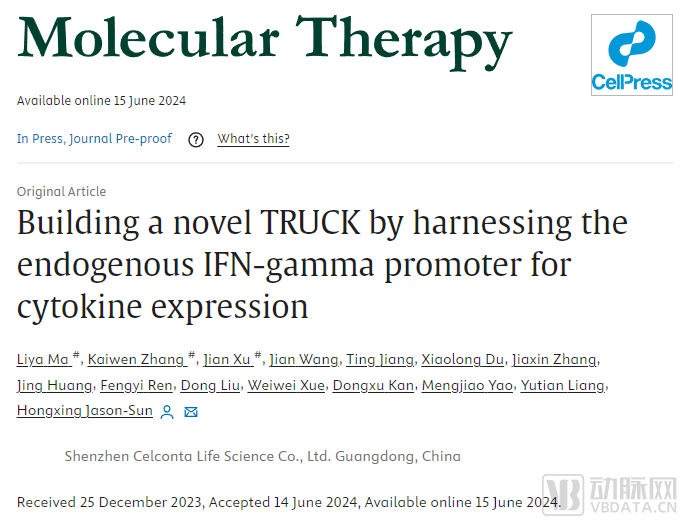
Recently, Shenzhen Xiankangda Life Science Co., Ltd. (hereinafter referred to as "Xiankangda Life") has made significant progress in the research of CAR-T cell therapy for solid tumors. Its research paper, **"Building a novel TRUCK by harnessing the endogenous IFN-gamma promoter for cytokine expression"**, has been successfully accepted and published by the international authoritative academic journal *Molecular Therapy*. This marks a global breakthrough in the field of cell therapy for Xiankangda Life, not only demonstrating its strong technical innovation capabilities and industry-leading position but also providing peers with new scientific perspectives and experimental methods, which is expected to accelerate the development process of cell-based drugs.
Currently, CAR-T therapy has achieved remarkable success in the treatment of hematological tumors, but it still faces many challenges in the treatment of solid tumors. Although many researchers have attempted to enhance the killing ability of CAR-T cells by enabling them to secrete cytokines, the risks associated with continuous cytokine secretion have limited further clinical application.
In this study, the research team utilized HDR-mediated gene knock-in technology to innovatively introduce exogenous IL-15 into the 3'-UTR region of the endogenous IFN-γ gene, regulating the expression of exogenous IL-15 via the endogenous IFN-γ promoter. Experimental validation demonstrated that the expression of IFN-γ is precisely controlled by TCR signaling, while the insertion of exogenous IL-15 does not affect the expression of endogenous IFN-γ. This precise and timely regulation effectively reduces the risks associated with continuous cytokine expression. Both in vivo and in vitro experimental data consistently showed that IL-15 expression driven by the IFN-γ promoter significantly enhances the anti-tumor activity of CAR-T cells, thereby confirming the effectiveness of IL-15 expression in boosting the anti-tumor function of CAR-T cells.
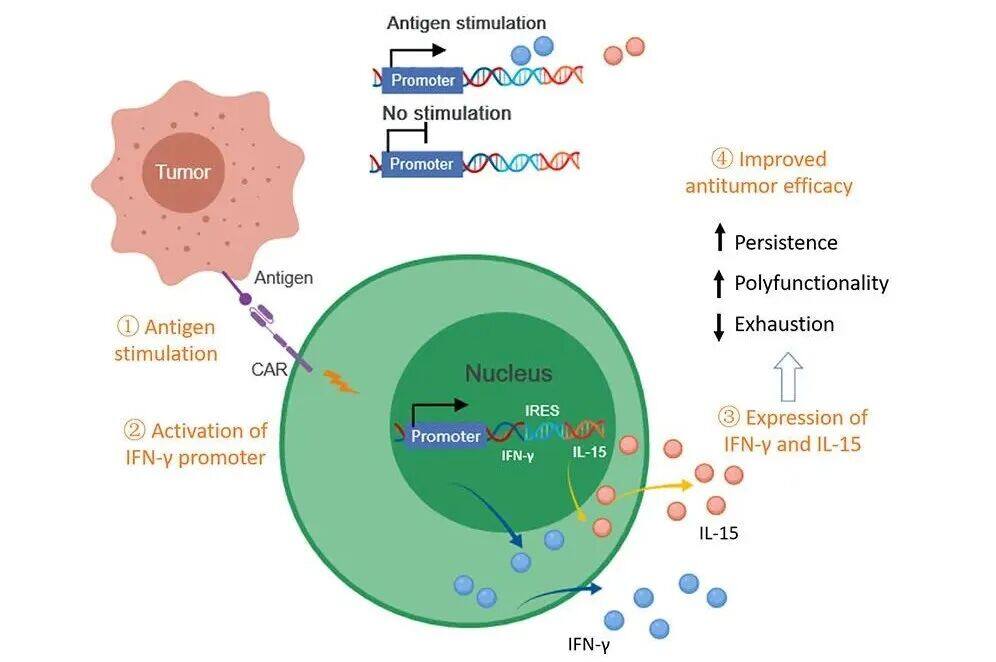
In addition, this study delves into key technologies such as gene editing and gene transduction, which are essential foundations of Xiankangda Life's core technology platform—the R-Star technology platform. The R-Star technology platform is an induction expression system based on gene editing technology, capable of simultaneous editing of multiple genes mediated by one HDR. It can precisely induce cell secretion of cytokines or expression of functional proteins, thereby significantly enhancing the anti-tumor activity of CAR-T cells.
Ma Liya, head of Shenzhen Xiankangda Life Science Co., Ltd., stated: "As the sole research entity, the publication of our latest research findings in *Molecular Therapy* is the result of the collective efforts of all team members. Currently, CAR-T cell therapy for solid tumors has encountered a bottleneck. This technology proposes an effective solution that not only significantly enhances the efficacy of CAR-T cell therapy but also greatly improves its safety, bringing new hope and possibilities to the field of cell therapy for solid tumors. We are actively advancing the clinical research process of the R-Star platform product to further validate its superior performance in future clinical practice. More importantly, this technology can significantly reduce the cost of formulation preparation, thereby greatly improving affordability in clinical applications. We hold high expectations and confidence regarding the future market entry of solid tumor CAR-T products and the benefits patients will gain from them."
About Shenzhen Xiankangda Life Science Co., Ltd.
Shenzhen Xiankangda Life Science Co., Ltd. is a high-tech enterprise focusing on the research and industrialization of cellular immunotherapy for solid tumors. The company has developed two mainstream cell therapy technologies: T cells (including CAR-T and CAR-iT) and NK cells (including PANK and CAR-NK). Through independent research and development, Xiankangda Life has created three proprietary technology platforms: Trans-CAR, Boost-CAR, and R-Star, as well as two process platforms for NK cells: hNK.LV and FCF-NK. Currently, the company has initiated clinical studies on CAR-T and PANK for solid tumors in multiple Class III hospitals in China, with preliminary data showing controllable safety and promising clinical efficacy.
* Clickable at the end of the article[Read the Original Text]View Paper
*Cover image source: 123rf