Recently, a research achievement based on a novel ultra-rapid metagenomic next-generation sequencing (ultra-rapid mNGS) technology, jointly conducted by Peking University People's Hospital and Hangzhou Matridx Biotechnology Co., Ltd., was successfully published in the "Chinese Medical Journal" (JCR Q1, IF= 7.5). Professor Wang Hui and Professor An Youzhong from Peking University People's Hospital, along with Dr. Liu Chao from Matridx Biotechnology, are the co-corresponding authors of this article. Yin Yuyao and Shen Jiawei from Peking University People's Hospital, as well as Du Zhenshan from Matridx Biotechnology, are the co-first authors of this paper. Special thanks to Illumina (China) Scientific Instrument Co., Ltd. for its strong support of this research.
Sepsis is a life-threatening clinical syndrome caused by organ dysfunction due to a dysregulated host response to infection. For every hour of delay in diagnosing and treating septic shock, mortality increases by 7.6%. Early and timely use of antibiotics, fluid resuscitation, and other supportive treatments can significantly improve patient outcomes.Although metagenomic next-generation sequencing (mNGS) is a novel solution for pathogen detection, it requires significant manpower and expertise from laboratory personnel. Moreover, a typical mNGS experiment takes approximately 24 hours [Figure 1A], with a sample turnaround time (TAT) significantly longer than serological testing and polymerase chain reaction (PCR). Therefore, clinicians urgently need faster mNGS to obtain accurate results in the shortest possible time, aiding clinical decision-making and enabling earlier treatment for patients.The study designed an ultra-fast mNGS workflow based on the Illumina platform [Fig. 1B], with a theoretical turnaround time (TAT) of only 7 hours.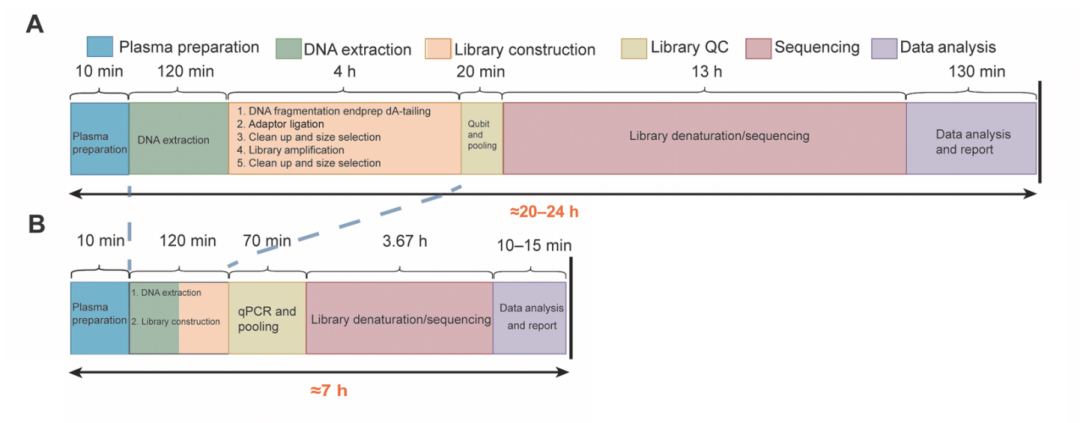
Figure 1
To explore the clinical application value of rapid mNGS using blood samples, the study enrolled 36 patients from the ICU department of Peking University People's Hospital. The enrollment criteria were:
(1) Aged 18 years or older, suspected sepsis (body temperature >38°C or <36°C, elevated serum C-reactive protein [CRP] or procalcitonin [PCT] levels);(2) Sequential Organ Failure Assessment (SOFA) score increased by 2 or more; (3) Expected survival time ≥8 hours; (4) Informed consent signed.Diagnostic Accuracy of Rapid mNGS
The study adopted three different reference standards to investigate the performance of mNGS, namely:- Based on a composite standard (CMTs) including all routine microbiological tests
- Clinical diagnosis based on medical history, imaging, microbiological results, and response to antibiotics
The diagnostic accuracy of Rapid mNGS compared to the three reference standards above is shown in Figure 2.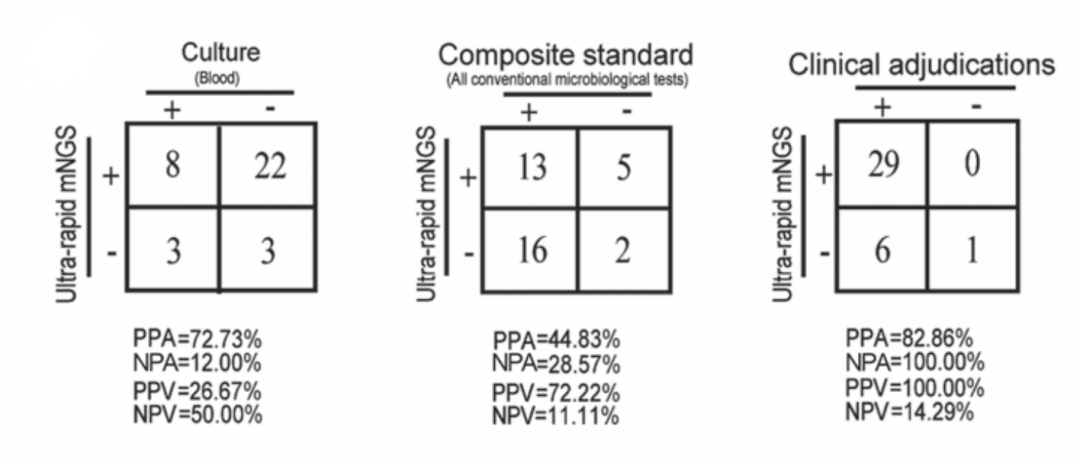
Figure 2
In addition, based on the composite microbiological and clinical criteria described in previous Karius trials, and combining laboratory and clinical data, the study categorized pathogen results as clinically relevant (definite, probable, or possible) or clinically irrelevant (unlikely). Compared with conventional mNGS,Ultra-fast mNGS showed consistent results in 3/5 of the samples. In 2/5 of the blood and sputum samples, ultra-fast mNGS detected more bacteria than culture.The average TAT of ultra-fast mNGS is 10.53 hours (with the shortest being 7.4 hours), significantly faster than other microbiological methods., especially culture methods (average TAT is 97.72 hours). In real clinical settings, qPCR does not perform faster than the G-test (average TAT of 26.66 hours vs. 19.87 hours). The delay in TAT is mainly due to experimental scheduling; after samples arrive at the clinical laboratory, technicians usually need to wait for more samples to arrive before starting batch processing of 10-20 samples, which makes conventional testing methods longer than ideal. In this study, sequencing was performed using the Miniseq Rapid Kit, without the need for sample accumulation, and the actual TAT is closer to the ideal TAT.The study also investigated whether faster mNGS reports could aid in antibiotic stewardship.After the ultra-fast mNGS reports results, clinical measures are categorized into the following situations:
Antibiotic Upgrade
Antibiotic Degradation
Increase the types of antibiotics
Reduce the variety of antibiotics (in the case of combination antibiotic therapy)
Validation/Confirmation of Empirical Treatment Without Altering Antibiotic Use
Irrelevant results and no change in antibiotic use
The results showed that the most common wasVerify the Accuracy of Empirical Treatment(n = 14), followed by increased antibiotic use (n = 10), decreased antibiotic use (n = 9), antibiotic escalation (n = 2), and unrelated outcomes (n = 1).
Among 36 rapid mNGS reports, 30 (83%) were determined to be clinically relevant through medical record review. On the 30th day after testing, 17 of the 30 patients in the clinically relevant group survived, and 13 (43%) died; among the six patients whose mNGS results were considered irrelevant, four survived and two (33%) died.Among patients empirically treated with antibiotics validated by mNGS, 9/10 (90%) survived, significantly higher than other clinical management groups.[Figure 3].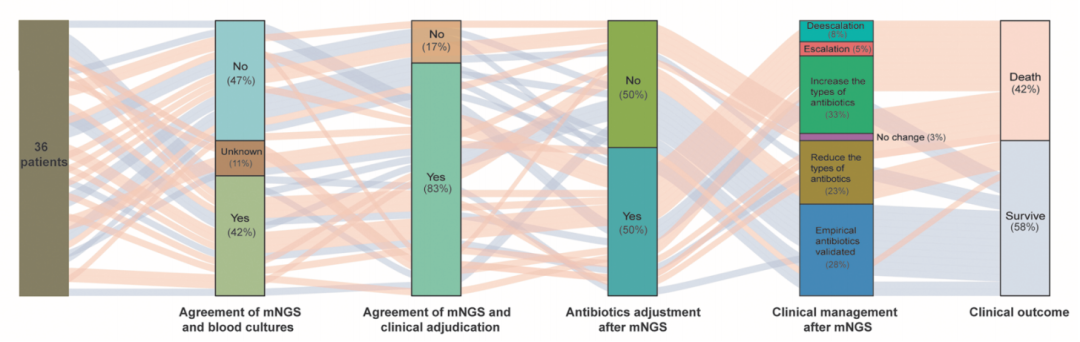
Figure 3
Antibiotic-Related Expenditure
Of the 36 patients, 20 had changes in antibiotic-related expenses. In 15 cases, a total reduction of 10,909.52 RMB (1558.5 USD) was observed. In 5 cases, antibiotic costs increased (1413.12 RMB / 201.9 USD), primarily due to the use of additional antibiotics targeting pathogens detected by mNGS.
Studies have shown that the average TAT of mNGS based on the Illumina MiniSeq Rapid Kit is only 10.6 hours, with a minimum of 7.4 hours. Moreover, with the help of fully automated library construction equipment, the ultra-fast mNGS workflow can be easily implemented in clinical settings.Considering various factors such as cost-effectiveness, antibiotic stewardship, and patient prognosis, rapid mNGS can serve as a powerful tool for clinical diagnosis.
References:
Yin Y, Shen J, Du Z, Wang B, Wang G, Chen H, Wang J, An Y, Liu C, Wang H. Clinical and cost analysis of an ultra-rapid metagenomic sequencing test for pathogen detection in adult patients with sepsis. Chin Med J (Engl). 2024 Jun 14. doi: 10.1097/CM9.0000000000003175. Epub ahead of print. PMID: 38879803.