

Novartis Breaks Ground on First Foreign-Invested Radiopharmaceutical Manufacturing Facility in Zhejiang, China

Novartis
Drug Development and Manufacturing
On July 2, Novartis held a groundbreaking ceremony in Haiyan, Zhejiang, for its first radiopharmaceutical production base in China, officially launching the construction project. Located in the nuclear technology application (isotope) industrial park in Haiyan County, Jiaxing City, Zhejiang Province, this production base represents an estimated investment of 600 million RMB. It is expected to begin operations by the end of 2026, at which time it will have the capacity to provide innovative drugs required for precise cancer treatment to Chinese patients on a large scale.
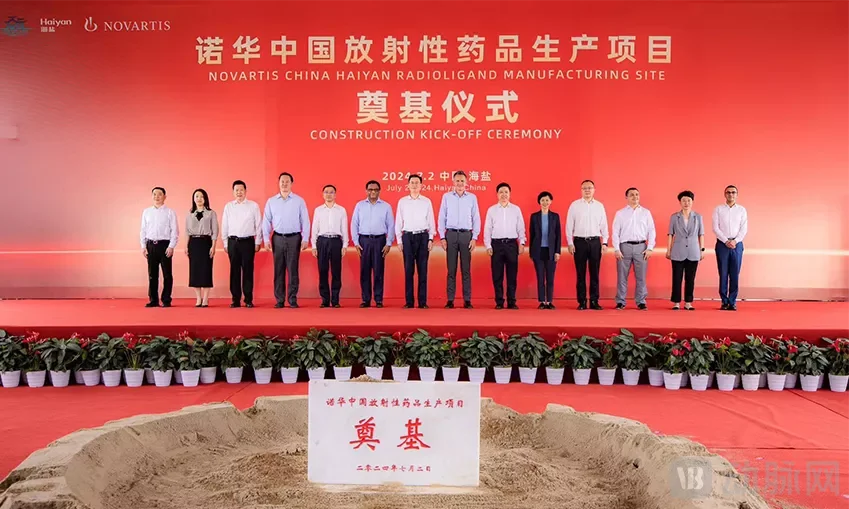
Based on this production base, Novartis can not only quickly respond to the clinical needs of patients in China but also significantly increase its global capacity for radioligand therapy. The completion and operation of this base will accelerate Novartis' introduction of innovative radioligand therapies into China, benefiting domestic cancer patients with clinical needs.At the same time, this is the first foreign investment project in China's nuclear medicine field, and also a signal that imported original radioligand therapies are gradually entering the Chinese market.
Novartis' two key products, Lutathera and Pluvicto, have not yet been approved for marketing in China, but multiple clinical studies have already been initiated in the country.During the 2023 CIIE, Novartis mentioned that it is expected to submit the registration and marketing application for Pluvicto in China in 2024. In a recent interview, Novartis stated that the registration application for Pluvicto is proceeding as planned, "We are working closely with relevant regulatory authorities with the aim of completing the approval process as soon as possible."
Radioligand Therapy Combines Targeted Compounds (Ligands) with Radioactive Isotopes to Form Radioligands. Once in the Bloodstream, Radioligands Bind to Specific Markers or Receptors on Cancer Cells, Releasing Radioactive Isotopes upon Binding to Destroy and Kill Cancer Cells. Compared to Traditional Tumor Treatments, Radioligand Therapy Offers Advantages of Precise Tumor Targeting, Potent Killing, and Limited Damage to Surrounding Tissues.
Radioligand therapy consists of two main components: a radioactive isotope and a cell-targeting compound or ligand. Therapeutic radioisotopes are produced in specialized nuclear reactors or generators, transported to manufacturing facilities, and combined with the cell-targeting compound. The final product is then placed in vials, undergoes quality testing, is packaged into specially shielded lead containers, and delivered directly to healthcare institutions as a ready-to-use therapy.
On the one hand, the raw materials of radioisotopes are facing a global shortage. Currently, isotopes are mainly produced in two ways: reactors and accelerators, with a large number of reactors concentrated in Europe and America.By 2030, the shutdown of multiple active reactors globally is expected to lead to a tight supply of medical isotopes worldwide. The global shortage of nuclides is arriving faster than anticipated. Last month, BMS paused new patient enrollment in the Phase III clinical trial of its RYZ101 pipeline, which was acquired through the purchase of RayzeBio, due to a shortage of Actinium-225 (Ac-225), the radionuclide raw material for RYZ101.
Even the global leader in nuclear medicine, Novartis, has faced capacity and supply chain issues. In the first half of 2023, there were problems with the global production and supply of Pluvicto, leading to distribution delays and drug shortages. This caused patients to experience delays in receiving treatment and hindered the drug’s promotion, resulting in a situation where "patients were queuing but unable to access the medication." It was not until the end of October that the FDA removed Pluvicto from the drug shortage list.
To address the imminent capacity issues, Novartis has accelerated the layout of its production bases in the past five years, including establishing radiopharmaceutical production bases in Italy, Spain, and the United States.In January this year, the FDA approved Novartis' commercial production of Pluvicto at its Indianapolis manufacturing site, which is currently Novartis' largest radiopharmaceutical production base and can reach patients across the U.S. within 12 hours.To meet the potential surge in demand, Novartis will also build a plant in Spain to expand its production capacity in Europe. CEO Vas Narasimhan stated that Novartis aims to deliver over 250,000 doses annually by 2024 through the establishment of four facilities.
On the other hand, due to the limitation of the half-life of radioactive isotopes, the drug's activity will decrease within a specific time period, thus requiring timely delivery and administration to patients. With a limited dosing time window, these drugs are typically produced in single-dose forms, taking into account transportation distance and cycle for drug delivery. This not only requires mature and complete upstream and downstream industries and radiopharmacy support but also necessitates the presence of medical institutions with clinical usage qualifications for radiopharmaceuticals within a certain range.
As early as 2018, when Lutathera was launched in the U.S., Novartis had already encountered challenges related to the difficulty of transporting radiopharmaceuticals and their clinical application. Lutathera’s sales initially grew very rapidly, generating $167 million in revenue in its first year of approval, which then increased to $441 million in the second year, but subsequently plateaued. One reason is that restrictions on medical institution qualifications and production-transportation cycles limited the widespread adoption of Lutathera. If the number of patients received by qualified medical institutions reaches saturation, Lutathera’s sales will hit a bottleneck.
Looking at Pluvicto, for American patients, before the new factory was approved in January this year, Pluvicto had to be shipped from the Italian factory and undergo inspections by customs, the FDA, and others. However, the half-life of Lu-177 is 6.647 days, and the shelf life of Pluvicto is only 5 days. Any weather impact or inspection delays could result in the drug becoming ineffective.
Affected by the half-life, medium- and short-term radiopharmaceuticals need to rely on the network of nuclear pharmacies/drug centers for production and delivery.China's nuclear pharmacy resources are mainly concentrated in two companies: China Isotope & Radiation Corporation and Dongcheng Pharmaceutical. For emerging nuclear pharmaceutical enterprises, building their own nuclear pharmacies faces significant time and financial pressures, with a construction cycle of at least three years and an investment of over 40 million yuan for a single nuclear pharmacy. Therefore, emerging nuclear pharmaceutical enterprises will first focus on building advantages in single-category competition before collaborating with the nuclear pharmacy resources of companies like China Isotope & Radiation Corporation and Dongcheng Pharmaceutical.
In contrast, according to data from the UNM College of Pharmacy's official website, there are approximately over 600 radiopharmacies globally, with more than 400 located in the United States alone. Based on information from Cardinal Health’s official website, a representative enterprise of U.S. nuclear pharmacies, it operates over 130 nuclear pharmacies and more than 30 cyclotrons, with supply chain capabilities enabling delivery services within three hours to over 95% of medical institutions across the U.S.For Novartis, a foreign company "with no shortage of money," it is worth continuing to monitor whether the operational model for nuclear pharmacies within China will be "cooperation and sharing" or "going it alone."
In China, policy promotion and industrial chain construction are continuously making efforts to break down the high barriers faced by nuclear medicine in the industrial chain and supply chain. The radiopharmaceuticals industry in China has become one of the key strategic emerging industries supported by the state, and is one of the foundational industries promoting the high-quality development of healthcare.
In June 2021, the National Defense Science and Technology Industry Bureau, the Ministry of Science and Technology, the Ministry of Public Security, the Ministry of Ecology and Environment, the Ministry of Transport, the National Health Commission, the National Healthcare Security Administration, and the National Medical Products Administration, among eight departments, officially released the "Medium- and Long-Term Development Plan for Medical Isotopes (2021–2035)." This is the first guiding document in China targeting the application of nuclear technology in the medical and health field, establishing an overall framework to further advance the development of the radiopharmaceuticals industry.
In April 2023, the National Medical Products Administration released the "Opinions on Reforming and Improving the Review and Approval Management System for Radiopharmaceuticals."Encourage innovation in radiopharmaceuticals driven by clinical value, encourage the import registration of original radiopharmaceuticals already marketed overseas within China, and propose to grant priority review and approval for marketing authorization applications of radiopharmaceuticals urgently needed clinically.
The Haiyan County-based Novartis site, located in the Nuclear Technology Application (Isotope) Industrial Park, spans 1,900 mu. Leveraging the unique advantages of the Qinshan Nuclear Power Heavy Water Reactor, it aims to build a national medical isotope industry demonstration base that integrates radionuclide research and production, isotope-labeled compound synthesis and application, radiopharmaceutical R&D and manufacturing, fundamental nuclear medicine research and clinical translation, and nuclear emergency rescue. Currently, the park has introduced 16 projects related to radionuclides and radiopharmaceutical R&D and production, with a total investment exceeding 5.5 billion yuan.
It is reported that Novartis' selection of the production base site in Haiyan took into comprehensive consideration the geographical and transportation convenience, the macro environment of politics, economy, and society, capacity construction and market development, personnel training and international integration, as well as the potential for close cooperation with professional medical institutions, ensuring that production aligns with the highest global standards.Moreover, China already has a well-developed healthcare and logistics infrastructure, which helps to reach patients across the country.
At the same time, China has a huge market for the application of nuclear medicine."Jiaxing Release" mentioned that this project will serve as the functional headquarters of Novartis' radiopharmaceuticals business in China, mainly producing and selling the Lu-177 nuclear medicine for treating prostate cancer.Lu-177 is the most commonly used radionuclide in RDC currently, emitting β-particle radiation with a half-life of nearly one week, making it particularly suitable for clearing small-volume tumors and metastases. Globally approved drugs include Novartis' Lutathera and Pluvicto.
According to Novartis' 2023 financial report, the company achieved a total annual revenue of $45.44 billion, representing a 10% year-on-year increase; net profit reached $8.572 billion, marking a 62% year-on-year rise.Revenue in China reached $3.3 billion, a year-on-year increase of 17%; in the fourth quarter alone, revenue in China was $800 million, a year-on-year increase of 38%. Moreover, among the priority development regions identified by Novartis, China ranks second only to the United States, highlighting its emphasis on the Chinese market.
The radioligand therapy platform is one of Novartis Oncology's four major therapeutic platforms, initially established through the acquisition of the French innovative drug company Advanced Accelerator Applications (AAA).In October 2017, Novartis acquired AAA for $3.9 billion, including its main product Lutathera and technology platform. In 2018, Novartis spent another $2.1 billion to acquire biopharmaceutical company Endocyte, merging it under AAA, and obtained multiple pipeline assets, including Pluvicto.
In 2018, Lutathera received FDA approval for marketing to treat patients with SSTR-positive gastroenteropancreatic neuroendocrine tumors. Pluvicto was approved by the FDA in March 2022 for the treatment of patients with castration-resistant metastatic prostate cancer. Radiopharmaceutical conjugates (RDC) represented by Lutathera and Pluvicto have significant implications for the radiopharmaceuticals market, igniting global pharmaceutical companies' enthusiasm for developing therapeutic nuclear medicines.
Globally, Novartis is exploring combination therapies with Lutathera and expanding its use to additional indications such as glioblastoma and breast cancer. Pluvicto has the potential to become a second-line treatment for prostate cancer, with ongoing investigations into its efficacy in patients with metastatic castration-resistant prostate cancer (mCRPC) that is positive for prostate-specific membrane antigen (PSMA).
In terms of drug structure, RDC is similar to ADC, mainly consisting of antibodies or small molecules (Ligand) that mediate targeting, a linker (Linker), a chelator (Chelator), and a radiopharmaceutical/imaging agent (radioisotope). The use of different radionuclides can achieve imaging or therapeutic functions, and some radionuclides possess both capabilities.
At the same time, Novartis is also expanding its next-generation radiopharmaceutical pipeline assets globally by acquiring and collaborating with Biotech companies to lay out cutting-edge molecular design and innovative platform technologies.As of 2023, Novartis has approximately 10 radioligand therapy-related research products globally, covering a range of oncological diseases.
In March 2021, Novartis entered into an assignment agreement with iTheranostics, a subsidiary of SOFIE Biosciences, to obtain the global exclusive rights for the development and commercialization of therapeutic applications targeting the new FAP (Fibroblast Activation Protein) agent library, including FAPI-46 and FAPI-74.
In April of the same year, Novartis entered into a global collaboration worth $1.3 billion with Artios Pharma, leveraging Artios' proprietary DDR technology platform to discover and validate next-generation DNA Damage Response (DDR) targets, thereby expanding Novartis' Radioligand Therapy (RLT) pipeline.
On May 2, 2024, Novartis acquired Mariana Oncology, a radiopharmaceutical startup, for an upfront payment of $1 billion. Leveraging its proprietary Peptide Discovery Platform System (PDPS), Novartis will discover and optimize innovative macrocyclic peptides based on specified targets. These macrocyclic peptides may be used for conjugation with radioligands or applied in other therapeutic and diagnostic applications.
Looking back at Novartis' 2023 financial report, Pluvicto showed impressive sales performance with a full-year revenue of $980 million, representing a year-on-year increase of 261%, demonstrating strong growth momentum. Another radioligand therapy, Lutathera, also achieved sales growth, generating $605 million in revenue in 2023, marking a year-on-year increase of 28%.As the production base in Indianapolis, USA, receives FDA approval and gets approved for marketing in potential drug markets, Novartis' nuclear medicine business may see continued growth in 2024.
References:
White Paper on the Nuclear Medicine Industry: Reviewing Nearly 7,000 Pipelines Globally, Competing in Target, Ligand, and Radionuclide Innovation https://mp.weixin.qq.com/s/dLCXg2qbOeBFxxAOgw7kRA
Multinational pharmaceutical companies continue to invest heavily in radiopharmaceuticals. How will the billion-dollar track break through the capacity bottleneck?
https://www.thepaper.cn/newsDetail_forward_27934261