Head-to-Head Comparison of ALZpath and Janssen Plasma p-tau217 Assays Demonstrates High Diagnostic Performance for Alzheimer’s Disease

ALZpath
Innovative Diagnostic Solutions Provider for Alzheimer's Disease

Johnson & Johnson
Healthcare Product Manufacturers, Health Service Providers
 Source: Quanterix Biotechnology
Blood Biomarkers for Alzheimer's Disease as Diagnostic and Clinical Trial Screening Tools Are Becoming Increasingly Important, with p-tau217 Considered One of the Most Sensitive and Specific Indicators of AD-Related Pathological Changes. This Study Compared the Cross-Sectional Performance of Two Commercially Available Plasma p-tau217 Assays (ALZpath p-tau217+ and Janssen p-tau217+) in 294 Individuals, Evaluating Their Correlation with Amyloid PET and Tau PET, as Well as Their Accuracy in Identifying AD Pathology. The Results Showed That Both Plasma p-tau217 Assays Were Closely Correlated with Amyloid and Tau PET. Additionally, Both Methods Could Differentiate AD Patients from Those with Other Neurodegenerative Diseases Through Pathological Identification.
The detection of amyloid and tau pathology using cerebrospinal fluid (CSF) and positron emission tomography (PET) are conventional methods for diagnosing Alzheimer's disease (AD).Recently emerged blood-basedADBiomarkers are expected to provide information about amyloid andtauPathological protein information forADDiagnosis。
As the era of AD-modifying therapies approaches,Biomarkers are needed to determine the presence of amyloid pathology to assess whether individuals are eligible for anti-amyloid treatment.. In addition,Plasma biomarkers may help identifytauPathology。
Since anti-amyloid therapies may be less effective in patients with advanced disease, as demonstrated by recent Phase II and Phase III donanemab trials, amyloid-positive patients can be stratified by tau burden using plasma biomarkers.
Phosphorylated tau217 (p-tau217) has become ADOne of the most promising blood biomarkers,This is based on its diagnostic performance, strong correlation with amyloid and tau pathology, and equivalence to established CSF biomarkers in head-to-head studies.
However, biomarker assays targeting tau protein Thr217 phosphorylation may vary due to their composition (antibodies targeting multiple or single phosphorylation sites), potentially leading to different associations with pathology. Therefore, it is necessary to establish their connection with core AD biomarkers and their diagnostic performance.
This study aims toComparison of Two Commercially Available Plasma with Different Target Specificityp-tau217 Immunoassay: ALZpath's Assay,Targeting a single phosphorylation site (with minimal cross-reactivity to p-tau181 and p-tau231), andJanssen'sp-tau217+ Assay(p-tau217+, additionally targeting p-tau212 and p-tau214), in individuals undergoing clinical symptom diagnosis evaluation, amyloid, and tau PET assessments.
Study Participants
This study relied on samples drawn from the Translational Research in Aging and Dementia (TRIAD) cohort. This retrospective study specifically included 294 participants who underwent amyloid and tau PET imaging and provided cross-sectional plasma samples for measuring plasma p-tau217 assays (ALZpath and Janssen).
Plasma and CSF p-tau217 Measurement
Plasma p-tau217+Janssen was measured using the Simoa® assay developed by Janssen, and CSF and plasma ALZpath p-tau217 concentrations were generated at the University of Gothenburg (Simoa®).
Brain Imaging
PET scans for amyloid and tau pathology were performed using [18F]AZD4694 and [18F]MK6240, respectively, at 40-70 minutes and 90-110 minutes post-injection. Cerebellar gray matter and inferior cerebellar gray matter were used as reference regions for calculating standardized uptake value ratios (SUVR) for Aβ and tau PET, respectively. Participants were also categorized into PET-based Braak stages according to the atlas of tau PET abnormalities.
We used these two assays to evaluate plasma p-tau217 concentrations in young individuals, cognitively unimpaired (CU) amyloid-negative older adults, CU amyloid-positive older adults, MCI amyloid-positive individuals, AD dementia amyloid-positive individuals, MCI amyloid-negative individuals, and individuals with non-AD neurodegenerative diseases.Plasma from two assaysThe concentration of p-tau217 increases with the severity of clinical disease.(Figure 1A).
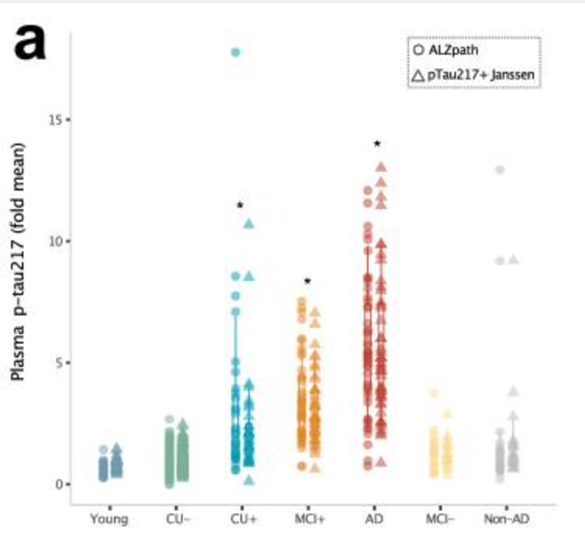
Plasma p-tau217 concentrations are lower in amyloid-negative MCI patients and non-AD neurodegenerative disease patients, with both assays showing high specificity for AD pathology.
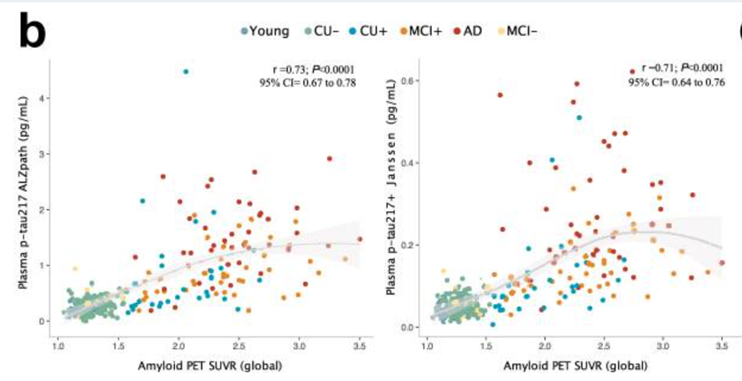
Next, we evaluated the relationship between plasma p-tau217 assay concentrations and PET results across the AD continuum (Figure 1B). Both assays showed very strong and equally good correlations with amyloid PET (ALZpath: r=0.73, P<0.0001, 95% CI=0.67–0.78; P-tau217+Janssen: r=0.71, P<0.0001, 95% CI=0.64–0.76).
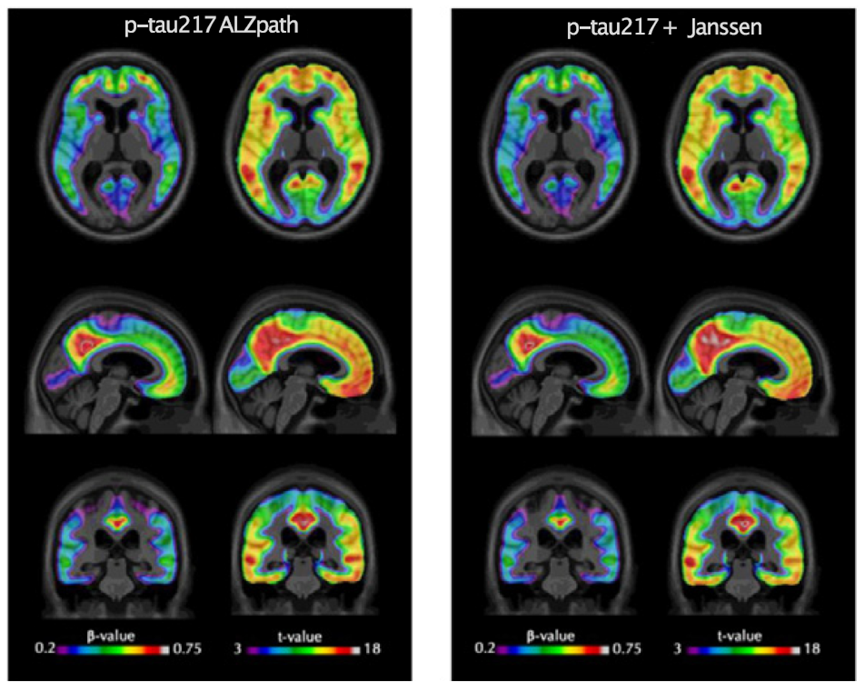
Voxelwise analysis also revealed similar associations between plasma p-tau217 measured using two assays and amyloid PET (Figure 1C).
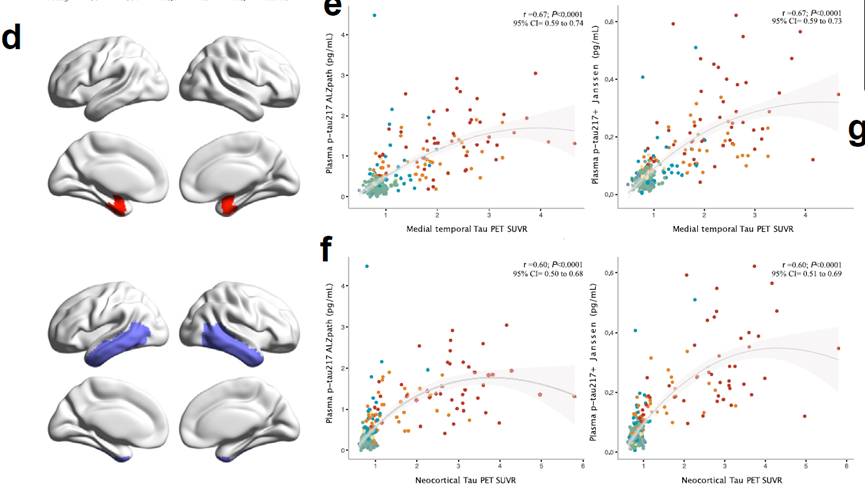
We then assessed the relationship between plasma p-tau217 assays and tau PET, measured in medial temporal and neocortical ROIs (Figure 1D). Both assays showed strong correlations with tau PET (ALZpath: r=0.67, P<0.0001, 95% CI=0.59–0.74; P-tau217+ Janssen: r=0.67, P<0.0001, 95% CI=0.79–0.73) (Figures 1E and F).
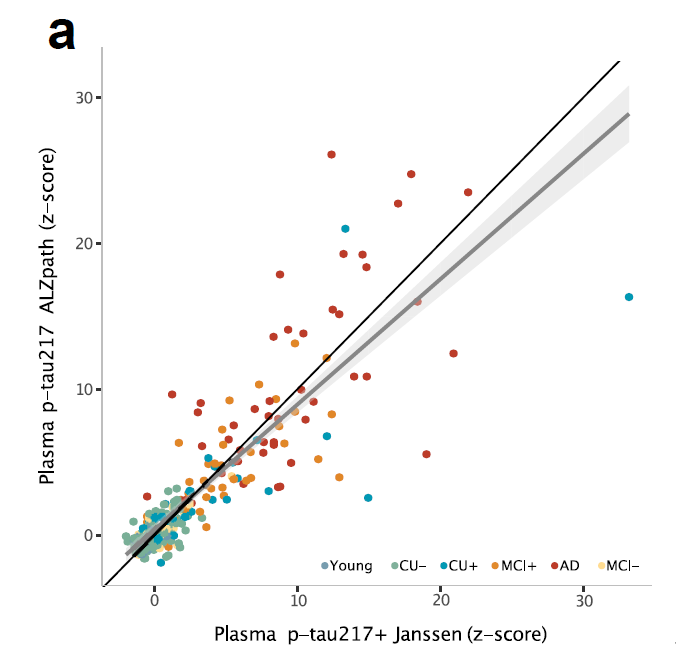
Subsequently, we evaluated the interrelationship between two plasma biomarker assays. Figure 2A shows a scatter plot of the z-scored p-tau217 ALZ concentrations relative to the p-tau217+ Janssen concentrations. We observed a strong correlation between the two plasma p-tau217 assays (r=0.85, p<0.0001, 95% CI=0.79–0.88).
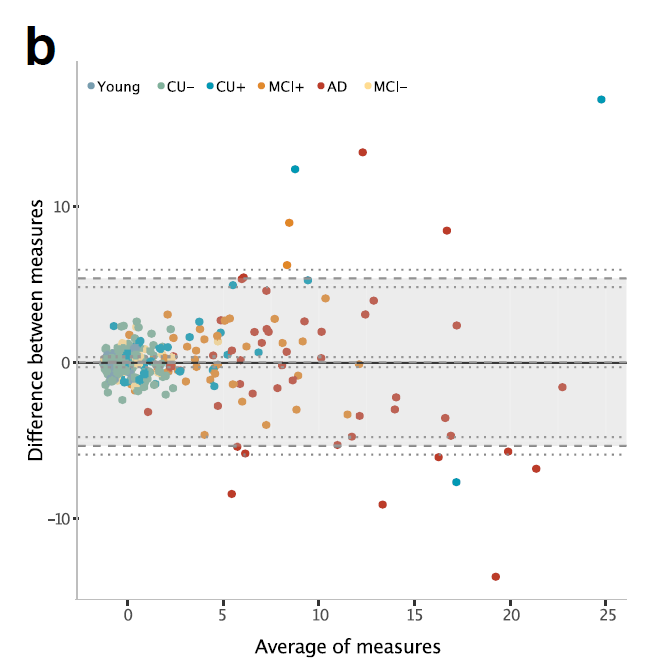
As shown in Figure 2B. Compared to when the average of the two plasma biomarkers is close to 0, the consistency between the two plasma p-tau217 measurement methods is poorer at higher concentrations.
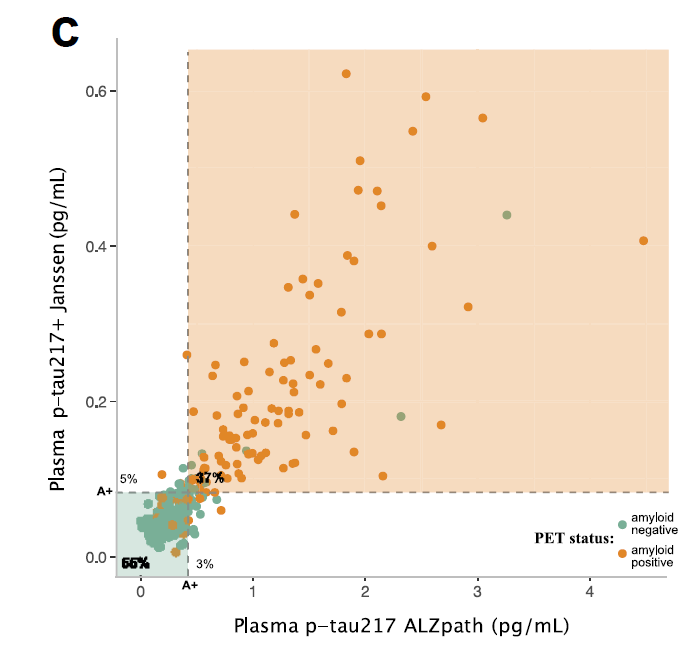
We then assessed the individual-level agreement between the two p-tau217 assays (Figure 2C). The plasma p-tau217 assay results were consistent in 92% of cases, and inconsistent in 8% of cases.
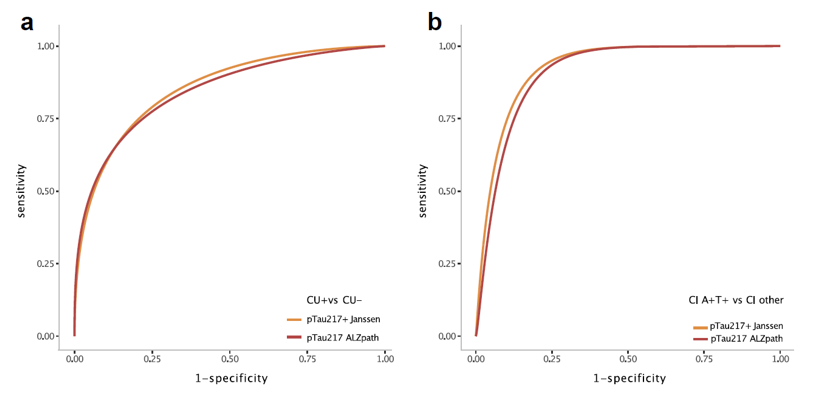
Next, we evaluated the performance of plasma biomarkers in identifying amyloid and tau PET positivity in cognitively unimpaired individuals and in individuals assessed as cognitively impaired by dementia experts (Fig. 3A and B).
Two plasma p-tau217 assays also demonstrated excellent performance in identifying amyloid positivity across all individuals (ALZpath: AUROC=0.92, 95%CI=0.89–0.95; p-tau217+ Janssen: AUROC=0.92, 95%CI=0.89-0.95).
Moreover, both assays performed well in identifying individuals with biological AD who were cognitively impaired (ALZpath: AUC=0.91, 95%CI=0.86–0.96; p-tau217+ Janssen: AUC=0.92, 95%CI=0.88–0.96).
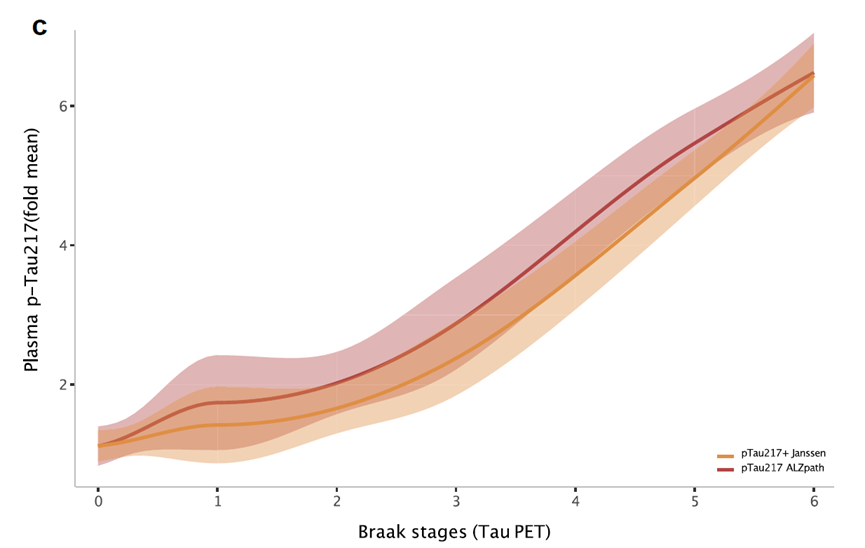
We also observed that both plasma p-tau217 assays yielded increased values according to AD severity measured by PET-based Braak staging (ALZpath: F=64.98, p<0.0001; p-tau217+Janssen: F=75.63, p<0.001, Figure 3C).There was a more dramatic increase in Phase III.
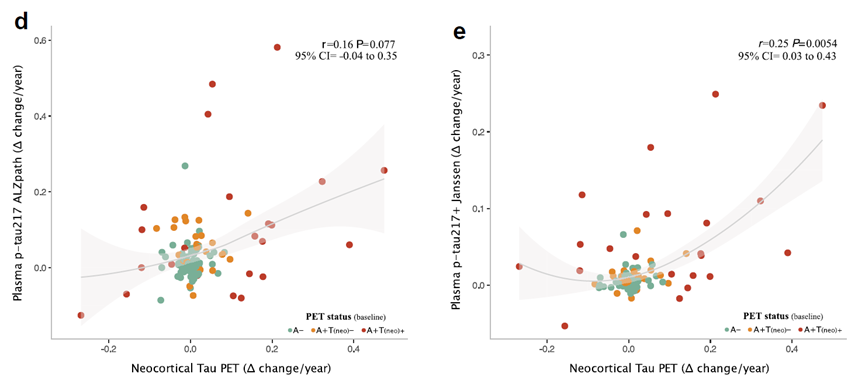
Finally, we tested the ability of two plasma assays to track longitudinal disease progression measured by tau-PET. We observed that both plasma p-tau217 assays showed similar correlations with annual tau-PET changes in the neocortex (ALZpath: r=0.16, p=0.077, 95%CI=−0.04 to 0.35, S=3.69, Spearman correlation; p-tau217+ Janssen: r=0.25, p=0.0054, 95%CI=0.03 to 0.43, S=7.53, Spearman correlation; Fig. 3D and E).
This study compared two commercially available plasma p-tau217 assays, evaluating their relationship with amyloid PET and tau PET, as well as their diagnostic performance for AD.These two assays have a similar and strong correlation with PET of neocortical amyloid.
Moreover, the two plasma assays have essentially the same diagnostic performance for amyloid PET positivity in asymptomatic individuals and for both amyloid PET and tau PET positivity in cognitively impaired individuals.
The study observed that in symptomatic AD patients, the correlation between p-tau217+Janssen assay and cortical tau PET was slightly stronger than that of p-tau217 ALZpath.In summary, the study provides evidence that two new commercial plasma p-tau217 assays have high diagnostic performance for AD.
Add WeChat for consultation