Disclaimer: Due to limited proficiency, errors are inevitable, and some information may not be the most up-to-date. Feel free to point out in the comments. This article is only for the introduction of medical and health-related drugs, not a recommendation of treatment plans (if involved); this article does not constitute any investment advice.
July 3, 2024Ophthalmology Gene Therapy CompanyBeacon Therapeutics AnnouncesCompleted $170 Million Series B Financing。This financing was led byForbionLeading investment,Including existing investors Syncona Limited and Oxford Science Enterprises, as well as new investors TCGX and Advent Life Sciences.This funding will be used forSupport BeaconThe leading asset AGTC-501Ongoing clinical development for the treatment of X-linked retinitis pigmentosa (XLRP),And support the company's 1/2 phase clinical trial for dry age-related macular degeneration (dAMD), which can provide critical data within two years.This biotechnology company willApply for approval in the United States and Europe in 2026, andBThis round of financing will bring the biotech company into the early commercialization stage.。The press release also announced that Beacon Therapeutics has appointed Dmitrij Hristodorov and Wouter Joustra, General Partners at Forbion, and Cariad Chester, Managing Partner at TCGX, as members of the Board of Directors.Dominic Schmidt, General Partner of Advent Life Sciences, joins as a Board Observer.To date,Beacon Therapeutics has raised approximately $290 million in funding,In June last year, the company completed a $120 million Series A financing round and acquired AGTC.。This round of financing was carried out after the company achieved multiple clinical milestones.These include the first patient dosing in the VISTA registration trial of AGTC-501, the initiation of the Phase II DAWN trial, and the presentation of 12-month interim results from the Phase II SKYLINE trial at the 47th Annual Meeting of the Macula Society.Beacon Therapeutics focuses on orphan diseases and epidemics, including XLRP and dAMD.AGTC-501It is the company's leading asset and is currently in the registration clinical trial phase for the treatment of XLRP.Earlier this year,BeaconAnnounced the Phase II Study SKYLINE for XLRP Patients(NCT03316560)12-month interim safety and efficacy results.Clinical trial results showed that at 12 months, 63% of eyes treated with a high dose of AGTC-501 (6.8E+11 vg/eye) demonstrated improved retinal sensitivity of at least 7 decibels (dB) at a minimum of five loci. Additionally, patients in this study group showed significant improvements in visual function and mean retinal sensitivity. On the other hand, the low-dose AGTC-501 (7.5E+10 vg/eye) group and the untreated eye group exhibited a 0% response rate.Currently, AGTC-501 is in direct competition with botaretigene sparoparvovec.Last December, Johnson & Johnson purchased from MeiraGTx for up to $415 million.botaretigene sparoparvovec(bota-vec, formerly known as AAV-RPGR), a gene therapy drug based on adeno-associated virus vector,For the treatment of patients with XLRP caused by mutations in the eye-specific RPGR gene (RPGR 0RF15),Currently conducting Phase III clinical trials(NCT04671433)。But Beacon believes the company canA better choice for XLRP patients.AGTC-501 can express the full-length RPGR protein, thus treating all photoreceptor damage caused by XLRP, including the loss of rod and cone cells. Beacon Therapeutics' experimental drug may"Two Biggest Issues" in This Disease: Peripheral Vision and Central Vision. But Johnson'sbotaretigene sparoparvovecThe truncated RPGR protein is provided.SeemsOnly affects peripheral vision, without affecting central vision.The company spokesperson saidNo endpoint has yet been seen to support Johnson & Johnson's therapy in improving cone function, and restoring these two functions helps improve night vision, myopia, and color vision.In addition, Beacon in dAMD andCone Rod DystrophyA preclinical program has been initiated, with Phase I clinical trials expected to begin next year.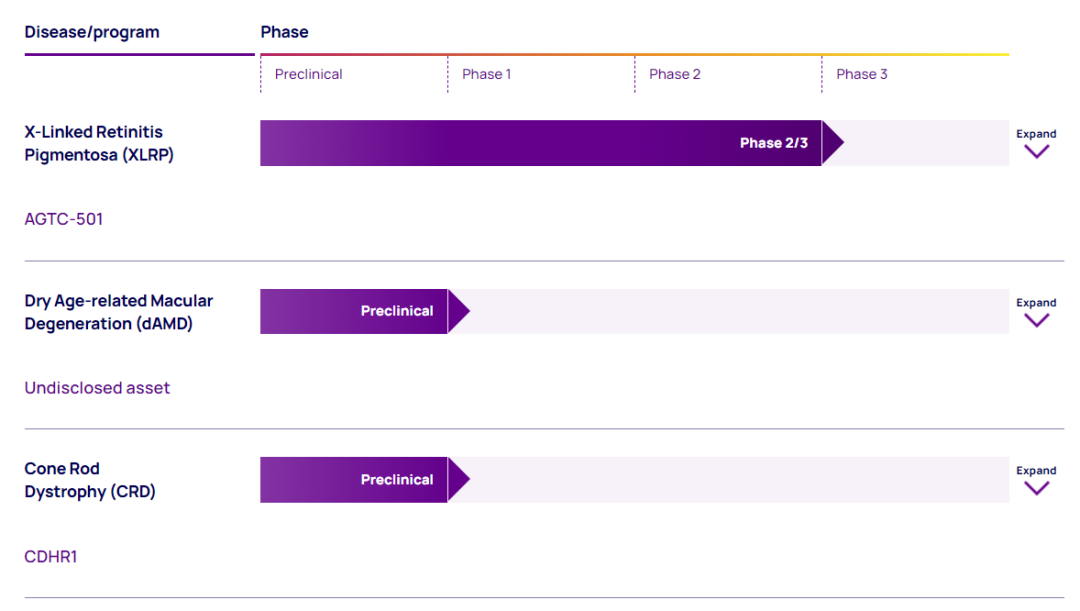
David Fellows, CEO of Beacon Therapeutics, said"We are committed to advancing our ophthalmology gene therapy pipeline to save and restore vision for patients with a range of prevalent and rare retinal diseases that cause blindness. I believe that with the addition of Dmitrij Hristodorov, Wouter Joustra, and Cariad Chester to the Beacon Therapeutics board, these funds will support the continued development of our late-stage and preclinical pipelines and accelerate AGTC-501 through clinical and commercial progress."
In the field of ophthalmic disease treatment, gene therapy has significant advantages.Ophthalmology saw the birth of Luxturna, the first FDA-approved drug utilizing gene therapy developed by Spark, for the treatment of Leber Congenital Amaurosis type 2 (LCA2) caused by mutations in the RPE65 gene.A number of pathogenic genes associated with ophthalmic diseases have been identified, which means that there are more potential targets for gene therapy.An increasing number of Chinese pharmaceutical companies are also entering the ophthalmology gene therapy sector, including Neurophth, Lancelot Biotechnology, Fornova Biopharma, Kanghong Pharmaceuticals, Tianze CloudTech, and Zhongyin Technology.Stellar Vision BioAnd other companies.Reference: Company Announcement