Roche Announces Failure of Phase II/III SKYSCRAPER-06 Trial of Tiragolumab in First-Line Non-Squamous NSCLC, Halts Clinical Development

Roche
Oncology Drug Research, Development, and Manufacturing

On July 4, Roche announced that its TIGIT antibody Tiragolumab failed to meet the primary endpoint in the Phase 2/3 clinical trial SKYSCRAPER-06 for non-small cell lung cancer (NSCLC).
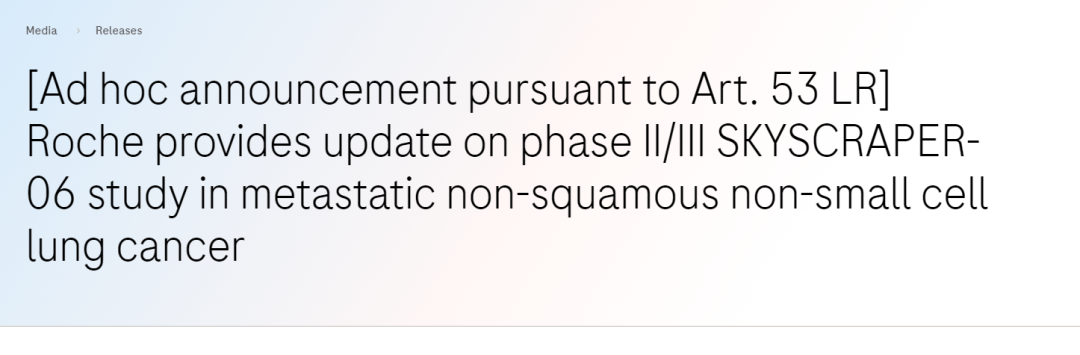
(Announcement Screenshot)
SKYSCRAPER-06 is a global multicenter clinical trial designed to evaluate the efficacy and safety of Tiragolumab in combination with PD-L1 inhibitor Tecentriq (Atezolizumab) and chemotherapy versus Pembrolizumab (Pembrolizumab) combined with chemotherapy as first-line treatment for patients with locally advanced unresectable or metastatic non-squamous non-small cell lung cancer.
The trial enrolled a total of 542 patients with previously untreated locally advanced unresectable or metastatic non-squamous non-small cell lung cancer. The primary endpoints of the study included progression-free survival (PFS) and overall survival (OS).
In the published trial results, the Tiragolumab combination group performed worse than the control group in terms of PFS and OS. Specifically, the hazard ratio (HR) for PFS was 1.27 (95% CI: 1.02, 1.57), and the HR for OS was 1.33 (95% CI: 1.02, 1.73), neither achieving statistically significant improvement.
This means that the combination therapy did not demonstrate the expected advantage in extending patient survival. Although the overall safety was consistent with the previously observed safety profile of Tiragolumab combined with Tecentriq and chemotherapy, and no new or unexpected safety issues were identified, the lack of efficacy led to the trial failing to meet its primary objective.
Based on the aforementioned results, Roche announced that it will unblind the study for patients and researchers and plans to halt this research. Meanwhile, Roche will notify the researchers and share the study results with regulatory authorities, followed by the release of detailed data at an upcoming medical conference. Additionally, Roche stated that it will evaluate whether related changes are needed for other ongoing Tiragolumab projects.
Tiragolumab is a novel investigational immune checkpoint inhibitor developed by Roche. By binding to TIGIT, it inhibits the suppression of the immune response by cancer cells. In preclinical studies, tiragolumab has been shown to synergize with other cancer immunotherapies (such as Tecentriq) to enhance immune responses.
Tecentriq (atezolizumab) is an approved cancer immunotherapy by Roche, indicated for the treatment of various difficult-to-treat cancer types, including certain forms of early-stage non-small cell lung cancer, small cell lung cancer, hepatocellular carcinoma, and more. Tecentriq works by binding to the PD-L1 protein expressed on tumor cells and tumor-infiltrating immune cells, blocking its interaction with PD-1 and B7.1 receptors, thereby activating T cells and enhancing the immune response.
However, the failure of the SKYSCRAPER-06 study means that the potential of this combination therapy needs to be reassessed.
TIGIT Monoclonal Antibody as an Emerging Immune Checkpoint Inhibitor: Recent Setbacks in Development
Nevertheless, Roche has not abandoned its exploration of the TIGIT target. The company is continuing to advance clinical trials for other TIGIT monoclonal antibodies, including the SKYSCRAPER-01 study for non-small cell lung cancer and the SKYSCRAPER-08 study for esophageal squamous cell carcinoma. In addition, Roche plans to initiate more clinical trials targeting other cancer types in the future to comprehensively evaluate the potential efficacy of TIGIT monoclonal antibodies.
Reference: Corporate Announcement


●First Batch! Sanofi/Regeneron's Dupilumab Approved for COPD in the EU
●Approved for Marketing: Bio-Thera's Citrate Beviracizumab for Antithrombotic Use in PCI Perioperative Period!
●Positive Phase 3 Clinical Results! Ipsen Expands Collaboration with Exelixis to Develop Cabometyx