Novartis Reports Discovery of WIZ-Targeting Molecular Glue Degraders for Fetal Hemoglobin Induction in Sickle Cell Disease

Novartis
Drug Development and Manufacturing

Sickle Cell Disease (SCD) is a common and life-threatening condition. Currently, 7.4 million people worldwide are living with SCD, and the prevalence is estimated to be increasing, with over 500,000 children born each year with the disease.
Inducing fetal hemoglobin (HbF) through treatment is a key focus of research and development in this field. However, developing safe and effective small-molecule inducers of HbF remains elusive.

On July 4, a research team from Novartis Biomedical Research published a study in the journal Science revealing the targeting of the transcription factor WIZ.(An Previously Unrecognized HbF Suppressor)OfMolecular Glue Degraders dWIZ-1 and dWIZ-2Strongly induces HbF in erythroblasts, paving the way for the development of new drugs to treat sickle cell disease (SCD).
Sickle Cell Disease (SCD) is caused by a missense mutation in the β-globin gene (HBB), which predisposes to hemoglobin polymerization and the formation of vaso-occlusive sickled red blood cells. Increased HbF can inhibit hemoglobin polymerization.
To identify small molecules that induce HbF, scientists first conducted a high-throughput screening assay (screening a library of 2,841 CRBN-biased molecules) and discovered Compound C, which can induce HbF through a protein degradation-dependent mechanism.
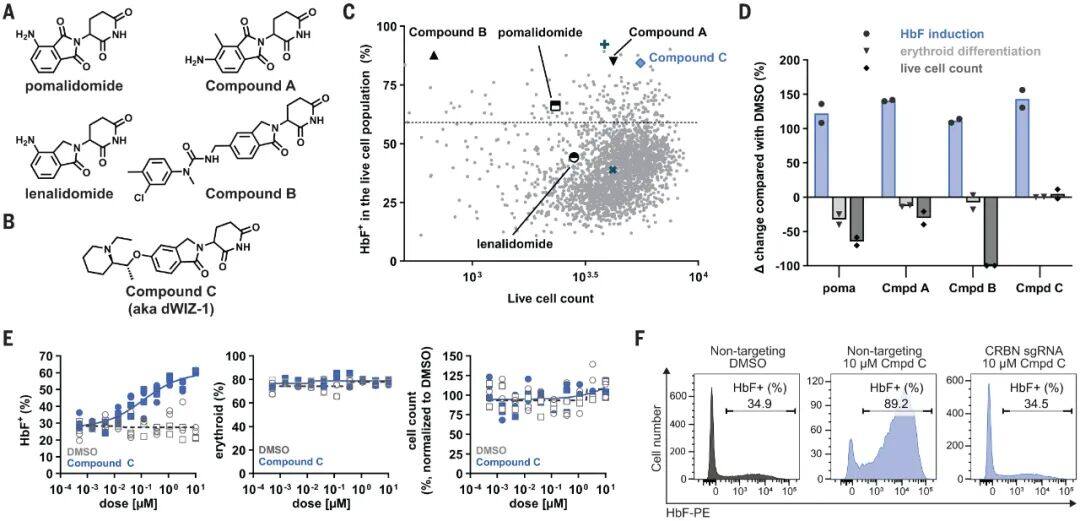
To identify potential targets of compound C, the study conducted an unbiased analysis of protein stability using mass spectrometry. Among 8,960 quantified proteins,WIZThe transcription factor was downregulated to the greatest extent. In addition, compound C was shown to be selective for WIZ. Based on this, scientists renamed compound C.dWIZ-1(Research confirms that WIZ is a previously unrecognized HbF suppressor in vivo.)。
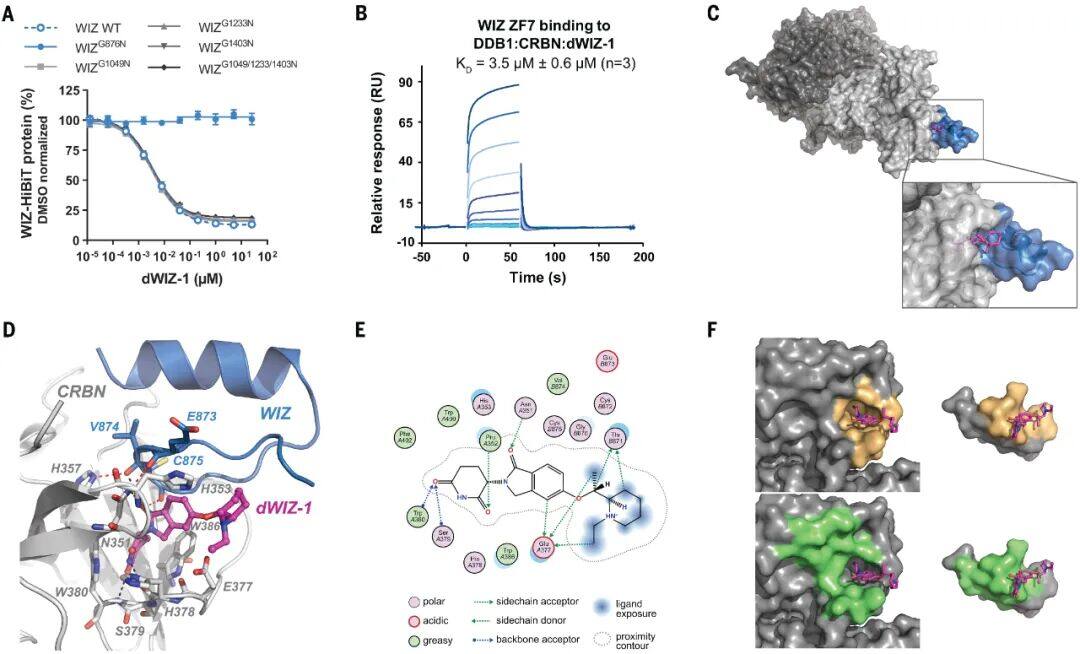
Although there were no previous reports on the structural characteristics of WIZ, sequence analysis and modeling by AlphaFold revealed 11 presumed zinc finger (ZF) structures. By analogy with IKZF1, which relies on ZF for recruitment to the CRBN-DDB1 ubiquitin ligase complex to achieve degradation, researchers validated the theory that dWIZ-1 recruits WIZ to CRBN-DDB1 to trigger targeted protein degradation. They also confirmed that dWIZ-1 recruits WIZ(ZF7) to CRBN in a dose-dependent manner.
In order to expand the research on WIZ degradation and HbF induction in vivo, the research team optimizeddWIZ-2In this case, the chiral methyl group of dWIZ-1 was removed, thereby improving its pharmacokinetic (PK) performance. dWIZ-2 effectively degraded WIZ in primary human erythroblasts in vitro. Additionally, dose-dependent degradation of WIZ was observed in erythroblasts derived from CD34+ cells of three SCD patients. Treatment with dWIZ-2 increased both the percentage of HbF-expressing cells and the total level of HbF in SCD-derived erythroblasts.
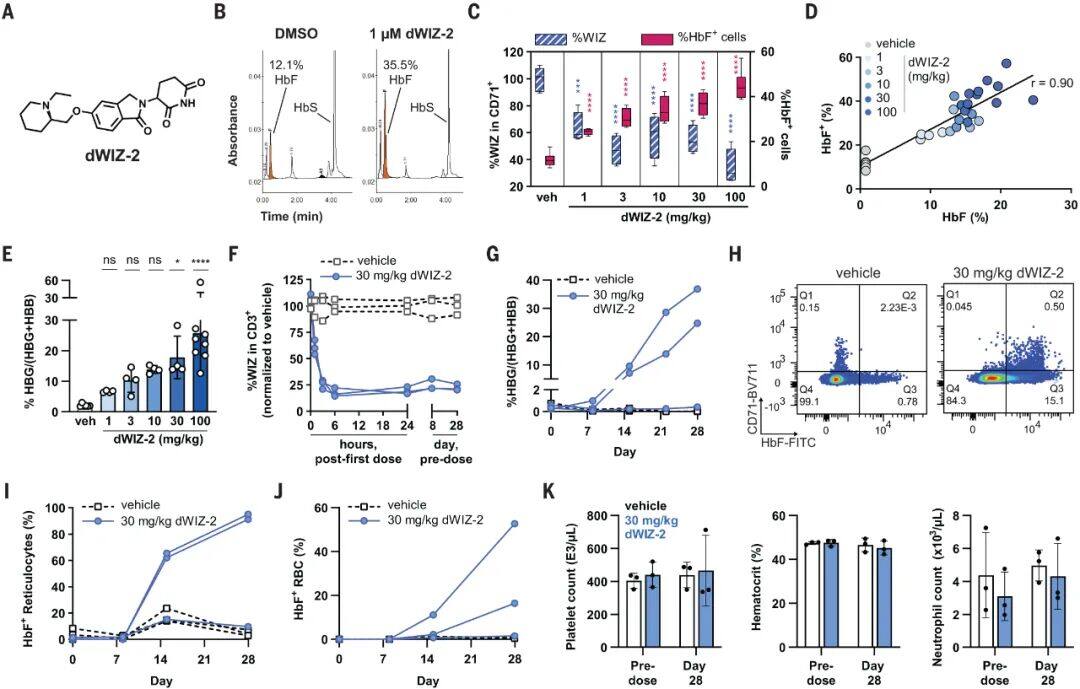
After oral administration of dWIZ-2 in mice, absorption was rapid, with peak concentrations reached 1-2 hours post-dosing and moderate bioavailability. Humanized mice transplanted with human hematopoietic stem cells tolerated daily oral dosing of dWIZ-2 well. Compared to the control, dWIZ-2 treatment led to robust and dose-dependent degradation of WIZ, with an increased proportion of human erythroblasts expressing HbF.
Studies conducted in healthy cynomolgus monkeys show(Oral administration of dWIZ-2 30 mg/kg daily for 28 days),dWIZ-2 has good PK characteristics(Rapid absorption, good oral bioavailability, long elimination half-life)After the first administration, the researchers detected rapid (<6 hours), deep (>75%), and sustained (>24 hours) degradation of WIZ in CD3 peripheral blood mononuclear cells (PBMCs). Toxicology studies showed no adverse signs or symptoms in animals treated with dWIZ-2.
In summary, these findings suggest that degrading WIZ, a historically challenging target, may become a globally accessible SCD treatment strategy.
Notably, the researchers also indicated that, due to WIZ being widely expressed across various tissues and throughout development, a comprehensive evaluation of the effects of WIZ degradation is necessary both prior to and during human clinical studies.
Note: All images in the article are from Science.
References:
[1]https://www.science.org/doi/10.1126/science.adk6129
[2]https://www.genengnews.com/news/gee-wiz-novartis-glue-degrader-drug-candidate-for-sickle-cell-shows-promise-in-animal-studies/
[3]Wang Ping, Song Jing, Fang Xiangyu, et al. Role of erythroblast-like Ter cells in the pathogenesis of collagen-induced arthritis[J]. Journal of Peking University (Health Sciences), 2019, 51(03): 445-450.