

HER3 ADC FDA Approval Delayed; Eight Domestic Candidates Already in Phase III

Daiichi-Sankyo
Pharmaceutical R&D Developer

MSD
Pharmaceutical R&D and Manufacturer

July 6, 2024
eMedClub News
Recently,Daiichi-Sankyo/MSD's HER3-targeted antibody-drug conjugate (ADC) HER3-DXd (patritumab deruxtecan) has been delayed in FDA approval, whose indications areFor the treatment of patients with EGFR-mutated locally advanced or metastatic non-small cell lung cancer (NSCLC) who have previously received at least two systemic therapies.

HER3-DXd utilizes Daiichi Sankyo's proprietary DXd ADC technology, consisting of a fully human anti-HER3 IgG1 monoclonal antibody, a cleavable tetrapeptide-based linker, and a topoisomerase I inhibitor. In October last year, MSD and Daiichi Sankyo entered into a collaboration agreement, with a total deal value of $22 billion, granting MSD the global development and commercialization rights outside Japan for this product and two other ADCs.
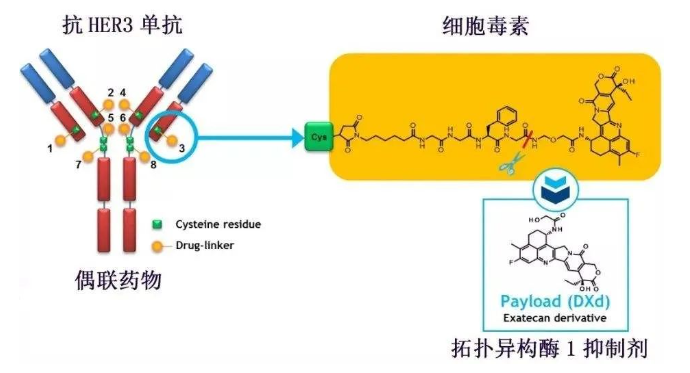
The submission of the candidate drug's BLA is based on data from the pivotal Phase II HERTHENA-Lung01 study. This is a global, multicenter, open-label clinical trial (n=225) that evaluated the safety and efficacy of HER3-DXd (5.6mg/kg) in patients with EGFR-mutated locally advanced or metastatic NSCLC whose disease progressed after prior treatment with EGFR-TKI and platinum-based chemotherapy. The primary endpoint of the study was the objective response rate (ORR) assessed by a blinded independent review committee (BICR).
The study results showed that,The ORR after treatment was 29.8%, including 1 complete response and 66 partial responses.; The median duration of response (DOR) was 6.4 months. In terms of safety, 64.9% of patients experienced treatment-emergent adverse events (TEAE) of grade 3 or higher, consistent with previous studies.
Notably, in May this year, Merus's HER2/HER3 bispecific antibody zenocutuzumab (Zeno) was accepted for review by the FDA and granted Priority Review designation. This indicates that the bispecific antibody is expected to be approved for marketing by November this year. It also suggests that the druggability of the HER3 target may see a breakthrough this year.
HER3 Target and ADCs in Development
eMedClub
The EGFR family is a group of cell membrane receptors that belong to the receptor tyrosine kinase (RTK) class and play crucial roles in physiological processes such as cell growth, proliferation, and differentiation. It consists of four highly homologous members: EGFR (also known as HER1 or ERBB1), HER2 (also known as ERBB2 or NEU), HER3 (also known as ERBB3), and HER4 (also known as ERBB4).

Among them, HER2 is a current hot target, showing significant differences in structure, activation mechanisms, functions, signaling pathways, cancer associations, and drug development. HER2 is a tyrosine kinase receptor with full activity, while HER3 differs in key residues of the kinase structure, leading to almost no intracellular tyrosine kinase activity. HER2 can be activated by forming heterodimers with other EGFR family members or by forming homodimers with itself, whereas the activation of HER3 mainly depends on forming heterodimers with other EGFR family members (such as HER2).
HER3 Expression Detected Across Various Cancers, Including Breast, Ovarian, Colon, Gastric, Lung, Skin, and Pancreatic Cancers. Despite the early discovery of the HER3 target, the development of tumor drugs targeting HER3 has been relatively slow. Unlike HER2, HER3 has low binding affinity, lacks intrinsic kinase activity, and lacks a direct biomarker reflecting its activation status, posing significant challenges and difficulties for HER3-targeted drug development. However, after researchers gradually overcame these challenges, multiple HER3 ADC candidates have been successfully advanced.
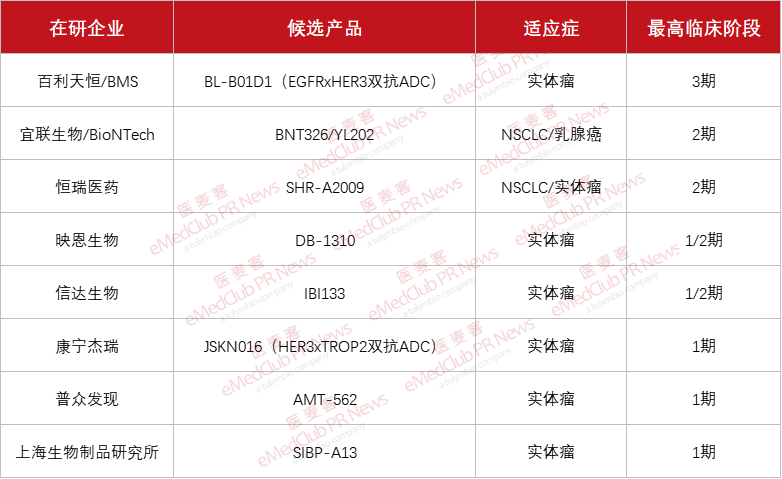
▲ Clinical-stage HER3 ADC(Image Source: Official Websites of Various Companies))
Currently, many companies in China have also laid out HER3 ADCs and made significant progress, with the fastest reaching Phase 3 clinical trials. Among these ADC candidates, some have successfully gone overseas, such as Yilian Biotech’s YL202 being licensed to BioNTech, and Baili Tianheng’s HER3/EGFR ADC licensed to BMS, with potential total collaboration amounts exceeding 9 billion US dollars.
Baili Tianheng/BMS: BL-B01D1
BL-B01D1 is aEGFRxHER3 Bispecific Antibody ADCIts antibody portion is SI-B001, utilizing an enzymatically cleavable linker, and is loaded with the camptothecin analog ED04. This product achieves targeted killing of EGFR-dependent tumors while preventing drug resistance caused by HER3, precisely eliminating tumor cells while reducing toxin damage to normal cells in the body. According to the official website, BL-B01D1 currently has six Phase 3 clinical trials ongoing for non-small cell lung cancer, nasopharyngeal carcinoma, esophageal squamous cell carcinoma, and breast cancer indications.
At the 2023 ASCO Conference, Baili Tianhe updated the progress of BL-B01D1 in nasopharyngeal cancer, with a total of 28 nasopharyngeal cancer subjects having undergone at least one efficacy evaluation.The objective response rate (ORR) was 53.6%, and the disease control rate (DCR) was 100%.In December 2023, Baili Tianheng partnered with BMS for over $8 billion to develop and commercialize BL-B01D1. In March this year, Baili Tianheng announced that it had received an $800 million upfront payment from Bristol-Myers Squibb (BMS) for the development and commercialization licensing agreement of BL-B01D1.
Yilian Bio/BioNTech: BNT326/YL202
BNT326/YL202 is an ADC candidate product targeting HER3, with a payload of topoisomerase I inhibitor YL0010014 and a patented linker TMALIN. At the 2024 ASCO Annual Meeting, clinical data for BNT326/YL202 showed that: as of April 16, 2024, a total of 55 patients (40 with non-small cell lung cancer and 15 with breast cancer) were enrolled in the Phase 1 dose-escalation study conducted simultaneously in China and the United States.In 51 evaluable cases, the ORR was 42.3%, and the DCR was 94.2%., mPFS was 6.0 months, mDOR was 5.8 months; in the 3.0mg/kg dose group, ORR was 60.0%, DCR was 100%.
In October 2023, Yilian Biotechnology announced a cooperation agreement with BioNTech to license the global rights (outside Greater China) of YL202 to BioNTech. This transaction will involve an upfront payment of $70 million, along with additional development, regulatory, and commercial milestone payments, with a potential total amount exceeding $1 billion. In May this year, the two parties reached another new strategic cooperation.
Hengrui Medicine: SHR-A2009
SHR-A2009 is an antibody-drug conjugate independently developed by Hengrui Medicine, targeting HER3. It can specifically bind to HER3 on the surface of tumor cells, and is subsequently internalized into the cells and transported to lysosomes, where it releases free toxins through hydrolysis, thereby killing tumor cells.
In January this year, Hengrui Medicine announced that,SHR-A2009 Granted Fast Track Designation (FTD) by the U.S. FDA, for the treatment of metastatic non-small cell lung cancer (NSCLC) with EGFR mutations whose disease has progressed after third-generation EGFR tyrosine kinase inhibitors and platinum-based chemotherapy.
DualityBio: DB-1310
DB-1310 is a product developed by DualityBio based on itsDITAC Technology PlatformThe ADC product targeting HER3, developed by conjugating a novel humanized anti-Her3 monoclonal antibody with a proprietary DNA topoisomerase I inhibitor through a cleavable maleimide linker, is currently undergoing Phase 1/2 clinical trials.
Innovent Biologics: IBI133
IBI133 is a HER3 ADC independently developed by Innovent Biologics, which was approved for clinical trials in April this year for the indication of unresectable locally advanced or metastatic solid tumors. Additionally, last year, Innovent Biologics...A Phase 1/2 Clinical Trial of IBI133 for Solid Tumors Has Been Initiated in Australia。
Alphamab Oncology: JSKN016 (HER3xTROP2 Bispecific Antibody ADC)
JSKN016 is a HER3xTROP2 bispecific antibody-drug conjugate (ADC) independently developed by Alphamab Oncology based on its proprietary glycan-specific conjugation platform. After binding to TROP2 and/or HER3 on the surface of tumor cells, it enters the lysosome through target-mediated endocytosis, releasing the cytotoxic topoisomerase I inhibitor (TOPIi), which induces apoptosis in TROP2 and/or HER3-positive tumor cells. Additionally, this inhibitor can penetrate the cell membrane into antigen-negative tumor cells, exerting a bystander effect. The combined effects effectively suppress tumor cell growth.
In May this year, Alphamab Oncology announced the Phase 1 clinical study of JSKN016 in Chinese patients with advanced malignant solid tumors.Completion of First Patient Dosing. June,Alphamab Oncology and ArriVentBioPharma Signs R&D and Commercialization Cooperation Agreement: Both Parties to Collaborate Using Alphamab’s Proprietary Linker-Payload Platform (Alphatecan) and Glycosite-Specific Conjugation Platform to Discover and Develop Novel ADCs.
Public Discovery: AMT-562
AMT-562 discovered by PuZhong isComposed of a novel anti-HER3 antibody Ab562, a hydrophilicity-enhanced linker MC-VA-PABC, and the payload exatecan (Ixitican).This year, AMT-562 has been approved for clinical trials and is proposed for development to treat advanced solid tumors. In previous preclinical studies, AMT-562 demonstrated potent and durable anti-tumor responses as well as good safety.
Shanghai Institute of Biological Products: SIBP-A13
SIBP-A13 is a product developed by the Shanghai Institute of Biological Products based on leading technology in China.Third-Generation ADC TechnologyThe newly developed ADC drug targeting HER3 possesses several pharmaceutical advantages, including a cleavable linker, potent payload activity, and an anti-tumor "bystander effect."
In September 2023, the Shanghai Institute of Biological Products of China Biologics announced that SIBP-A13 had been approved by the CDE to enter clinical trials, applicable to patients with difficult-to-treat or recurrent metastatic EGFR-mutated non-small cell lung cancer, metastatic breast cancer, and metastatic head and neck tumors.
Summary
eMedClub
In the HER3 ADC track, there are several companies with rapid progress. It is believed that in the future, the first...HER3 After the ADC is launched, there is hope for a small development boom in China. The launch of ADCs with more targets may also bring more treatment options to patients, making the ADC field more diversified.
2.https://mp.weixin.qq.com/s/hHUfnBLGjOD-sP6eHrG6uA
Overview of Gene Therapy Series Articles
1、An Overview of AAV Empty Shell Detection Technology
2、The Road to AAV Commercialization
3、Overview of 16 CDMO Companies in the CGT Field
4、AAV Upstream and Downstream Industry Chain (Upstream Chapter)
5、AAV Upstream and Downstream Industry Chain (Downstream Chapter)
6、Advantages and Challenges of AAV in Clinical Applications
7、New Technology for AAV Capsid Modification
8、Directions for the Improvement of China's Gene Therapy Regulatory System
9、CGT CDMO Enterprise with Differentiation
10、AAV Gene Therapy in the Field of Rare Diseases
11、Regulatory Regulations for AAV Therapy in China
12、AAV Vector AdvantagesChemical Strategy(Above)
Overview of Cell Therapy Series Articles
1、Overview of CGT CDMO Companies
2、Differentiated CGT CDMO Enterprises
3、Review of Various Pharmaceutical Companies' Universal CAR-T Technology Pathways
4、New Paradigm of TCR-T Therapy in Combating Solid Tumors
5、Pioneer Enterprise in CAR-T Solid Tumor Targets
6、"The 'Logistics Support Force' of CAR-T Therapy"
8、CAR-T Industry Research Report
9、2022 China Stem Cell Industry Panorama

Overview of Series Long-Form Articles




Share

Collection

Like

In View