

Tuopai Medical 'Leads' Domestic High-End Ophthalmic Equipment by Capturing Both Ends of the Industrial Chain

TowardPi
High-end Ophthalmic Medical Device Developer
China Securities News (Reporter Peijia Meng) — At the 25th Retinal Disease Academic Exchange Conference held recently, TowardPi officially launched its high-end ophthalmic surgical microscope product — "Boyun" Digital Holographic Intraoperative OCT Navigation Surgical Microscope. This is the first ophthalmic microscope in the industry to be equipped with a 400K high-speed swept-source OCT intraoperative navigation function, pioneering features such as 3D intraoperative OCT navigation, intraoperative OCT blood flow navigation, and 4D-4K digital display. The launch of this product marks a breakthrough in China-produced high-end medical microscopes, representing the direction of China-produced medical microscopes transitioning towards digitization and intelligence, and filling the gap for China-produced medical microscopes in complex clinical surgical scenarios.
Public information shows that TowardPi, founded in 2017, has now become one of the leading enterprises in China's ophthalmic medical device industry. In 2023, the company's ophthalmic OCT (Optical Coherence Tomography) product ranked first in market share across China. How did this enterprise, born from the technology transfer of Tsinghua University, quickly rise in the ophthalmic equipment field and achieve multiple industry-first innovations? Recently, a reporter from the China Securities Journal interviewed Professor Huo Li, Chief Scientist of TowardPi and professor at Tsinghua University’s Department of Electronic Engineering, along with Wang Yingqi, CEO of TowardPi.
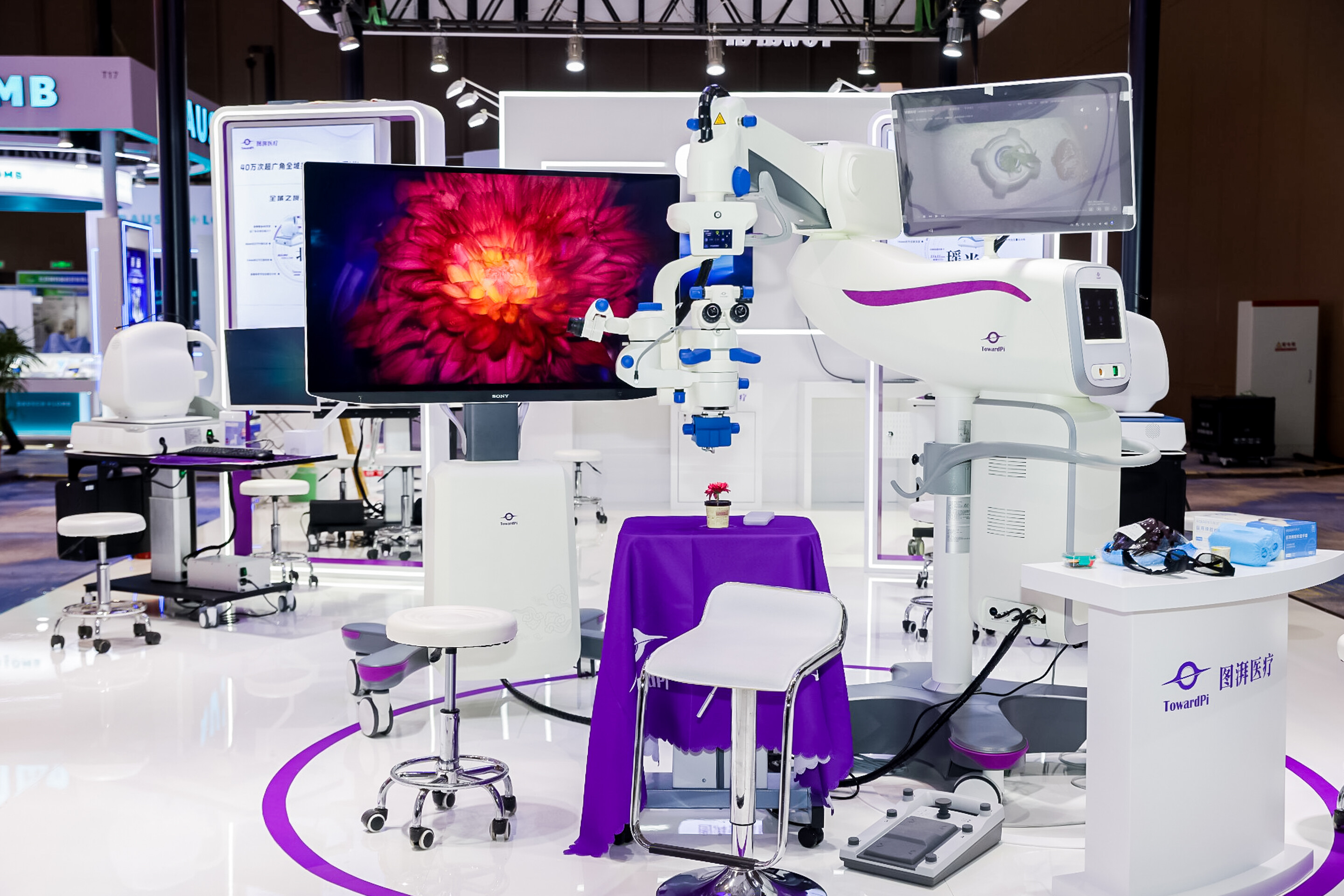
“Dialing Cloud” Digital Holistic Intraoperative OCT Navigation Surgical Microscope (Image Source: TowardPi)
Full-line Product Layout
"In a single sentence, the advantage of 'Boyun' is that we have equipped the microscope with 'X-ray vision'," said Wang Yingqi. Previous ophthalmic surgical microscopes did not integrate全域扫频OCT technology with microscope technology, but 'Boyun' achieves this fusion, allowing ophthalmologists to see real-time 3D modeling information beneath the lesion area during surgery. This will drive advancements and transformations in various procedures such as vitrectomy and retinal injections.
"Eye底 disease surgery is extremely complex, with a single operation often taking more than three to four hours. The technical difficulty is high, and the learning cost is significant. Through the empowerment of 'DialCloud,' there is hope to greatly lower the surgical threshold and improve surgical precision in the future," Huo Li told reporters. In addition to integrating the industry-leading 400,000全域扫频OCT technology into ophthalmic surgical microscopes, the company has also added full digital display control and intelligent algorithm guidance to 'DialCloud' to help doctors perform surgeries with higher quality.
The "Dialing Cloud" surgical microscope has reached a leading level in the industry and broken the decades-long import monopoly in the field of medical microscopes, thanks to TowardPi's years of technical accumulation in the swept-source OCT field. Public information shows that ophthalmic OCT is often used for cross-sectional scanning at the anatomical level of living retinal tissue, with advantages such as being non-invasive, high resolution, fast scanning speed, and supporting 3D reconstruction. According to statistics from relevant institutions, in 2023, the market share of TowardPi's ophthalmic OCT product sales reached 27%, ranking first in the entire industry; from January to April 2024, TowardPi's market share in OCT products expanded to nearly 45%, further increasing its lead. Meanwhile, the company’s ultra-wide-field fundus camera and biometer products have also obtained medical device certificates and started sales, further advancing toward becoming China's first high-end ophthalmic medical equipment "full platform" supplier.
The launch of the "Dialing Cloud" surgical microscope marks TowardPi's critical business expansion from ophthalmic diagnostic equipment to ophthalmic treatment devices. "All ophthalmic surgeries require the use of a microscope. We chose to enter this field hoping to gain wider recognition from ophthalmologists, enhance the image of domestically produced high-end brands among medical experts, facilitating the promotion of other advanced surgical equipment in the future," said Wang Yingqi. He also mentioned that the company’s two major treatment devices, the femtosecond laser surgery system and the phacoemulsification-vitrectomy machine, have entered the crucial stage of development and will proceed to clinical trials within 1-2 years.
Seize the "Two Ends" of the Industrial Chain to Achieve Medical-Engineering Integration
From obtaining certification and launching sales in the fourth quarter of 2021 to the end of 2023, TowardPi Medical achieved the top position in the industry for its OCT product within just two years, with subsequent products ready to be launched. In Huo Li's view, the company’s rapid market entry was due to its grasp of both ends of the industrial chain, achieving deep "medical-engineering integration."
"The top of the industrial chain is clinical demand. We need to discover the real needs of doctors and patients and transform these needs into product ideas," said Huo Li. TowardPi's products are never a simple imitation of foreign competitors but rather a targeted exploration of clinical needs in China’s medical field, achieving differentiated innovation and establishing advantages.
"Deep integration of medical and engineering depends on whether one is willing to invest time, manpower, and establish mechanisms for long-term, in-depth, and continuous communication with doctors, rather than just having a simple chat." Wang Yingqi further explained that TowardPi, from product managers to marketing staff and even the scientist team, has established long-term, positive interactive mechanisms with doctors at all levels in the ophthalmology field. The emphasis on clinical communication has allowed TowardPi to capture many product highlights and has also increased clinicians' recognition of domestically produced brands.
The bottom end of the industrial chain involves significant technological breakthroughs in a large number of basic components to achieve superior product performance. Taking the high-speed data acquisition card, a core component in OCT, as an example, TowardPi has achieved the industry's leading sampling rate for this component, enabling the equipment to support scanning rates of 400,000 times per second or higher, while also supporting imaging depths of over 12mm. "The majority of TowardPi's underlying components are self-developed, which is different from many companies that only engage in system integration. We must maintain our tracking and sensitivity to underlying technologies because any breakthrough in new foundational technology could be disruptive to existing products," said Mr. Huo Li.
It is precisely because TowardPi has seized both ends of the industry chain that it can rapidly develop various industry-leading products in a short period of time, akin to "building with blocks." "By perfecting the underlying technology and transforming it into high-performance components, different products can be created through combination. This model also enables us to quickly respond to and update product forms when we identify new significant clinical needs," said Wang Yingqi.
Continuous R&D Investment Drives the Development of Medical Optoelectronics Industry
From the underlying components to the end products, the process tests the overall capability of China's optoelectronic precision manufacturing industry chain. During product development, TowardPi also faces many "vacuum zones" in the industry, and Huo Li refers to the resolution process as "filling the industrial gaps."
"Our surgical microscope has a component called a zoom body, which has an arc that requires precision machining, with a precision value reaching the micron level. At that time, it was impossible to find a mature supplier," Huo Li gave an example. This required in-depth communication with suppliers, with TowardPi handling the design and validation themselves, then persuading the supplier to conduct small-batch trial production, and ultimately achieving qualified mass production. It is this kind of collaborative progress that has enabled TowardPi Medical to cultivate a self-controlled supply chain system. "This process of adjustment is one where we closely integrate with China's optoelectronic industry chain and drive progress upstream in the industry chain," Huo Li said.
From technological breakthroughs to technology export, and then to process mass production, the strong R&D strength and continuous investment in innovation of TowardPi Medical play an indispensable role behind the scenes. Public information shows that TowardPi Medical was incubated by the Tsinghua Industry-University-Research Institute, and its core technology stems from the transformation of scientific and technological achievements at Tsinghua University. The company's core technical team is composed of faculty and students from Tsinghua University’s majors such as electronic engineering, biomedical engineering, and precision instruments, with over a hundred R&D personnel, accounting for about one-third of the company’s total workforce, and annual R&D investment reaching nearly 100 million yuan.
"The setup of our R&D team also reflects TowardPi's philosophy. Our R&D personnel are not only divided by product projects but also by technology types, with each technology group focusing on the corresponding underlying components to support rapid technological iteration," introduced Li Huo.
TowardPi's current layout in the high-end ophthalmic equipment field is clearly visible. Looking to the future, the company will expand the application of its equipment horizontally to more department fields on the basis of in-depth exploration in ophthalmology, and ultimately become a full-platform medical equipment company with optoelectronic technology at its core. "We hope to quickly transform new technologies and methods in the field of medical optoelectronics into industry-leading innovative products through the company's strong integration of medical engineering and innovation capabilities in achievement transformation, in order to meet clinical needs in China and even around the world," said Li Huo.