

Qilu Pharmaceutical Challenges Roche's 'Big Three' with HER2 Biosimilars as Competition Heats Up Among Domestic Players like Fosun Henlius and Takeda Zhenglida

Qilu Pharmaceutical
Specialty Formulations and Active Pharmaceutical Ingredients (API) Developer
As a potential market that large pharmaceutical enterprises must compete for, the layout surrounding major varieties in the oncology market has always attracted significant attention from the industry.
Recently, the official website of the National Medical Products Administration released an announcement, declaring that Qilu Pharmaceutical's Trastuzumab for Injection (trade name: Antutu) has officially received marketing authorization approval. This drug will be used for the treatment of HER2-positive early breast cancer, metastatic breast cancer, and metastatic gastric cancer.




In fact, Bevacizumab (Avastin), Rituximab (Rituxan), and Trastuzumab (Herceptin) have long been the three major brand drugs in Roche's product portfolio, also known as the "three pillars" of Roche's oncology field. In particular, Trastuzumab holds a cornerstone position in the HER2 drug domain.
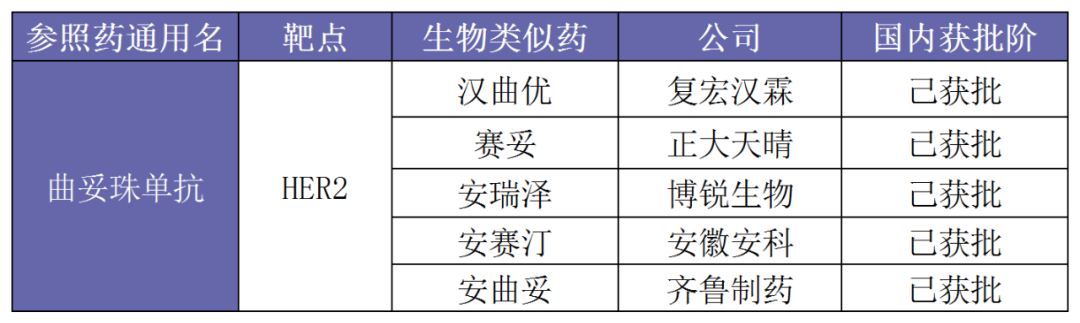
However, as the HER2 drug market continues to face price competition from biosimilars and direct challenges from ADC (antibody-drug conjugate) products, Roche's branded drugs are under increasing pressure.Before the approval of Qilu Pharmaceutical's product this time, trastuzumab biosimilars from four companies have already received marketing approval.
Market analysis suggests that the domestic biosimilar sector is thriving. Numerous pharmaceutical companies are competing for market share with biosimilar products of rituximab and bevacizumab. Policy-driven bulk procurement of biosimilars will also intensify price competition. In the HER2 drug market, whether it's trastuzumab biosimilars, pertuzumab biosimilars, or innovative products represented by subcutaneous injections and ADCs, all are further reshaping the competitive landscape.

Sword Pointing at the "Three Horses"
Qilu Pharmaceutical Accelerates Product Layout
The market impact on Roche's "troika" began with bevacizumab.
Qilu Pharmaceutical successfully obtained approval for the first domestically produced Bevacizumab (brand name: Ankeda) in 2019. Data shows that the Bevacizumab biosimilar achieved sales of 1.8 billion yuan in its first year on the market, drawing significant industry attention.
In the therapeutic field of rituximab, although Qilu Pharmaceutical has not directly developed biosimilars, its recently approved injectable concentrate of bendamustine hydrochloride (brand name: You Ran) has made progress in the indication for treating indolent B-cell non-Hodgkin lymphoma (NHL) where the disease progresses during or after treatment with rituximab or rituximab-containing regimens.
The trastuzumab approved this time by Qilu Pharmaceutical has launched an offensive against Roche's heavyweights in the HER2 field clinical treatment.
As a HER2-targeted monoclonal antibody developed by Roche, the original drug Herceptin has become a cornerstone in the treatment of HER2-positive breast cancer since its FDA approval in 1998. By specifically binding to the HER2 receptor, it effectively blocks tumor cell proliferation signals, significantly improving patient survival rates.
According to incomplete statistics, Herceptin has accumulated sales of over 97 billion Swiss francs since its market launch, with peak annual sales exceeding 7 billion Swiss francs. However, with the expiration of the original patent and the subsequent approval of several biosimilars, the "patent cliff" has gradually challenged its market share.
Data shows that Qilu Pharmaceutical's trastuzumab biosimilar was initiated for research in 2017, using the same Chinese hamster ovary (CHO) cell expression technology as the original trastuzumab. During the non-clinical research phase, the pharmacokinetic characteristics, safety, and immunogenicity of this biosimilar in cynomolgus monkeys were highly similar to those of the original drug.
In terms of efficacy evaluation, the objective response rates (ORR) at 24 weeks for Qilu Pharmaceutical's trastuzumab biosimilar and the control group were 59.7% and 56.1%, respectively, with a risk ratio (RR) of 1.065, falling within the pre-set equivalence margin (0.8–1.25), fully demonstrating its similarity in efficacy to the originator drug.
Industry insiders stated that with the continuous development of biopharmaceutical technology and the enhancement of innovation capabilities in China, an increasing number of companies have begun to engage in the research and production of biosimilars such as injectable trastuzumab. The entry of these companies not only diversifies product options in the domestic pharmaceutical market but also provides patients with more cost-effective and reliable treatment solutions, which is expected to benefit a broader patient population.

Crowded HER2 Track
From Similar Drugs to ADC: Multi-Product Competition
Injectable Trastuzumab is a major blockbuster in anti-tumor drugs. In 2023, the sales of injectable trastuzumab in Chinese urban public hospitals, county-level public hospitals, urban community health centers, and township health centers reached 6.8 billion yuan, with a growth rate of 4.52%.

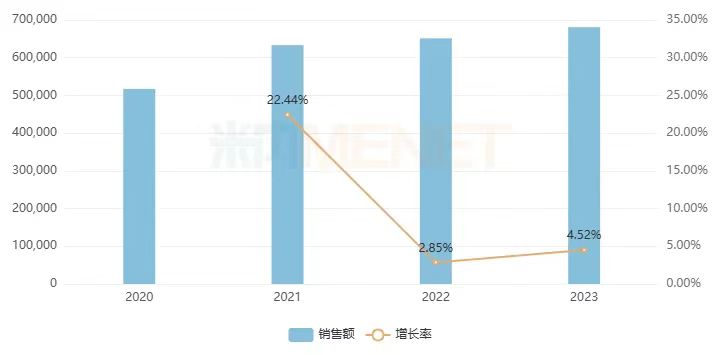
Sales of Trastuzumab for Injection (Unit: 10,000 yuan)
As domestically-produced biosimilars of trastuzumab for injection have been successively approved for marketing in China, Roche must face an increasing number of market competitors.Currently, trastuzumab products available on the Chinese market are supplied by multiple pharmaceutical companies. In addition to Roche, Henlius, Anke Bio, Bright Biology, CTTQ, and Qilu Pharmaceutical have already sounded the horn for the market competition.

However, as a pioneer in HER2-targeted therapy, Roche obviously does not want to give up easily. In the HER2 product field, in addition to trastuzumab, the launch of pertuzumab and the "dual-target" regimen, as well as the approval and inclusion of subcutaneous injection products into medical insurance, have to some extent extended the product lifecycle in this niche market. Earlier this year, Roche's subcutaneous formulation combining trastuzumab and pertuzumab (Herceptin Hylecta) was approved for marketing in China. This product not only combines the two drugs, pertuzumab and trastuzumab, but also further simplifies the treatment process.
Notably, pertuzumab has also gained attention and strategic focus from pharmaceutical companies in China. Multiple pharmaceutical enterprises have started developing its biosimilar drugs and have made significant progress.
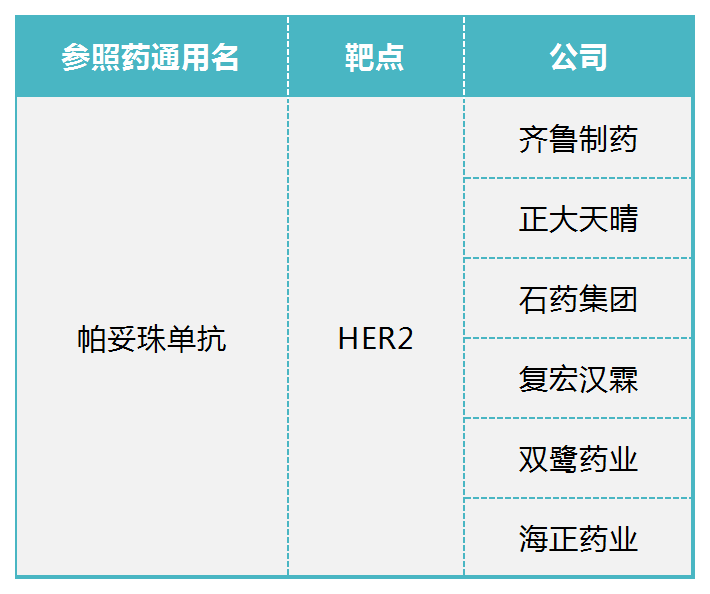
Previously, Qilu Pharmaceutical Co., Ltd. has already submitted the first marketing application for a pertuzumab biosimilar (QL1209) in China. Other Chinese pharmaceutical companies such as Zhengda Tianqing, Shijiazhuang Pharmaceutical Group, Fosun Henlius, Double-Crane Pharmaceuticals, and Hisun Pharmaceutical are also accelerating the development of biosimilars for this product.

If the market pressure brought by the competition of biosimilars in the HER2 product field is more reflected in pricing, the emergence of novel ADC drugs has also caused considerable trouble for Roche.
AstraZeneca/Daiichi Sankyo's Trastuzumab Deruxtecan (DS-8201) has become an undeniable presence, with strong clinical data and treatment outcomes potentially leading to a disruptive market shift in the HER2 field.
Hengrui Medicine, a leading enterprise in China's innovative drug sector, has also made significant progress in the field of HER2-positive breast cancer. Its developed drug, Pyrotinib, as a highly selective HER2 TKI, has shown good efficacy in combination therapy regimens; additionally, Hengrui has expanded into the ADC drug sector with products like Recombinant Trastuzumab (SHR-A1811), further enriching its product pipeline. Kelun Pharmaceutical’s focus in this area is mainly on ADC drugs, with its developed A166 Injection (Bodu Trastuzumab) becoming the first domestically produced HER2 ADC for breast cancer to be submitted for marketing approval in China.
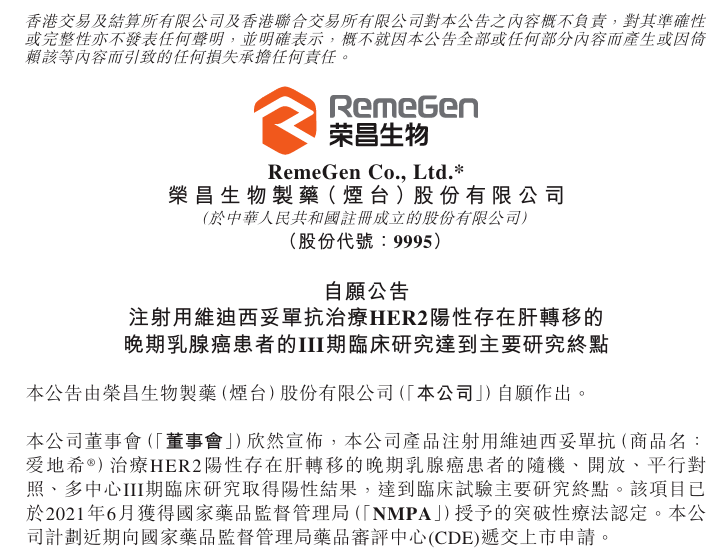
Rongchang Bio recently announced that Disitamab Vedotin (trade name: Aidi Xi®) Achieved positive results in the Phase III clinical trial for treating HER2-positive advanced breast cancer patients with liver metastases, reaching the primary endpoint, and plans to submit an application for marketing authorization to the CDE soon.




www.yyjjb.com.cn
Insight into Industry Trends

"Pharmaceutical Economy Newspaper"
Academic Official Account
Focus on the Frontiers of Oncology Academia

Terminal Official Account