

Biosyngen's First-in-Class Solid Tumor CAR-T Therapy BRG01 Enters Pivotal Phase II Clinical Trial for EBV-Positive Nasopharyngeal Carcinoma

Biosyngen
Developer of Innovative Immune Cell Technology Products

July 14, 2024
eMedClub News
Recently, BioGene announced that the Center for Drug Evaluation (CDE) of the National Medical Products Administration (NMPA) has approved the initiation of a pivotal Phase II clinical trial for BRG01 injection (EBV-specific CAR-T) to treat patients with recurrent/metastatic EBV-positive nasopharyngeal carcinoma. This isThe world's first solid tumor cell-originated drug independently developed, approved in both China and the U.S., and has entered Phase II trials., which is a significant advancement in the field of solid tumor cell therapy.

Director of the Phase I Ward, Sun Yat-sen University Cancer Center; Deputy Director, Sun Yat-sen University Lung Cancer Research InstituteProfessor Zhang LiAs the Principal Investigator (PI) of the BRG01 injection clinical trial, Professor Zhang expressed high expectations for this clinical approval. He noted: “BRG01 is a potential ‘first-in-class’ T-cell therapy targeting EBV-positive tumors. Its unique mechanism and compelling preclinical data give us great confidence in its performance in Phase II clinical trials. We look forward to further clinical studies confirming its promising efficacy, bringing new hope for treatment to more patients.”

Professor Zhang Li
According to previous reports, the patient enrollment for the BRG01 Phase I clinical trial in China and the U.S. was completed at the end of January this year, and all enrolled patients have received BRG01 infusion treatment.MedCareer has recently learned that the Phase I registrational clinical trial of BRG01 has successfully completed the DLT (Dose-Limiting Toxicity) observation.9 casesEvaluation of the patient's treatment efficacy,All subjects were patients with advanced nasopharyngeal carcinoma and had failed at least one treatment with an immune checkpoint inhibitor, including PD-1 antibody.。
With this progress,BioRay Biologics disclosed exciting preliminary data to Yima News for the first time. The data shows that BRG01 has demonstrated excellent safety and preliminary efficacy: in PET-CT scans,75% of patients receiving high doses experienced local tumor shrinkage and reduced metabolic activity, with some patients even achieving 100% complete remission of tumor lesions.. In addition, BRG01 also demonstrated excellent anti-EB virus efficacy,The EB virus load in the patient's peripheral blood significantly decreased to normal levels after infusion.。
These data not only demonstrate the potential of BRG01 in cancer treatment but also highlight its dual advantages in antiviral therapy, laying a solid foundation for future clinical applications.This is believed to be an important basis for CDE's approval of BRG01 to enter Phase II clinical trials.
BRG01 is an autologous T-cell immunotherapy product that uses gene modification technology to express chimeric receptors targeting Epstein-Barr virus (EBV) antigens on the surface of T cells. It is the world's first next-generation CAR-T cell therapy specifically targeting EBV developed by Biotheus. The therapy received clinical tacit approval from the CDE in December 2022 and from the FDA in February 2023. Subsequently, it was granted Orphan Drug Designation (ODD) by the FDA in June 2023 and Fast Track Designation (FTD) in July 2023, with its dual applications in China and the US progressing rapidly.
At the American Society of Gene and Cell Therapy (ASGCT) annual meeting held in May this year, Biotheus presented the preclinical research results of this therapy. The relevant data were also published as original research in Frontiers in Immunology. In addition, at the Gordon Research Conference (GRC) on Nasopharyngeal Carcinoma held in Switzerland in early June this year, Professor Renata Stripecke, scientist at Biotheus, inventor of the pipeline, Director of the Institute of Translational Immunology at the University of Cologne Medical School, and professor at Hannover Medical School, also presented the preclinical research results and the latest clinical data of this therapy.
As we all know, cell therapy drugs have achieved remarkable results in the field of hematological tumors, and five CAR-T products for hematological system tumors have been approved for marketing in China.But there has been no breakthrough in the field of solid tumors.In February this year, the FDA granted accelerated approval to Iovance's TIL therapy lifileucel for the treatment of advanced melanoma, marking the beginning of the commercial era for cell-based drugs in solid tumors. This has given a significant boost of confidence to many companies developing cell therapies for solid tumors. However, overcoming solid tumors is indeed challenging, requiring unique insight and perspective from the very start in terms of technology, target selection, and indications. It must meet the clinical needs of patients while fully considering its drug development feasibility.
Nasopharyngeal carcinoma (NPC) is a malignant tumor that occurs in the mucosal epithelium of the nasopharynx and is one of the common malignant tumors of the head and neck. According to data from the World Health Organization, the number of new cases of nasopharyngeal carcinoma diagnosed globally in 2020 reached 133,000. New cases of nasopharyngeal carcinoma in China account for about 50% of the global total, especially in Guangdong and Guangxi, which are high-incidence areas, accounting for approximately 60% of new cases in China. In recent years, immune checkpoint inhibitors have been used in second-line and above treatments for nasopharyngeal carcinoma, but the overall response rate (ORR) does not exceed 30%, meaning that more than 70% of patients cannot benefit from it.There is a huge unmet clinical need.。
The occurrence and development of nasopharyngeal carcinoma are closely related to EBV infection. The infection rate of EBV in the population exceeds 90%, and it has been defined by the World Health Organization as a Class I carcinogen. Tumors associated with EBV mainly include nasopharyngeal carcinoma, EBV-positive gastric cancer, lymphoma, and lymphoproliferative diseases. Research has found that nasopharyngeal carcinoma tumor cells often express EBV antigens, while EBV-positive tumor cells express target proteins for CD4+T cells and CD8+T cells, which is highly conducive to the infiltration of CAR-T cells targeting EBV into tumor tissues and exerting their killing function.
In fact, thanks to the selection of EBV as a special target, apart from nasopharyngeal carcinoma, this CAR-T cell therapy developed by BioGend is alsoDevelopment of Treatments for EBV-Positive LymphomaIn April 2023, BRG01 officially received the implied permission for clinical trials from the CDE and FDA for this new indication and is currently conducting Phase I clinical research.
Baiji Bio's layout in the field of solid tumor cell therapy goes far beyond this. Currently, the company has becomeA biotech enterprise simultaneously possessing the three major cell therapies for solid tumors and hematological malignancies: CAR-T, TCR-T, and TIL., and the relevant product pipelines have all completed dual submissions and approvals in both China and the U.S., the latter two'sIndications cover various solid tumors such as lung cancer and hepatocellular carcinoma.。
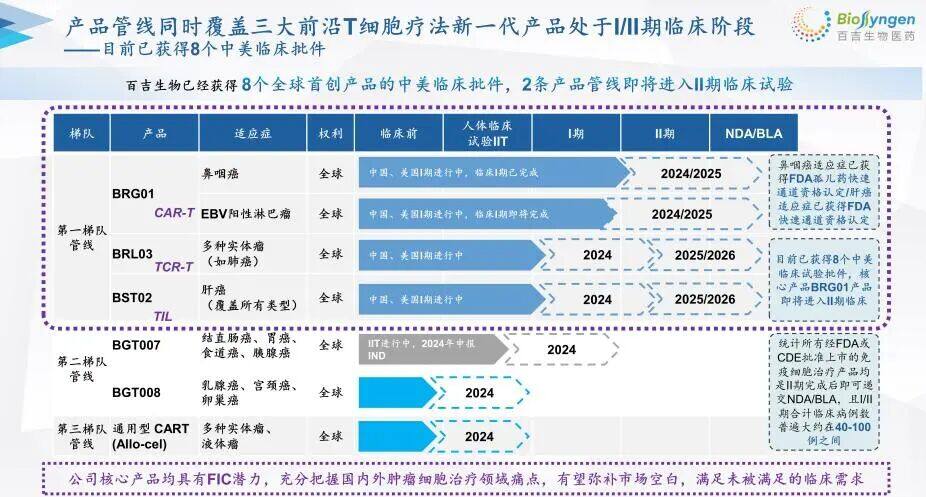
For BRG01 Injection Advancing to Phase II Clinical Trial, Co-founder and CEO of BiotheusDr. Chen Yijing"It is the result of our team's years of hard work that the Phase II clinical trial plan for BRG01 injection has been approved, and it also represents high recognition of the company’s core technology and R&D capabilities. Biotheus has always been committed to the research and development of first-in-class original new drugs globally, aiming to meet unmet clinical needs in the field of cancer treatment. In the future, we will continue to increase investment in R&D, accelerate the clinical trials and market launch process of BRG01, providing more effective and accessible treatment options for patients worldwide."
With the efficient execution and rapid R&D achievements of Biotheus, we have reason to expect more clinical breakthroughs in solid tumor cell therapies within a shorter timeframe, bringing new treatment hopes to patients.


Dian Dian "Share”、“Like" and "In View", give me a little charge~"