IASO Bio Announces NMPA IND Clearance for IASO-782 Injection to Treat Systemic Lupus Erythematosus

IASO Biotechnology
Cancer Treatment New Drug Developer

July 25, 2024, Nanjing, Shanghai, China, San Jose, California, USA — IASO Bio, a biopharmaceutical company dedicated to the research, development, manufacturing, and commercialization of innovative cell therapies, announcedThe IND application for IASO-782 Injection, a fully human anti-CD19 monoclonal antibody independently developed by the company, has received tacit approval from the National Medical Products Administration (NMPA) for the proposed treatment of Systemic Lupus Erythematosus (SLE).。
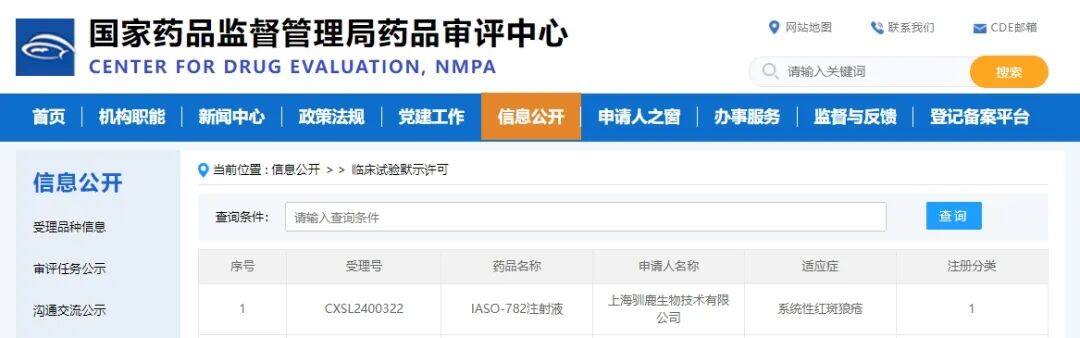
Previously, the IASO-782 injection had received IND approval in both China and the United States for indications including Immune Thrombocytopenia (ITP) and Warm Antibody Autoimmune Hemolytic Anemia (wAIHA). The recent approval for Systemic Lupus Erythematosus (SLE) further expands the therapeutic scope of the IASO-782 injection, once again demonstrating IASO Bio's innovative strength in the biopharmaceutical field and deep understanding of patient needs.
Dr. Chen Jie, Chief Medical Officer of IASO BioStated: "The field of autoimmune diseases is a key focus of IASO Bio's strategic development. Since last year, the IASO-782 injection has successfully received three IND approvals in both China and the U.S. Additionally, the clinical trial application for IASO Bio’s CAR-T cell product, Ixmyelocel-T injection, for treating neuromyelitis optica spectrum disorders and refractory generalized myasthenia gravis, has previously obtained tacit approval from the National Medical Products Administration. Moreover, our partner Cabaletta Bio has developed a CAR-T cell therapy using the CD19 sequence licensed from us to treat autoimmune diseases, which has received IND approval from the U.S. Food and Drug Administration for four autoimmune diseases, including systemic lupus erythematosus. IASO Bio will continue to collaborate with industry peers to further advance innovation and progress in the treatment of autoimmune diseases, bringing significant clinical benefits to patients through innovative therapies."
About Systemic Lupus Erythematosus (SLE)
Systemic Lupus Erythematosus (SLE) is a systemic autoimmune disease and one of the earliest human diseases discovered to be associated with abnormalities in B lymphocyte subsets. Its primary clinical features include involvement of multiple systems and organs, a natural course of alternating disease flares and remissions, and the presence of large amounts of autoantibodies in the body. Without timely treatment, irreversible damage to the affected organs can occur, ultimately leading to patient death. According to a Frost & Sullivan report, there were approximately 8.049 million SLE patients globally in 2023, of which about 1.048 million were in China. The male-to-female ratio of affected individuals is 1:10~12.[1]。
About IASO-782 Injection
IASO-782 is a fully human monoclonal antibody targeting CD19, with Fc mutations to enhance antibody-dependent cell-mediated cytotoxicity while maintaining other Fc functions (such as antibody-dependent cell-mediated phagocytosis). The B-cell surface antigen CD19 is expressed during B-cell development, from pre-B cells through plasmablasts and some plasma cells. Many autoimmune diseases, such as ITP and wAIHA, are primarily mediated by pathogenic B cells and plasma cells producing autoreactive antibodies. IASO-782 can effectively deplete CD19-positive B cells, plasmablasts, and some plasma cells in the body, thereby reducing or eliminating autoreactive antibodies produced by these cells. IASO-782 has the potential to treat a range of autoimmune diseases associated with autoreactive antibodies. Additionally, as a fully human antibody, IASO-782 exhibits low immunogenicity and is less likely to induce anti-drug antibodies after repeated dosing, offering potential advantages for treating autoimmune conditions requiring long-term, repeated administration.
About IASO Bio
References
1. Zhang Xiao, et al. ‘2020 Chinese guidelines for the diagnosis and treatment of systemic lupus erythematosus’. Rheumatology and Immunology Research 1, no. 1 (1 December 2020): 5–23. https://doi.org/10.2478/rir-2020-0009.